
Pre-orders are open No payment today. Stock will be checked during the inventory in early August, then you will receive a payment link for the available trees.

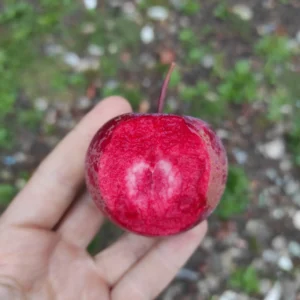
Red flesh apple trees

Apple trees

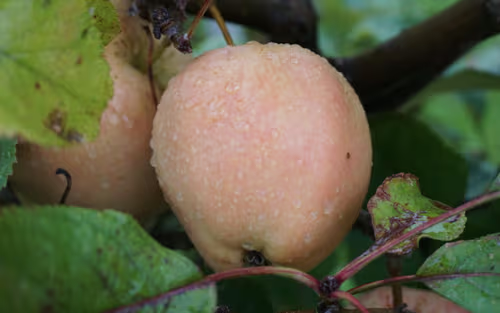
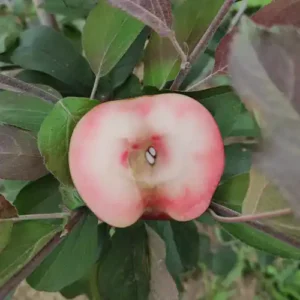
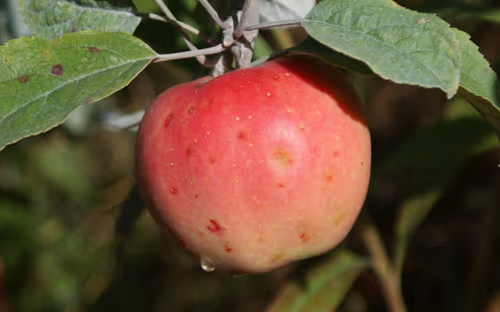
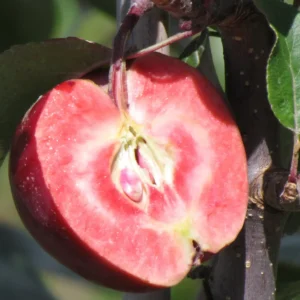
Pink Pearmain

A red-fleshed apple variety producing attractive fruit with pink-streaked flesh and aromatic flavour.
From 26,50 

Apple trees

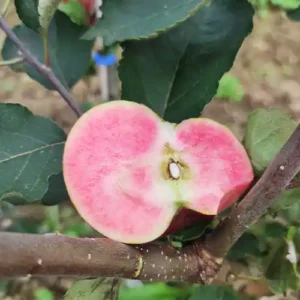
Rote Gardeteler

Rote Gardeteler red-fleshed apple tree, with flat, fully red apples, blackcurrant notes and good winter storage.
From 26,50 

Apple trees

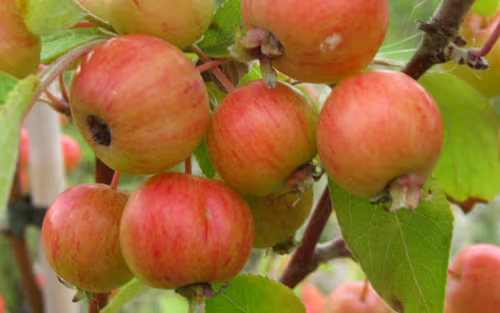
Zommerood

Zommerood red-fleshed apple tree, a sweet, strongly aromatic summer apple, picked in mid-August.
From 26,50 

Apple trees

Early Red Meat

Early Red Meat is an early season apple with a marbled red / pink flesh. It produces a dark pink apple juice.
From 26,50 
Autumn 2026

Apple trees

Everest

Malus Evereste is a popular traditional crab-apple with masses of white blossom, then red-yellow fruits.
From 26,50 
Autumn 2026

Apple trees

Golden Gem

From 26,50 
Autumn 2026

Apple trees

Golden Gem

A flowering crab apple pollinator with abundant white blossom, suitable for apple flowering groups 3 and 4.
From 26,50 

Apple trees

Hidden Rose

Hidden Rose is named for the unexpected rose pink flesh hidden under the plain green skin.
From 26,50 
Autumn 2026

Apple trees

Maggy

A striking red-fleshed apple variety producing colourful fruit with aromatic flavour.
From 26,50 

Apple trees

Pendragon

An unusual red-fleshed apple from Cornwall or Devon in England. The bark, blossom, and leaves also have a dull-red tint.
From 26,50 

Apple trees

Pillar Red Flesh

A red-fleshed apple which grows with a columnar habit.
From 26,50 

Apple trees

Pink Pearl

Pink Pearl features bright pink flesh, and pink apple blossom.
From 26,50 
Autumn 2026

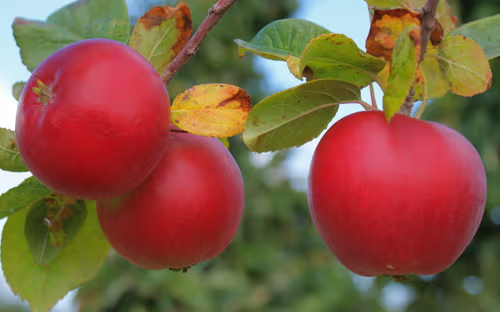
Preston's Red Flesh apple tree, a rare red-fleshed apple with tart flavour and strong red fruit aroma, picked in mid-September.
From 26,50 
Autumn 2026

Apple trees

Red Devil

Red Devil is a versatile English eating apple, and produces a sweet red-tinted juice.
From 26,50 
Autumn 2026

Apple trees

Red Sentinel

An ornamental crab apple producing abundant white blossom and persistent glossy red fruits through winter.
From 26,50 
Autumn 2026

Apple trees

Red Star

A rare red-fleshed apple variety producing large tender fruit with red berry aromas at maturity.
From 26,50 
Autumn 2026

Apple trees

Redford

A red-fleshed apple variety producing colourful fruit with balanced sweet-tart flavour.
From 26,50 

Apple trees

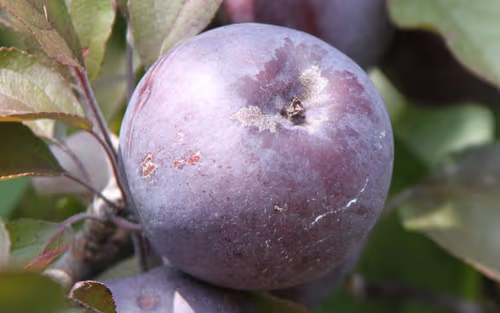
Roberts Crab

Roberts Red or Roberts Crab is an unusual red-fleshed crab-apple, with dark pink blossom, and purple fruits.
From 26,50 
Autumn 2026

Apple trees

Rosette

From 26,50 

Apple trees

Rubayat

Rubaiyat is a red-skinned apple, with bright red flesh.
From 26,50 
Autumn 2026

Apple trees

Sanguine de Helmut

From 26,50 
Autumn 2026

Apple trees

Sanguine Precoce

From 26,50 

Apple trees

Scarlet Surprise

Scarlet Surprise is an early-season pink-fleshed apple.
From 26,50 
Autumn 2026

Apple trees

Sugar Ball

A compact red-fleshed apple variety producing sweet colourful fruit with excellent ornamental appeal.
From 26,50 
Autumn 2026

Apple trees

Van Eseltine

An upright ornamental crab apple with fragrant double pink flowers and excellent pollinating value.
From 26,50 
Autumn 2026

Apple trees

Winderatter Rubin

From 26,50 

Red-fleshed apples: naturally coloured from skin to core

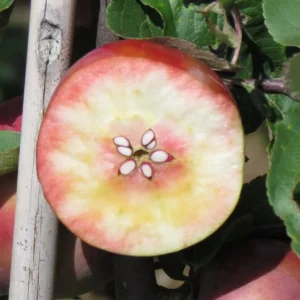
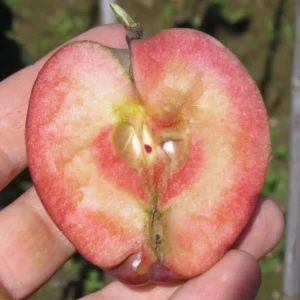
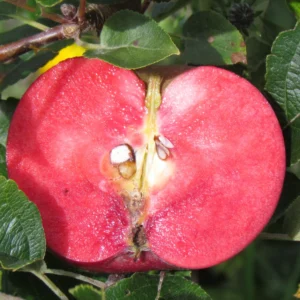
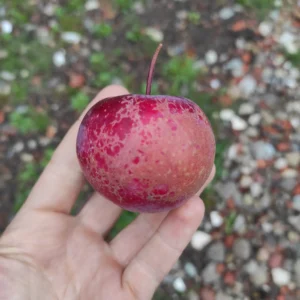
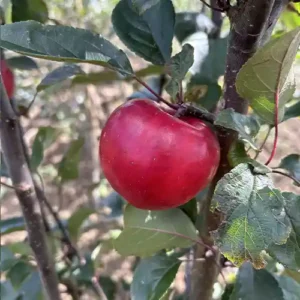
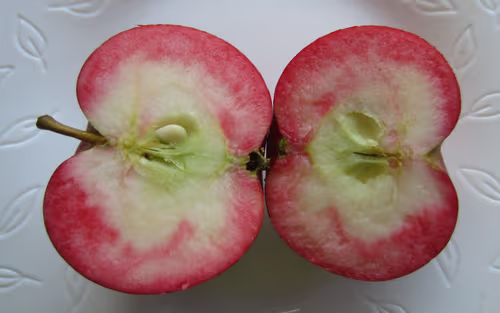
Red-fleshed and pink-fleshed apples accumulate natural pigments called anthocyanins within their flesh. Depending on the variety, the colour may remain concentrated around the core, appear as pink marbling or extend through almost the entire fruit in shades ranging from pale pink to deep crimson.

Red-fleshed apples are not a single variety and are not a recent invention. Naturally pigmented apple trees have existed for a long time, and generations of breeders have crossed them with dessert, cooking, cider and disease-resistant apples to improve fruit size, texture, flavour, productivity and processing quality.

This explains the considerable diversity within the category. Some varieties remain small, sharp and tannic, while others now produce crisp, juicy and balanced dessert fruit.

Their juice may be pink, red or ruby-coloured, but a strongly coloured apple does not automatically produce a stable red juice. The final result depends on the variety, maturity, pressing method, exposure to oxygen and, in fermented products, the fermentation process.

Ancient origins in the wild apples of Central Asia

A significant proportion of modern red-fleshed breeding material descends from a pigmented Central Asian wild apple commonly referred to as Malus niedzwetzkyana or Malus sieversii f. niedzwetzkyana.

Unlike an ordinary apple tree, pigmentation may occur throughout the plant, including the flowers, young leaves, shoots, fruit skin, flesh and sometimes even the wood.

This material attracted the attention of botanists and breeders during the late nineteenth and early twentieth centuries. It was initially valued for ornamental colour, exceptional winter hardiness and its potential in breeding programmes.

The original fruit generally had little in common with a modern dessert apple. It was often small, highly acidic, astringent and sometimes prone to internal browning.

Breeding therefore aimed to preserve the red pigment while progressively reducing the less desirable characteristics inherited from wild apples.

Breeders in eastern Europe, Russia and North America used this material extensively. Their work produced varieties and breeding parents such as ‘Redfield’, ‘Almata’ and several hardy red apples intended mainly for juice, processing or ornamental use.

Albert Etter and the American pink-fleshed apple lineage

During the early twentieth century, Californian breeder Albert Etter followed a partly different route. Much of his work was based on the old apple ‘Surprise’, whose pink flesh was not necessarily accompanied by red leaves and dark-red flowers.

Etter crossed ‘Surprise’ with dessert apples in an attempt to produce larger, juicier and more pleasant fruit for fresh eating.

‘Pink Pearl’, commercially introduced during the 1940s, became the best-known result of this work.

A substantial part of Etter’s breeding programme was never commercially released during his lifetime. Trees later recovered from his former orchard and surrounding area helped preserve selections now known as ‘Grenadine’, ‘Rubaiyat’, ‘Pink Parfait’, ‘Blush Rosette’ and ‘Pink Pearmain’.

Other pink-fleshed apples discovered in old American orchards, including ‘Airlie Red Flesh’, marketed as Hidden Rose, may belong to related genetic lineages, although their precise origins are not always fully documented.

Two main genetic types of red-fleshed apple

Type 1: pigmentation throughout much of the tree

Type 1 apples are mainly associated with the Malus niedzwetzkyana lineage. A particular form of the regulatory gene MdMYB10 stimulates anthocyanin production in several plant organs.

Young leaves may be reddish, the flowers may be pink or deep red, and the flesh begins developing colour relatively early during fruit growth.

These apples often produce the deepest red flesh and most strongly coloured juice. Historically, however, this lineage was frequently associated with high acidity, astringency, short eating periods and a greater risk of internal browning.

Modern breeding aims to retain the intense pigmentation while improving sweetness, texture, storage and overall dessert quality.

Type 2: colour expressed mainly inside the fruit

Type 2 apples generally have green leaves and more conventional white or pale-pink blossom. Their flesh develops colour later during ripening through a different genetic regulation system associated with MdMYB110a.

The colour may be lighter, marbled, concentrated around the core or unevenly distributed through the flesh.

‘Surprise’ and several varieties derived from Albert Etter’s breeding work belong broadly to this group.

This lineage has often provided an effective route towards good dessert quality without strong red pigmentation throughout the leaves and branches.

Considerable variation remains within both groups. The genetic type alone does not predict sweetness, texture, disease resistance or storage life.

Modern breeding: retaining the colour while improving flavour

Early red-fleshed apples were often botanical curiosities, highly acidic juice apples or breeding parents rather than high-quality dessert varieties.

Breeders crossed strongly pigmented apples with varieties offering better texture, more sugar, larger fruit, improved storage or greater resistance to disease.

The descendants were then selected over several generations. Flesh colour is genetically complex, and two seedlings carrying the main red-flesh genes may still differ greatly in colour intensity and distribution.

Other genes influence acidity, tannins, sweetness, browning, firmness and aroma. Retaining strong pigmentation without also retaining excessive acidity or poor texture requires extensive selection.

Modern programmes have produced varieties such as ‘Baya Marisa’ and groups marketed under names including Redlove, Red Moon, Kissabel and Lucy.

These commercial names cover distinct varieties. Their harvest periods, colour, texture, flavour, storage life and recommended uses should therefore be compared individually.

What does a red-fleshed apple taste like?

Flesh colour does not predict flavour. Red-fleshed apples may be intensely sharp, sweet, balanced, aromatic, tannic or relatively neutral.

Older, deeply pigmented lineages are often highly acidic and may have a slightly drying or astringent finish. These characteristics can be excellent for juice, jelly, compote, cooking and blending, even when the fruit is not particularly pleasant to eat raw.

Varieties derived from ‘Surprise’ and more recent breeding programmes may have crisp, juicy flesh and a more balanced sugar-to-acid ratio.

Depending on the variety and maturity, aromas may suggest red berries, raspberry, redcurrant, citrus or floral notes. These descriptions can change considerably according to climate, crop load and harvest date.

A very dark-red apple is not automatically more aromatic or better tasting. A lightly pink variety may provide considerably better fresh-eating quality than an intensely coloured but extremely sharp fruit.

Harvest stage is particularly important. Picking too early exaggerates acidity and prevents the aroma from developing, while leaving some varieties too long on the tree can lead to soft flesh, mealiness or internal browning.

Choose the variety according to its intended use

For eating fresh

Choose a variety specifically selected as a dessert apple. Compare sweetness, acidity, texture, skin quality, juiciness and eating period before considering the intensity of the red colour.

The flesh should be sufficiently crisp or fine-textured, with enough sugar to balance its acidity. Colour should complement eating quality, not replace it.

For cooking, baking and compote

Red-fleshed apples can produce naturally pink compotes, pies, sauces, jellies and baked desserts.

The colour retained after cooking varies according to the variety, acidity of the recipe, temperature, cooking time and contact with air.

Sharp varieties are often particularly useful for baking because their flavour remains perceptible after sugar is added.

A soft-fleshed apple is suitable for compote, while firmer varieties retain the shape of slices or pieces more effectively.

For naturally pink or red juice

The colour of the cut fruit does not reliably predict the colour of the finished juice.

Some dark-red apples produce juice that rapidly turns orange or brown, while other varieties retain a relatively stable pink or ruby colour.

For juice production, compare colour stability, pressing yield, sugar content, acidity and aromatic quality.

For colouring a blend

A strongly pigmented variety can be blended with sweeter, less acidic or more tannic apples.

The proportion required varies greatly according to the variety and processing method. Small trials are more reliable than applying the same percentage to every harvest.

Why can red apple juice lose its colour?

The red colour is mainly produced by water-soluble anthocyanins, including cyanidin-based pigments.

These pigments begin changing as soon as the fruit is crushed and the juice comes into contact with oxygen.

Polyphenol oxidase naturally present in the apple contributes to browning reactions. Depending on the variety, a bright-red juice may remain stable, become orange or gradually turn yellow-brown.

A relatively low pH generally favours a brighter and more stable red colour. Pigment concentration alone does not determine the result, as enzyme activity and the other phenolic compounds in the fruit are also important.

Use healthy fruit that is fully developed but not overripe. Process it promptly and at a cool temperature, limiting unnecessary agitation, splashing and prolonged exposure of the pulp to air.

Crushing and pressing systems that limit oxygen generally provide better colour retention. At a small scale, fill containers promptly, minimise empty headspace and avoid unnecessary transfers.

Ascorbic acid is commonly used to reduce browning in conventional apple juice, but its interaction with anthocyanins is complex. It should not be treated as an automatic solution for every red-fleshed variety.

Can red-fleshed apples produce naturally pink cider?

Yes. A sufficiently pigmented variety can give a cider a pale-pink, red or ruby colour, either alone or blended with conventional cider apples.

The red apple must nevertheless be considered as a complete cider ingredient rather than simply a colouring agent.

Many red-fleshed varieties are high in acidity but relatively low in tannins. Others may lack sufficient sugar or produce a juice with limited aromatic complexity.

Blending allows the colour and acidity of a red-fleshed apple to be combined with sweet, bittersweet, bitter or sharp cider apples supplying sugar, body, tannins and structure.

The colour observed immediately after pressing does not guarantee the colour of the finished cider. Pigments may oxidise, react with other compounds, precipitate or be removed with the lees.

Yeasts may also bind part of the anthocyanin content to their cell walls. Different yeast strains can therefore produce different colour intensity from the same juice.

To retain a pink colour, protect the juice from oxygen during crushing and pressing, ferment in a properly filled vessel, avoid unnecessarily high temperatures and test each variety separately before producing a large blend.

Ferment varieties separately before blending

When several varieties are available, press and ferment at least a small quantity of each one separately.

This shows which varieties retain a red or pink colour and which rapidly become yellow, orange or brown.

Separate fermentation also reveals the actual flavour after the sugars have fermented. A juice that seems pleasantly sharp before fermentation may produce a cider that is too hard, while an unremarkable fresh apple may develop interesting fermented aromas.

Small blending trials can then be prepared after fermentation. The red-fleshed apple may provide colour, acidity and aroma, while conventional cider varieties contribute the sugar, tannins or body that are missing.

This approach is more reliable than combining the whole harvest immediately because colour stability and flavour balance vary between varieties and from one season to another.

Harvest at the correct stage

Pigment concentration does not always increase at the same rate as sugar content.

In some varieties, the colour intensifies during ripening but then becomes less stable as the fruit approaches over-ripeness.

Overripe fruit is also softer, more difficult to press cleanly and more vulnerable to oxidation and microbial deterioration.

For juice and cider, harvest fruit that is fully developed, sufficiently rich in sugar, healthy and still reasonably firm.

Avoid leaving fallen fruit on wet ground for long periods, particularly with varieties whose colour and flesh deteriorate quickly.

For fresh eating, harvest according to the variety’s texture, flavour and eating period rather than waiting for the darkest possible flesh colour.

View the apple harvest calendar

Harvest periods vary according to the variety, country, region, exposure, rootstock, crop load and weather conditions during the season.

Pollination, rootstocks and tree management

Red-fleshed apple trees follow the same general pollination rules as other apple varieties.

Most produce more reliably with a genetically different apple tree flowering at a compatible time.

Pink or red blossom does not determine pollen compatibility. Flowering period, ploidy, pollen fertility and any claimed self-fertility must be checked separately for each variety.

Triploid varieties generally produce pollen of poor fertility and should not be relied upon as the only pollinator for neighbouring trees.

Rootstock choice should be based on soil, available space, desired tree form, vigour and the level of maintenance available. Red flesh does not require a special rootstock.

Planting, formative pruning, disease management and harvesting are carried out in the same way as for conventional apple trees.

Good sunlight can nevertheless improve anthocyanin expression in several varieties and also supports sugar accumulation and fruit quality.

Which red-fleshed apple tree should you choose?

For fresh eating, choose a variety specifically described as a dessert apple. Compare sweetness, acidity, crispness, aroma, ripening period and storage life before considering the intensity of the colour.

For jelly, compote and baking, a sharp and strongly pigmented variety may be excellent even when it appears austere when eaten raw.

For juice, choose a variety whose colour remains sufficiently stable after crushing and pressing.

For pink cider, also examine sugar content, acidity, pH, tannins and behaviour during fermentation. Flesh colour alone cannot predict cider quality.

A collection containing several genetic lineages reveals the full diversity of red-fleshed apples: pale pink or dark crimson, sharp or sweet, and suitable for dessert, cooking, juice or cider blending.

Frequently asked questions about red-fleshed apples

Is a red-fleshed apple a single variety?

No. The term covers many varieties with pink or red flesh, originating from different genetic lineages and breeding programmes.

Are red-fleshed apples genetically modified?

The commonly cultivated varieties are not genetically modified. Their colour originates from natural genetic variation followed by conventional crossing and selection.

Why do some varieties have red leaves and flowers?

They generally belong to the Type 1 lineage, in which the genetic regulation of anthocyanins also produces pigmentation in leaves, flowers, shoots and sometimes wood.

Why is the flesh of some apples pink only around the core?

Pigment distribution depends on the genetic lineage and on several interacting genes. In Type 2 varieties, the colour is mainly expressed in the fruit and often develops relatively late during ripening.

Are the darkest-red apples the best tasting?

No. A dark-red apple may be highly acidic or astringent, while a pale-pink variety may be sweet, crisp and strongly aromatic.

Can red-fleshed apples produce naturally red juice?

Yes, but colour stability varies considerably. Some varieties brown rapidly after crushing, while others retain a pink or red colour more effectively.

Why does red apple juice become orange or brown?

Oxygen, polyphenol oxidase, pH and the other phenolic compounds in the fruit influence the breakdown and transformation of the pigments.

Can naturally pink cider be made without adding other fruit?

Yes. Red-fleshed apples can provide the colour directly. They are often blended with traditional cider apples to balance sugar, acidity, tannins and aroma.

Does fermentation always preserve the pink colour?

No. Pigments may oxidise, react with other compounds, bind to yeast cells or settle with the lees. The variety, pH, yeast and fermentation method all influence the result.

How can I find out whether a variety is suitable for pink cider?

Observe the juice immediately after pressing, monitor its colour when exposed to air and carry out a small separate fermentation.

Why should different varieties be fermented separately?

Separate trials reveal the final colour, acidity, aroma and possible faults of each variety before a larger blend is prepared.

Do red-fleshed apple trees require a special pollinator?

No. They require a compatible apple variety flowering at the correct time, in the same way as other apple trees.

Do they need a particular rootstock?

No. Choose the rootstock according to soil, vigour, available space, desired tree form and the level of maintenance planned.