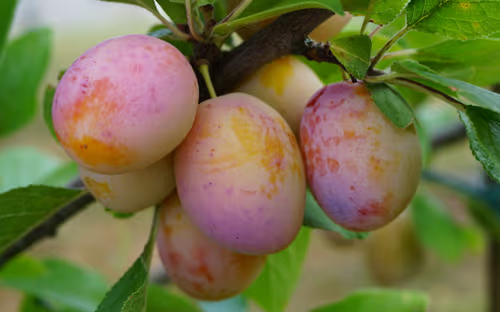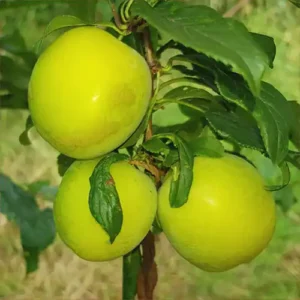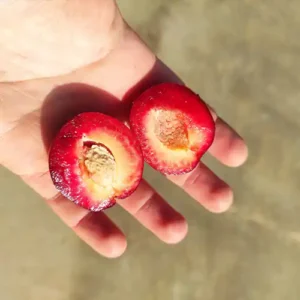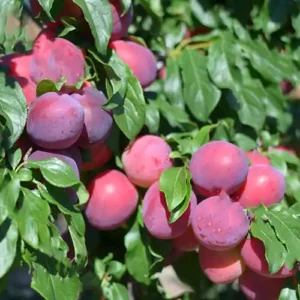

Pluots (Prunus hybrids)
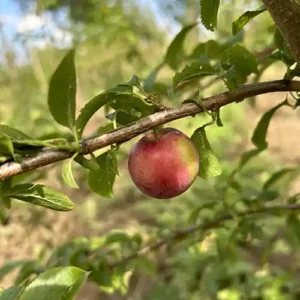
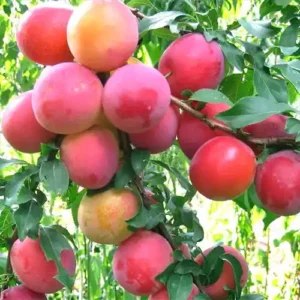
Kometa Pozdnaya interspecific plum tree, with sweet, juicy 30–40 g fruit, good keeping quality, early flowering and self-fertile.
Pluots (Prunus hybrids)
What does this category of pluots and hybrid plums really include?
This category brings together fruit trees obtained by crossing different species within the genus Prunus. It includes genuine plum–apricot hybrids, but also European and eastern European selections derived from several species of diploid plum.
The word pluot is now often used loosely for any fruit appearing intermediate between a plum and an apricot. Genetically, this is not always accurate. The cultivars grouped here do not all share the same parentage, and some hybrid plums may contain no documented apricot ancestry.
The behaviour of a cultivar cannot therefore be predicted from its commercial name alone. Fruit texture, apricot aroma, flowering, pollination, winter hardiness, disease susceptibility and ripening season must be considered cultivar by cultivar.
This diversity is precisely what makes the group valuable. Some cultivars resemble exceptionally aromatic plums, others look more like dark-skinned apricots, while certain eastern European selections behave as early and colourful hybrid plum trees.
Pluot, plumcot, aprium, black apricot or hybrid plum?
Plum–apricot hybrids
A direct cross between a plum and an apricot may be described broadly as a plumcot or plum–apricot hybrid.
The fruit does not necessarily display an equal mixture of the visible characteristics of both parents. It may look almost entirely like a plum while retaining a clear apricot perfume, or resemble a dark apricot while possessing the juiciness and acidity of a cherry plum.
Pluots
In its stricter horticultural use, the name pluot describes complex plum–apricot hybrids in which plum ancestry and plum-like fruit characteristics are generally dominant.
Many possess smooth plum-like skin, juicy flesh and a high sugar concentration, while retaining floral, honeyed or fruity aromas inherited from apricot.
The name does not prove one fixed genetic percentage and should not be applied automatically to every unusual hybrid plum.
Apriums
Aprium is used for complex hybrids whose appearance and eating texture remain more strongly associated with apricot.
They may have slightly velvety skin and denser flesh while incorporating plum ancestry for juiciness, colour, fertility or adaptation.
Black apricots and biricoccoli
Black apricots and Italian biricoccoli belong to a much older history than modern commercial pluots.
They are generally associated with hybrids between the apricot, Prunus armeniaca, and the cherry plum or myrobalan, Prunus cerasifera, often classified within Prunus × dasycarpa.
Hybrid plums without proven apricot ancestry
Many Russian, Ukrainian, Crimean and other eastern European hybrid plums were developed from cherry plum, Japanese or Chinese plum and other diploid Asian plum species.
They may be exceptionally aromatic, early, brightly coloured and winter hardy without necessarily carrying any apricot ancestry.
They belong naturally in a broad collection of unusual Prunus hybrids, but their individual product descriptions should identify them as hybrid plums rather than claiming an undocumented plum–apricot pedigree.
Traditional hybrids between apricot and cherry plum
Some of the oldest known plum–apricot hybrids developed from crosses between the apricot and the cherry plum or myrobalan.
These hybrids did not necessarily originate in modern breeding programmes. Spontaneous seedlings could appear wherever apricots and cherry plums grew together, flowered simultaneously and were regularly propagated from seed.
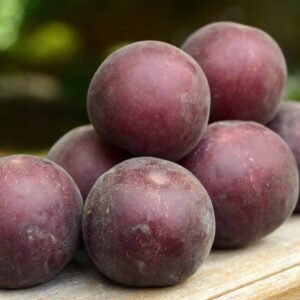
The fruit frequently combines dark purple skin, very juicy and slightly acidic flesh, an attached stone and a genuine aroma of ripe apricot.
Fruit quality varies considerably because the group contains different seedlings and locally selected clones rather than one single uniform cultivar.
The Italian biricoccolo has a much older history than the modern pluot
The biricoccolo is an old Italian fruit that was cultivated long before the names pluot and aprium appeared.
It is generally associated with Prunus × dasycarpa and probably developed from hybridisation between apricot and cherry plum.
The fruit is often dark, sometimes slightly velvety, with flesh combining the juice and lively acidity of a plum with a clearly recognisable apricot perfume.
Italian biricoccoli should not be assumed to represent clones of one original plant. They may descend from several ancient hybridisation events selected locally and preserved through grafting in family gardens and orchards.
Their value is not merely historical. Good selections can combine distinctive flavour, robustness and excellent cooking quality, even when their fruit size or storage life does not match that of a modern commercial cultivar.
Black apricots from Armenia, the Caucasus and eastern Europe
Comparable traditional hybrids have been preserved in Armenia, central Asia, the Caucasus, the Balkans and different parts of eastern Europe.
They are variously described as black, purple or violet apricots and are generally associated with the hybrid group Prunus × dasycarpa.
The Armenian cultivar ‘Shlor-Tsiran’, whose name means plum–apricot, produces dark violet fruit with juicy and lively flesh reminiscent of cherry plum and a genuine apricot aroma.
These resources attracted breeders because certain forms flowered later, tolerated some spring frosts more successfully or displayed better disease behaviour than susceptible apricot cultivars.
Breeding programmes in Russia, Ukraine, Crimea, Bulgaria and neighbouring regions subsequently used similar material to obtain larger, more regular fruit adapted to continental growing conditions.
Eastern origin does not by itself guarantee exceptional winter hardiness or successful ripening in every European climate. The actual pedigree, flowering period, frost tolerance and harvest season of the cultivar remain more informative.
Modern hybrids between apricot and diploid plums
Modern hybridisation can involve apricot, Japanese or Chinese plum, cherry plum and hybrids that already possess a complex pedigree.
Selected seedlings may then be crossed again with plum, apricot or another hybrid to reinforce particular fruit or tree characteristics.
The objective is often to obtain fruit that is larger, firmer, more regular and easier to produce than early spontaneous hybrids.
The result may appear almost completely plum-like while retaining a distinctive apricot aroma, or remain closer to apricot in its flesh, skin and texture.
A multi-generation pedigree cannot be described reliably by a simple visual impression or one theoretical percentage.
Why cross plums and apricots?
The purpose of these crosses is not simply to create an unusual-looking fruit. Breeders try to combine characteristics that rarely occur together in one conventional cultivar.
Preserving the perfume of apricot
One of the most valuable objectives is to introduce the characteristic aromatic profile of apricot into a fruit with plum-like skin and juiciness.
The best hybrids are not merely sweet. They can develop floral, honeyed, almond-like or intensely fruity aromas suggesting ripe apricot, apricot preserve or occasionally tropical fruit.
This perfume may remain highly perceptible even when the fruit has smooth skin and an appearance almost indistinguishable from a plum.
Combining aroma with juiciness
Apricots can provide intense aroma, but some cultivars possess relatively dry flesh or become floury when overripe.
Cherry plum and other diploid plums can contribute greater juiciness, fresher acidity and a different flesh texture.
The objective may therefore be a fruit with the perfume of apricot but more juice and freshness than a traditional apricot.
Improving climatic adaptation
Cherry plum and several Asian plum species provide useful genetic resources for winter hardiness, adaptation to different soils, regular cropping and tolerance of environmental stress.
Some black apricots have been used to seek later flowering and improved tolerance of spring frost compared with very early-flowering apricot cultivars.
Increasing fruit size and firmness
Early natural hybrids sometimes produced small and irregular fruit with a relatively large stone.
Modern breeding aims to increase fruit size, the proportion of edible flesh, uniformity and resistance to handling.
Useful firmness allows fruit to be picked and transported without becoming immediately soft, but it should not be achieved at the expense of aroma and eating quality.
Extending the harvest season
Plum and apricot species possess very different ripening periods.
Hybridisation can create fruit maturing before, during or after the usual plum season.
This diversity is useful in a collection, provided that late cultivars receive enough summer warmth to develop their sugar and aroma in the region where they are planted.
The apricot aroma is real, but varies greatly between cultivars
The aroma of apricot is not produced by one single substance. It results from a complex combination of lactones, esters, terpenes, carotenoid-derived compounds and other volatile molecules.
A hybrid may retain high concentrations of some compounds associated with apricot while producing very little of others.
This explains why two cultivars with apparently similar parentage can possess completely different flavours.
Some hybrids release an obvious apricot perfume as soon as the fruit is cut.
In others, the apricot influence becomes noticeable mainly in the mouth or in the aroma remaining after the fruit has been swallowed.
Some genuine plum–apricot hybrids display almost no recognisable apricot perfume. Their value may instead lie in colour, sweetness, acidity, precocity, robustness or texture.
Apricot perfume develops mainly at full maturity
Many of the compounds responsible for apricot aroma increase during the final stage of fruit maturity.
A hybrid picked too early may already possess an attractive skin colour and firm edible flesh while remaining almost devoid of perfume.
The fruit may soften after harvest without developing the complete aromatic profile that it would have produced on the tree.
This explains why the same cultivar can taste exceptional when harvested fully ripe from a garden yet seem relatively ordinary when picked early for transport.
To evaluate a pluot or plum–apricot correctly, taste fruit that has reached physiological maturity rather than fruit that has merely softened during storage.
A hybrid does not express half of every characteristic from each parent
A direct hybrid receives approximately half of its genetic material from each parent, but this does not mean that every fruit characteristic will be exactly intermediate.
A seedling may possess almost entirely plum-like skin and flesh while retaining an intense apricot perfume.
Another may display velvety skin and apricot-like flesh while keeping the acidity, juiciness and attached stone of a cherry plum.
Later generations make theoretical percentages even less useful because hybrids may be crossed back to a plum, an apricot or another complex hybrid.
A relatively small part of the genome may exert a major influence on aroma, colour, fertility or disease response.
It is therefore more rigorous to identify documented parents and describe the characteristics actually observed in the cultivar than to rely on an approximate plum-to-apricot percentage.
Do not confuse eastern European hybrid plums with plum–apricot hybrids
Many eastern European hybrid plums were created by crossing cherry plum with Japanese, Chinese, Ussurian or other diploid Asian plums.
These cultivars may offer outstanding flavour, spectacular skin and flesh colours, very early maturity and excellent adaptation to continental climates.
None of these qualities proves that apricot occurs in their pedigree.
Orange flesh or a strong perfume should not be treated as genetic evidence either.
A cultivar may remain within this commercial category because it is an original and valuable Prunus hybrid, but its product page should describe it as a hybrid plum unless apricot ancestry has been reliably documented.
Which characteristics should be compared before choosing a cultivar?
Documented parentage
Known parents help explain the general behaviour of a cultivar.
A hybrid between apricot and cherry plum does not necessarily possess the same pollination requirements, fruit texture or climatic needs as a hybrid between cherry plum and Japanese plum.
Aroma and flavour
Where the main objective is a plum-like fruit with the perfume of apricot, select a cultivar whose aroma has been clearly described and observed at full maturity.
Do not assume that every fruit carrying the name pluot will possess a strong apricot flavour.
Ripening season
Early and mid-season cultivars provide greater security in cool climates.
Very late fruit may remain low in sugar or encounter autumn rain before developing its full aromatic quality.
Firmness and juiciness
Some hybrids are exceptionally juicy and should be eaten or processed promptly.
Others remain firm for longer and tolerate handling, transport and short storage more successfully.
Stone and proportion of flesh
A large fruit can still contain a substantial stone.
The proportion of edible flesh and whether it separates easily from the stone are particularly important for cooking, preserves and drying.
Behaviour in wet weather
Compare susceptibility to splitting, brown rot and deterioration after rain.
A very sweet and juicy cultivar may provide outstanding fruit in favourable weather while becoming difficult to harvest during a wet season.
Pollination
Self-fertility varies greatly. Some hybrids produce useful crops alone, while others are self-incompatible or possess pollen of low fertility.
The correct pollinating partner must be identified for the individual cultivar.
Ripening season remains decisive in cool European climates
A cultivar may be completely winter hardy while remaining incapable of developing its full fruit quality during a cool summer.
Apricot perfume, sugar concentration and flesh colour depend strongly on light and temperature during the final stage of maturity.
A late cultivar selected in a continental region may tolerate winters much colder than those of western Europe yet still require a warmer and brighter summer to ripen successfully.
Winter hardiness and the ability to ripen under cool conditions are therefore separate characteristics.
For northern, maritime or elevated sites, prioritise cultivars whose early or mid-season maturity has been demonstrated in temperate European conditions.
View the Pluot and Hybrid Plum Harvest Calendar
The calendar is intended primarily for comparing cultivars. Actual dates vary according to country, region, exposure, rootstock, crop load and seasonal weather.
Improved frost tolerance is possible, but not automatic
Some black apricots and eastern European hybrids flower later or tolerate certain frost events better than conventional apricot cultivars.
This improvement was one of the historic objectives of crossing apricot with cherry plum and other hardy species.
It would nevertheless be incorrect to conclude that all pluots are more resistant to frost.
Some hybrids begin growing and flowering as early as Japanese plums or apricots.
Flowering date, intrinsic frost tolerance of the buds and flowers, duration of the cold event and stage of young fruit development must be considered separately.
An early hybrid planted in a frost pocket may be at greater risk than a later-flowering European plum growing only a short distance away.
Chromosome groups help explain pollination difficulties
Apricot, cherry plum and Japanese plum are generally diploid species, meaning that they possess two sets of chromosomes.
Many hybrids developed from these groups are also diploid or belong largely to the diploid plum gene pool.
This can allow pollination between certain Japanese plums, cherry plums and closely related hybrids, provided that their flowering periods overlap and they are genetically compatible.
European plums such as many gages, quetsches and damsons are generally hexaploid, with six sets of chromosomes.
Their different chromosome structure and frequently different flowering period mean that they should not be recommended automatically as pollinators for a diploid pluot or hybrid plum.
Chromosome number alone does not prove compatibility. It only helps identify which botanical groups are more plausible pollinating partners.
Pollination of interspecific hybrids requires particular attention
Interspecific hybrids can possess reduced pollen fertility because chromosomes inherited from different species do not always pair normally during pollen formation.
This problem is especially evident in some hybrids close to the first generation.
A tree may therefore flower abundantly and receive pollen successfully while remaining a poor pollinator for neighbouring trees.
It is important to distinguish the ability to receive pollen, the ability to produce viable pollen and genetic compatibility with another cultivar.
These three characteristics are related but not identical.
What can pollinate a pluot or plum–apricot hybrid?
The answer depends entirely on the cultivar and its pedigree. There is no universal pollinator for every hybrid within the genus Prunus.
Another hybrid flowering at the same time may be effective when it produces viable pollen and is genetically compatible.
Certain Japanese plums, cherry plums or eastern European hybrid plums may pollinate cultivars belonging predominantly to the diploid plum group.
This compatibility must still be confirmed cultivar by cultivar.
The presence of an apricot tree does not guarantee successful pollination.
The fact that a breeder once obtained a controlled cross between apricot and plum does not mean that every apricot will easily pollinate every plum–apricot hybrid in a garden.
European plums should not be recommended automatically because they are generally hexaploid and may flower at a different time.
Where reliable pollination information is unavailable, planting two unrelated diploid hybrids with strongly overlapping flowering periods is more prudent than relying on one arbitrary plum or apricot cultivar.
Why might a hybrid flower without producing fruit?
The absence of a compatible pollinator is the first possibility to investigate, but it is not the only explanation.
The cultivar may produce pollen of low fertility or its flowering period may fail to overlap sufficiently with the intended partner.
Low temperatures can prevent normal pollen germination and growth of the pollen tube.
Bees and other pollinating insects are also less active during cold, windy or continuously wet weather.
Frost can destroy the ovules or young fruit without immediately removing the petals, creating the impression of normal flowering before the small fruit stops developing.
A young tree may also flower before it has developed enough vigour and leaf area to retain a substantial crop.
Should the fruit be thinned?
Productive hybrids can set more fruit than the tree is able to ripen properly.
Numerous small fruits may remain crowded together on relatively thin branches.
Excessive crop load reduces fruit size, sugar concentration and apricot aroma while delaying maturity.
After natural fruit drop, leave enough space for the remaining fruit to develop without touching at maturity.
The correct spacing depends on the expected fruit size of the cultivar.
Remove malformed, damaged or poorly positioned fruit first, particularly where it is carried by a weak branch.
Thinning also reduces the risk of branch breakage and can improve crop regularity from one year to the next.
Are hybrid plums more resistant to disease?
Hybridisation can transmit useful tolerance of particular diseases, but it does not automatically create a tree resistant to every problem affecting plums and apricots.
Some black apricot genotypes have shown useful behaviour against brown rot and shot-hole disease compared with susceptible apricot cultivars.
This concerns specific selections and cannot be generalised to the whole category.
Pluots and other hybrids can still be affected by blossom and fruit brown rot, bacterial canker, shot-hole disease, leaf spots, aphids and the principal pests of plums.
A cultivar selected in a dry continental climate may behave differently during a persistently wet spring in western or northern Europe.
An open crown, moderate pruning, removal of mummified fruit and a well-drained planting position remain important even for a cultivar described as robust.
Brown rot, rain and fruit splitting
Brown rot can infect flowers during wet weather and cause the death of blossom clusters and short shoots.
Close to harvest, split or wounded fruit becomes especially vulnerable to fungal decay.
Very juicy and high-sugar hybrids may split when heavy rain or substantial irrigation follows a dry period.
Susceptibility to splitting is highly dependent on cultivar and cannot be predicted solely from skin thickness or flesh firmness.
Relatively consistent soil moisture, appropriate thinning and picking at the correct stage reduce aggravating factors without making a susceptible cultivar completely resistant.
Which rootstock should be chosen?
The rootstock should be selected according to the dominant parentage of the cultivar, documented compatibility and soil conditions.
The presence of apricot in the pedigree does not mean that an apricot rootstock is automatically the most suitable choice.
Many plum–apricot hybrids behave predominantly like diploid plums and are more commonly grafted onto plum-compatible root systems.
Cherry plum or myrobalan
Cherry plum, Prunus cerasifera, is frequently used for hybrid plums and several plum–apricot selections.
It normally produces a vigorous tree and tolerates a relatively broad range of soils.
It is generally more suitable for heavy or temporarily moisture-retentive ground than many peach rootstocks, although it does not tolerate permanent waterlogging.
Seedling myrobalans are variable and may produce suckers, while clonal selections provide greater uniformity without necessarily reducing vigour substantially.
St Julien-type rootstocks
St Julien rootstocks can reduce vigour compared with myrobalan and encourage earlier cropping.
They generally suit reasonably fertile, moisture-retentive and well-structured soil.
Compatibility must still be confirmed for the individual hybrid cultivar.
Multipurpose interspecific Prunus rootstocks
Rootstocks such as Ishtara, Torinel and other interspecific selections are used with several plum and apricot cultivars.
Their broad general compatibility does not guarantee a durable graft union with every plum–apricot hybrid.
Delayed incompatibility may become visible several years after apparently normal initial growth.
Peach and peach–almond rootstocks
These rootstocks may suit certain compatible hybrids in light, warm and freely drained soils.
They are generally less secure in cold, compact or moisture-retentive northern soils.
Their use should be restricted to combinations whose compatibility and adaptation are sufficiently documented.
How should pluots and hybrid plum trees be trained and pruned?
Most hybrid plums and pluots crop on relatively young branches and on short fruiting structures that can remain productive for several years.
They should not automatically be pruned like peaches, whose crop depends much more heavily on shoots formed during the previous season.
An open-centred tree or a central leader with well-spaced framework branches can both provide sufficient light around the fruit.
Pruning should concentrate on removing badly positioned branches, dead wood, cankered sections and areas that have become excessively dense.
Avoid systematically shortening every shoot. Severe cutting stimulates excessive vegetative growth and may delay fruiting.
Large cuts are preferably made during dry weather while the tree is actively growing, reducing the period during which wounds remain vulnerable to wood diseases.
How can full maturity be recognised?
Skin colour is not always a reliable maturity indicator.
Some cultivars remain green, yellow-green or mottled when fully ripe, while others become darkly coloured several days before reaching their best eating quality.
Observe the background colour, slight softening of the flesh, development of aroma and ease of detachment.
The apricot perfume frequently becomes much stronger during the final days of maturity, making tasting essential.
Fruit exposed to the greatest amount of sunlight normally ripens first.
Several selective picking rounds provide much better quality than harvesting every fruit on the tree as soon as the first specimens are coloured.
A fruit picked too early may soften after harvest while remaining acidic, low in sugar and almost devoid of aroma.
Which hybrid should you choose?
For a genuine apricot perfume
Choose a cultivar whose apricot aroma is clearly documented or observed at full maturity rather than a hybrid plum placed in the category only because of its complex origin.
For a cool European climate
Choose an early or mid-season cultivar capable of ripening during a temperate summer and avoid varieties whose blossom is exceptionally early in a frost-prone location.
For continental winter hardiness
Eastern European breeding material can provide useful hardiness, but compare the frost tolerance of the flower buds and the ripening season rather than considering only the minimum temperature tolerated by dormant wood.
For eating directly from the tree
Prioritise a good balance between sugar, freshness, perfume, skin quality and juiciness.
A very firm cultivar selected for transport is not necessarily the one providing the best eating quality in a garden.
For preserves and compotes
Useful acidity, strongly coloured flesh and an apricot perfume that remains detectable after cooking are particularly valuable.
Fruit size, juice content and whether the flesh separates readily from the stone also influence ease of processing.
For planting only one tree
Select only a cultivar whose self-fertility has been confirmed reliably.
The presence of apricot ancestry or the word pluot in the name does not indicate that the tree will crop alone.
Frequently asked questions about pluots and hybrid plums
Are all cultivars in this category crosses between plum and apricot?
No. Some are genuine plum–apricot hybrids, while others derive from several plum species and have no documented apricot ancestry.
What is a pluot?
A pluot is generally a complex plum–apricot hybrid whose fruit remains predominantly plum-like. The name should not be applied automatically to every unusual hybrid plum.
What is a plumcot?
Plumcot is a broad term used for hybrids between plum and apricot, particularly direct or relatively early-generation crosses.
What is an aprium?
An aprium is a complex plum–apricot hybrid whose fruit characteristics remain predominantly apricot-like.
What is a biricoccolo?
It is an old Italian type of plum–apricot, generally associated with Prunus × dasycarpa and probably originating from apricot and cherry plum.
What is a black apricot?
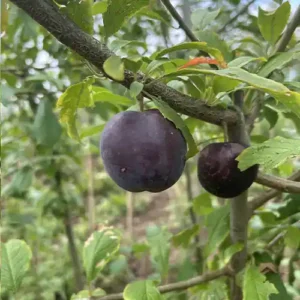
A black apricot is generally a hybrid between apricot and cherry plum. Its fruit may possess dark violet skin, juicy acidic flesh and a characteristic apricot perfume.
Is a Russian plum always a pluot?
No. Many Russian and eastern European hybrid plums descend from cherry plum, Chinese plum and other diploid plums without documented apricot ancestry.
Do these hybrids genuinely taste of apricot?
Some possess an intense apricot aroma, while others remain much closer to an ordinary plum. Aroma depends on the cultivar and the stage of maturity.
Why does my fruit have no apricot aroma?
It may have been picked too early, ripened under insufficient warmth or belong to a cultivar in which apricot ancestry has little influence on the aroma.
Are pluots always exceptionally sweet?
No. Sugar concentration depends on cultivar, sunlight, crop load and harvest stage. Some hybrids retain useful acidity and are not intended to be purely sweet.
Are pluots diploid?
Many cultivars derived principally from apricot, Japanese plum and cherry plum belong to the diploid gene pool. The exact chromosome structure should nevertheless be checked for the individual hybrid rather than assumed from its commercial name.
Are two trees required?
In many cases, yes. Several hybrids are self-incompatible or produce little viable pollen. A compatible cultivar flowering at the same time must be selected.
Can an apricot tree pollinate a plum–apricot hybrid?
Sometimes, but this should not be assumed. Compatibility must be documented for the specific combination of cultivars.
Can a European plum pollinate a pluot?
It is often a poor choice because European plums are generally hexaploid and may flower at a different time. A compatible diploid plum or hybrid is usually a more plausible pollinator.
Can a Japanese plum pollinate a pluot?
Some Japanese plum cultivars can pollinate closely related diploid hybrids when flowering overlaps, but compatibility must still be confirmed variety by variety.
Are these hybrids more resistant to frost?
Some black apricots and eastern European hybrids possess good winter hardiness or later flowering, but this is not a universal characteristic of the group.
Are hybrid plums disease-resistant?
Not automatically. Individual cultivars may still be affected by brown rot, canker, shot-hole disease, leaf spots and fruit rots.
Which rootstock is suitable?
Myrobalan suits many hybrid plums and a broad range of soils. St Julien and certain interspecific rootstocks may reduce vigour, but durable compatibility must be confirmed for the cultivar.
Should the fruit be thinned?
Yes when fruit set is heavy. A balanced crop normally produces larger fruit with more sugar and a more clearly developed apricot perfume.
How can ripe fruit be recognised?
Combine changes in background colour, slight softening, aroma, ease of detachment and tasting. External colour alone is frequently misleading.