Pre-orders are open No payment today. Stock will be checked during the inventory in early August, then you will receive a payment link for the available trees.
Choosing an Asian pear tree

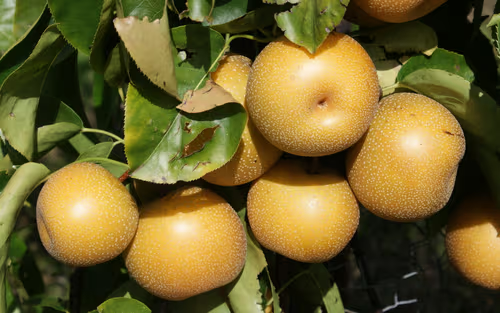
Asian pears produce crisp and exceptionally juicy fruit that normally develops its full flavour on the tree. For large and regular crops, compare pollination, harvest season, storage life, fruit thinning and the long-term compatibility of the rootstock.

View harvest calendars Choose a rootstock

Asian pear trees

Asian pear trees

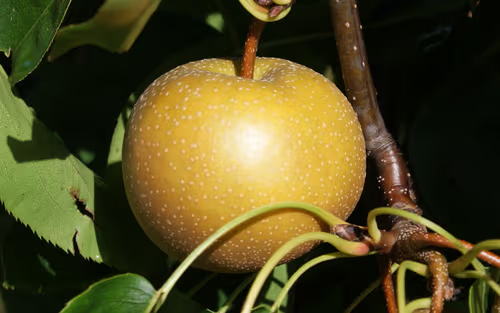
Benita

Bénita nashi pear tree, with large, crisp, juicy and delicately aromatic fruit, ripening in late August.
From 26,50 

Asian pear trees

Kumoï

One of the most popular Asian pears, with a firm flesh and sweet flavour.
From 26,50 

Asian pear trees

New World

New World nashi pear tree, with large, good-flavoured fruit, nashi-like but more tender, harvested in October.

From 26,50 

Asian pear trees

Shin Li

A productive nashi-pear hybrid producing sweet, crisp and juicy fruit with a distinctive spicy aroma.
From 26,50 

Asian pear trees

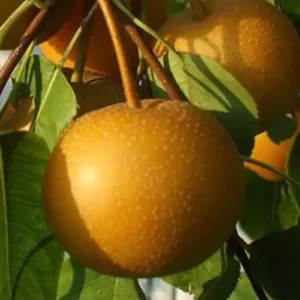
Tsu Li

Tsu Li nashi tree, with good-sized refreshing fruit that ripens in September and keeps easily for up to 6 months.
From 26,50 

Asian pear trees

Chojuro

NULL
From 26,50 
Autumn 2026

Asian pear trees

Hayatama

A high-quality Asian pear variety producing crisp, very juicy fruit with a fresh aromatic flavour.
From 26,50 

Asian pear trees

Hosui

Hosui has perhaps the best flavour of any Asian pear - it is very juicy and very sweet.
From 26,50 
Autumn 2026

Asian pear trees

Isadora

A productive Asian pear variety producing crisp juicy fruit with refreshing sweet flavour.
From 26,50 
Autumn 2026

Asian pear trees

Nijiseiki

A popular Asian pear variety producing crisp juicy fruit with sweet refreshing flavour.
From 26,50 
Autumn 2026

Asian pear trees

Reddy’s Robbin

An attractive red-fleshed apple variety with sweet aromatic flavour and ornamental qualities.
From 26,50 

Asian pear trees

Shinseiki

This popular early-season Asian / Nashi pear variety produces crisp sweet-flavoured pears, which can be kept for up to 3 months.
From 26,50 

Asian pears are pears, not crosses between apples and pears

Asian pears, commonly known as nashi pears, belong to the genus Pyrus like European pear trees.

Their rounded shape and crisp flesh can resemble an apple, but they are not hybrids between apples and pears.

Most cultivated Asian pears descend principally from Pyrus pyrifolia and related Asian pear species.

Their eating texture is very different from that of a melting European dessert pear.

The flesh remains firm and crisp while containing an exceptionally large quantity of juice.

According to the cultivar, flavours may be mild, sweet, honeyed, floral, spicy, musky or lightly acidic.

Choosing an Asian pear should not be based only on fruit colour or size.

Pollination, harvest season, storage life, crop load, tree vigour and rootstock compatibility all have a major influence on the final quality of the crop.

What should be compared when choosing an Asian pear cultivar?

Harvest season

The earliest Asian pears ripen during summer, while later cultivars are harvested during autumn.

Combining several maturity periods extends fresh consumption and prevents the complete crop from becoming ready at the same time.

In cool European climates, early and mid-season cultivars generally reach their full sweetness and aroma more reliably than exceptionally late varieties.

Later cultivars can still be valuable where the position is warm and sunny and where their superior storage potential justifies the longer season.

Flavour and texture

Some cultivars possess extremely crisp, light and watery flesh, while others are denser, sweeter and more aromatic.

The best fruit combines abundant juice with sufficient sugar, a clean aroma and enough acidity to prevent the flavour from appearing flat.

A cultivar described simply as sweet is not necessarily more interesting than one possessing a stronger balance between sugar, freshness and perfume.

Yellow, green and russeted skin

Yellow and yellow-green cultivars often produce smooth and bright fruit.

Bronze and russeted Asian pears may develop richer or more complex aromas, although skin colour alone cannot predict eating quality.

Russet is a normal characteristic of many cultivars and should not be confused with superficial disease damage.

Fruit size

Fruit size is influenced strongly by genetics, but also by pollination, thinning, soil moisture, leaf health and crop load.

A cultivar known for large fruit will still produce numerous small pears when several fruits are retained within every cluster.

Correct thinning is therefore often more important than fertiliser when the objective is to obtain large Asian pears.

Storage life

Some cultivars are intended mainly for consumption shortly after harvest.

Others remain crisp for several weeks or months when harvested at the correct stage and stored carefully under refrigeration.

Storage quality includes more than firmness. The fruit should retain a clean flavour without developing internal browning, fermentation or an excessively vinous aroma.

Disease behaviour

Asian pear cultivars differ in their susceptibility to fire blight, pear scab, leaf spots, cankers and pear psylla.

No general statement describing all Asian pears as disease-resistant is sufficiently accurate.

In humid regions, healthy foliage and an open crown are particularly important for regular fruit development and long-term tree vigour.

Cross-pollination is usually required for regular crops

Most Asian pear cultivars crop more reliably when pollinated by another genetically different pear flowering at the same time.

Many possess a self-incompatibility system that prevents or substantially limits fertilisation by their own pollen.

A cultivar may occasionally produce several fruits alone without being dependably self-fertile.

For a regular crop, plant at least two compatible cultivars whose flowering periods overlap strongly.

Two different cultivar names are not automatically sufficient.

The trees must flower together and each must produce pollen capable of fertilising the other.

Some cultivars flower abundantly but provide pollen of reduced usefulness and should not be treated as universal pollinators.

Can a European pear pollinate an Asian pear?

A European pear can sometimes pollinate an Asian pear, and an Asian pear can sometimes pollinate a European cultivar.

Both belong to the genus Pyrus, and useful cross-pollination is possible between many cultivars.

The principal limitation is often the flowering calendar rather than the distinction between European and Asian pears.

Asian pears frequently flower relatively early, so a late-flowering European pear may provide little useful pollen even when the cultivars are otherwise compatible.

For a small garden, the safest combination is normally two Asian pear cultivars known to flower together rather than relying on an unidentified pear growing somewhere in the neighbourhood.

Where a European pear is intended as the pollinator, check its flowering period for the local climate rather than relying only on a general flowering-group number.

Cold and wet weather can still reduce fruit set

Asian pear flowers are visited by bees and other pollinating insects.

Cold, rain and strong winds during flowering reduce insect activity and can limit effective fertilisation even when compatible cultivars are present.

Spring frost may damage open flowers or young fruitlets without seriously injuring the dormant branches of the tree.

A tree can therefore flower heavily but retain very little fruit after an unfavourable blossom period.

Where cropping is poor, consider flowering overlap, pollinator activity, frost, tree age and general health before adding fertiliser.

Fruit thinning is essential for large Asian pears

Asian pear trees can set far more fruit than they are capable of developing properly.

This natural fertility can produce clusters of small, weakly flavoured pears and overloaded branches.

After the principal natural fruit drop, retain generally one well-formed fruit per cluster.

On heavily cropped branches, leave approximately 12 to 15 centimetres between the remaining fruit, adjusting the spacing according to cultivar and expected fruit size.

Remove malformed, damaged and distinctly undersized fruit first.

Retain fruit supported by strong stalks and positioned where it has enough space to develop.

Thinning increases fruit size, improves sugar concentration, encourages more even maturity and reduces the risk of broken branches.

It also prevents the current crop from using an excessive proportion of the reserves required to form flower buds for the following year.

A tree producing hundreds of small Asian pears is often not deficient in nutrients. It is frequently carrying too many fruit.

Choose the rootstock with long-term compatibility in mind

The rootstock influences vigour, anchorage, soil adaptation, time to first cropping, mature dimensions and the long-term health of the graft union.

This choice is particularly important for Asian pears because not every rootstock used successfully with European pear cultivars is automatically suitable.

A tree may grow apparently normally for several years before a weak or incompatible graft combination begins to decline.

Short-term growth is therefore not complete proof of durable compatibility.

Pyrus calleryana

Pyrus calleryana is traditionally used as a rootstock for Asian pears because of its broad compatibility and powerful root system.

It normally produces a vigorous and strongly anchored tree.

This rootstock is better suited to an orchard or a garden with substantial space than to anyone seeking a genuinely compact tree.

Its precise behaviour still depends on seed source, soil, climate and the grafted cultivar.

Pyrus betulifolia

Pyrus betulifolia is another vigorous Asian pear rootstock valued for compatibility and adaptation to several soil conditions.

It can provide strong growth and useful tolerance of dry periods once established.

It should not be considered dwarfing and requires enough space for the resulting tree.

European pear seedlings and clonal Pyrus rootstocks

Seedlings of European pear and certain clonal Pyrus rootstocks can support some Asian pear cultivars successfully.

The outcome depends on the precise cultivar, rootstock clone, soil and growing conditions.

Where long-term performance is not well documented, the combination should be presented with appropriate caution rather than assumed to be universally compatible.

Quince rootstocks

Quince should not be treated as the standard rootstock for Asian pears.

Direct compatibility is variable and frequently poor, depending on the cultivar.

A graft may begin growing before later showing a weak union, restricted vigour or progressive decline.

Some combinations may be possible with a compatible interstem, but this creates a more complex tree whose long-term performance depends on all three components.

Read our guide to fruit-tree rootstocks

Where should an Asian pear tree be planted?

Choose a sunny position where the fruit can accumulate sufficient sugar and develop its characteristic aroma.

Good light also helps the foliage dry after rainfall and supports the formation of flower buds for the following season.

Asian pears tolerate cool winters, but open flowers and young fruit remain vulnerable to late spring frost.

Avoid enclosed hollows and the bottom of slopes where cold air collects during clear nights.

A position protected from severe winds is useful, but the tree should not be enclosed within dense vegetation or between buildings where air movement is poor.

Allow enough room for the mature dimensions produced by the selected rootstock.

A vigorous Asian pear on Pyrus calleryana or another seedling rootstock should not be planted as though it were a dwarf apple tree.

Soil, drainage and water availability

Asian pear trees prefer deep, fertile and adequately drained soil that retains useful moisture during shoot and fruit development.

Clay soil can be suitable where it remains structured and contains enough air.

Compacted or permanently saturated ground restricts root function and increases the risk of progressive decline.

In heavy soil, improve the movement of water through the wider planting area rather than filling one narrow hole with loose compost.

A slightly raised planting position may reduce local water accumulation where the surface soil is heavy, but cannot correct a permanently waterlogged subsoil.

Dry soil reduces shoot growth, fruit size and the ability of the tree to retain a heavy crop.

Irregular water availability can also increase physiological stress and cause part of the crop to fall.

Maintain a weed-free or mulched root zone, particularly during the first years.

Planting a young Asian pear tree

Dormant bare-root trees should be planted between leaf fall and early spring whenever the ground is neither frozen nor saturated.

Container-grown plants can be installed over a longer period, but active young growth is more vulnerable to frost than the dormant wood of an established tree.

Where a container tree has already begun growing under protection, wait until the principal frost risk has passed or provide temporary protection.

Prepare a broad area of finely worked soil after it has drained sufficiently.

Remove couch grass, bindweed and other perennial weeds carefully before planting.

Do not place the tree within a narrow pocket of pure potting compost or fresh manure.

Backfill mainly with the original soil, improved over a broad area with mature compost where necessary.

Position the root collar correctly and keep the graft union clearly above the finished soil level.

Water thoroughly after planting and maintain regular moisture throughout the first growing season whenever rainfall is insufficient.

Do not stop watering after the first few weeks. A tree that begins growing normally in spring may still suffer severe establishment stress during its first dry summer.

Avoid excessively vigorous growth

Asian pear trees can produce long and strongly upright shoots, particularly on vigorous rootstocks or in highly fertile soil.

Excessive vegetative growth delays cropping, shades the interior of the crown and makes the tree more difficult to manage.

Nitrogen applications should remain moderate.

A tree with healthy foliage and sufficient annual growth does not need to be forced to become more vigorous.

Opening the angle of young branches with ties or spreaders is often more effective than shortening every shoot.

A branch trained towards a wider angle generally grows less vertically and begins forming fruiting structures more readily.

Avoid exceptionally narrow forks because heavily cropped Asian pear branches can split under the weight of the fruit.

Training and pruning an Asian pear tree

Asian pears can be trained with a central leader and several well-spaced tiers of branches.

This structure provides a strong framework and allows light to reach the inner fruiting wood.

During the early years, select the future main branches and correct shoots growing at excessively upright angles.

Remove competing leaders before they become large enough to create weak forks.

On an adult tree, prevent the accumulation of crowded shoots, hanging wood and branches growing directly above one another.

Asian pears form short fruiting structures that can remain productive for several years.

Severe annual pruning removes this useful wood and normally causes an undesirable burst of vertical regrowth.

Pruning should remain progressive: remove dead or diseased wood, open heavily shaded areas and renew ageing branches gradually.

Fruit thinning and branch positioning are often more useful than repeated shortening of every shoot.

Are Asian pear trees naturally disease-resistant?

Asian pears are sometimes described broadly as resistant pear trees, but cultivar behaviour varies too much for this claim to be applied to the complete group.

Fire blight

Fire blight, caused by Erwinia amylovora, can infect Asian pear flowers, shoots and branches.

Symptoms may include blackened flowers, rapidly wilting shoots and tips curving into a characteristic hook.

Some cultivars show useful tolerance while others are highly susceptible.

Excessive nitrogen and dense tender growth can make management more difficult.

Pear scab and leaf spots

Susceptibility to pear scab and other leaf-spot diseases differs between cultivars.

In humid climates, a cultivar retaining healthy foliage is more likely to fill its fruit and store enough reserves for the following year.

Maintain an open crown and remove heavily affected fallen leaves where disease is recurrent.

Pear psylla

Pear psylla can colonise young shoots and produce sticky honeydew followed by black sooty mould.

A severe infestation weakens growing tips and reduces leaf efficiency.

Very vigorous trees supplied with excessive nitrogen often produce large quantities of tender growth attractive to these pests.

Codling moth and fruit damage

Codling moth and other fruit-feeding insects can damage Asian pears in the same way as European pears and apples.

Damaged fruit may fall prematurely or develop internal decay.

Remove affected fallen fruit and do not leave unusable fruit beneath the tree.

Asian pears ripen on the tree

Harvest behaviour is one of the most important differences between Asian pears and many European dessert pears.

A European pear is frequently picked firm and allowed to soften and develop its final texture after harvest.

An Asian pear should generally develop its sweetness, aroma and eating maturity while it remains on the tree.

Fruit picked too early may remain crisp, but it will lack sugar and flavour.

It does not improve in the same way as a European pear ripened indoors.

A ripe Asian pear remains firm and crisp. Do not wait for it to become soft.

How can a ripe Asian pear be recognised?

Skin colour must be interpreted according to the cultivar.

Yellow cultivars normally lose their green background, while bronze cultivars develop their characteristic mature colour and more pronounced aroma.

A mature fruit often detaches when lifted and turned gently, although this test varies between cultivars.

Tasting remains the most reliable method where several fruits are available.

The flesh should be crisp, juicy and sufficiently sweet, with the characteristic aroma of the cultivar.

A fruit can appear fully coloured several days before reaching its best flavour.

Fruit on the sunnier side of the tree usually ripens first, so several selective harvests provide better quality than picking the complete crop at once.

Asian pear harvest season

Early cultivars begin ripening during summer, while the latest Asian pears can continue into autumn.

Actual harvest dates vary according to cultivar, country, exposure, rootstock, tree vigour, crop load and seasonal weather.

The calendar is intended mainly for comparing cultivars rather than predicting one exact picking date for every garden.

Variety
September 1–15 16–30
Available Available on backorder Currently unavailable

Harvest periods are indicative and may vary according to the region, exposure, rootstock and the season’s weather conditions.


Harvest Asian pears carefully

Asian pears feel firm and robust, but their flesh bruises easily beneath the skin.

A fruit dropped into a bucket or pressed by other fruit may develop internal brown marks that remain invisible immediately after harvest.

Support the pear in the hand and lift it gently rather than pulling strongly on the stalk.

Place fruit in shallow trays and avoid stacking heavy layers.

Harvest during dry and relatively cool conditions where possible.

Fruit intended for storage must be sound, mature, firm and free from bruising, insect damage and broken stalks.

Storing Asian pears

Storage life differs greatly between cultivars.

Some Asian pears should be eaten within several weeks, while good storage cultivars can remain crisp for several months under suitable refrigerated conditions.

Fruit must already be mature when placed into storage.

Refrigeration slows deterioration but cannot create the flavour missing from an immature pear.

Inspect stored fruit regularly and remove specimens developing softness, internal browning, fermentation or decay.

Prolonged storage can produce a vinous or fermented flavour even when the fruit remains externally firm.

For household use, combining an early cultivar, a mid-season variety and one good storage pear is often more useful than planting several trees whose fruit all ripens during the same week.

Which Asian pear tree should you choose?

For a cool climate, choose an early or mid-season cultivar capable of developing full flavour reliably.

For fresh eating directly from the tree, prioritise flavour, juice content and texture rather than fruit size alone.

For prolonged storage, choose a cultivar with documented keeping quality and handle every fruit carefully during harvest.

For a small garden, pay close attention to rootstock vigour and remember that many traditional Asian pear rootstocks produce substantial trees.

For an orchard or large garden, a vigorous and deeply rooted combination may provide strong anchorage and long-term growth.

In wet or heavy soil, choose a compatible rootstock adapted to the conditions and improve drainage across the wider planting area.

For reliable cropping, select the pollinating cultivar at the same time as the main variety.

Finally, plan to thin the crop every year. Even the best cultivar produces disappointing fruit when the tree is allowed to retain several pears within every cluster.

Frequently asked questions about Asian pear trees

Is an Asian pear a cross between an apple and a pear?

No. Asian pears belong to the genus Pyrus. Their rounded shape and crisp texture resemble an apple, but they are true pears.

Are nashi pears and Asian pears the same fruit?

Nashi is a widely used name for the cultivated Asian pears commonly associated with Pyrus pyrifolia and related species.

Are two Asian pear trees required?

In most cases, planting two compatible cultivars with overlapping flowering periods gives a much more regular crop than relying on self-pollination.

Can a European pear pollinate an Asian pear?

Yes, in many cases, provided that the cultivars flower at the same time and are genetically compatible.

Can one cultivar be described as a universal pollinator?

No. Flowering dates, pollen quality and genetic compatibility must all be considered for the particular combination.

Why does my Asian pear flower without producing fruit?

Possible causes include lack of compatible pollen, poor flowering overlap, cold or wet weather limiting insect activity, frost damage or a tree that is still too young.

Why are my Asian pears very small?

Excessive crop load is the most frequent cause. Retain generally one fruit per cluster and provide enough spacing between the remaining pears.

When should Asian pears be thinned?

Thin after the principal natural fruit drop, once well-formed fruit can be distinguished from damaged or weak fruitlets.

Can Asian pears be grafted onto quince?

Some combinations may begin growing, but direct compatibility is frequently uncertain. Rootstocks belonging to the genus Pyrus are generally safer for durable trees.

Does Pyrus calleryana produce a small tree?

No. It normally produces a vigorous Asian pear with a strong root system and requires substantial space.

Can Asian pears grow in clay soil?

Yes, where the clay remains structured and adequately drained. Permanently saturated or compacted soil creates a substantial risk of root decline.

Are Asian pears resistant to fire blight?

Resistance varies considerably between cultivars. Some show useful tolerance, while others can be severely affected.

How should an Asian pear tree be pruned?

Maintain a well-lit framework, preserve productive short fruiting wood and remove crowded, dead or diseased branches progressively. Avoid severe annual cutting.

Should Asian pears soften after picking?

No. They should normally remain crisp and develop their eating maturity on the tree before harvest.

Do Asian pears become sweeter after picking?

They do not improve substantially after an early harvest. Fruit intended for eating should already possess sufficient sweetness and aroma when picked.

How can a ripe Asian pear be recognised?

Observe the mature skin colour of the cultivar, ease of detachment, aroma and flavour. A ripe Asian pear remains firm and crisp.

Why are my Asian pears brown inside?

Internal browning can result from bruising, excessive storage, physiological disorders, overmaturity or unsuitable storage conditions.

How long can Asian pears be stored?

Storage life varies from several weeks to several months according to cultivar, maturity, handling and refrigeration.

Can Asian pear trees be grown in containers?

Only a comparatively compact tree on a suitable rootstock can be maintained for a period in a very large container. Most vigorous Asian pear combinations are better planted in open ground.