
Quince trees
Quince trees
Quince trees
Quince trees
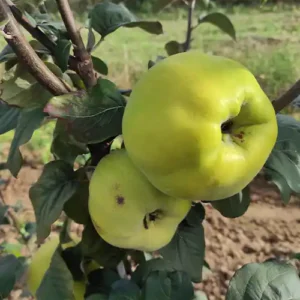
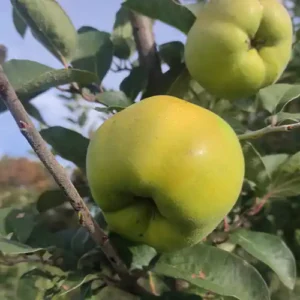
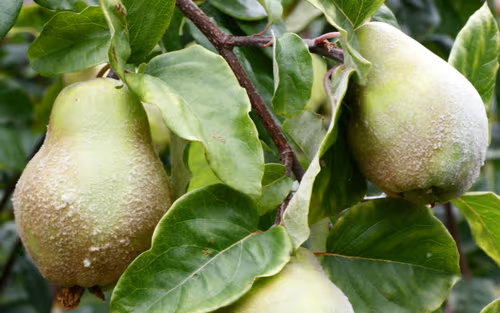
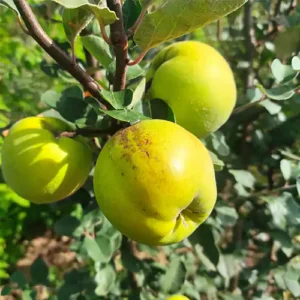
Du Quesnoy quince tree, a local variety with medium to large fragrant quinces, harvested in November.
Quince trees
Kuganskaya quince tree, with large spicy, fragrant quinces, easy to peel and edible raw when fully ripe.
Quince trees
Quince trees
Quince trees
How should you choose a quince tree?
Quince trees are sometimes chosen solely according to the maximum size of their fruit, but fruit size alone provides little information about the practical value of a cultivar.
For a productive tree and high-quality quinces, compare the ripening season, intensity of aroma, flesh texture, juice content, culinary use, disease behaviour and rootstock.
A cultivar capable of producing exceptionally large fruit may remain green and weakly aromatic where the autumn is too cool or short.
A slightly smaller but earlier quince may turn fully yellow, develop a much stronger perfume and be harvested safely before the first severe frost.
In humid parts of northern and western Europe, foliage health also deserves particular attention.
Some cultivars retain a relatively healthy canopy during wet summers, while susceptible varieties can lose a substantial proportion of their leaves through quince leaf spot before the fruit has completed ripening.
The best cultivar is therefore not necessarily the largest-fruited one, but the variety that combines reliable maturity, useful fruit quality and suitable disease behaviour under the intended growing conditions.
The true quince is not the same plant as Japanese quince
True quince, Cydonia oblonga
The fruiting quince grown for large aromatic quinces belongs to the species Cydonia oblonga.
It normally forms a small tree or large, non-thorny shrub with large white or pale pink flowers followed by yellow, strongly scented fruit.
The cultivars offered in this category belong principally to this species.
Japanese quince, Chaenomeles
Japanese quinces belong to the genus Chaenomeles and are generally thorny shrubs cultivated principally for their red, pink, white or orange spring flowers.
Their smaller fruit is edible, aromatic and useful for jelly and flavouring, but it is not the same fruit as the large quince produced by Cydonia oblonga.
Chinese quince, Pseudocydonia sinensis
The Chinese quince belongs to another distinct species, Pseudocydonia sinensis.
It can produce large and fragrant fruit, but its growth habit, bark, foliage, climatic requirements and fruit characteristics differ from those of the true quince.
Apple-shaped and pear-shaped quinces
Quince cultivars are traditionally divided into two broad groups according to fruit shape.
Maliform quinces are relatively round and resemble apples, while pyriform quinces are elongated and resemble pears.
This classification describes appearance rather than overall quality.
It does not determine flavour, pectin content, cooking colour, disease resistance, storage life or ripening season.
Apple-shaped quinces are sometimes associated with firm, dry and strongly aromatic flesh.
Some pear-shaped cultivars possess slightly softer and juicier flesh, but differences between individual cultivars are much greater than this general tendency.
Choose according to the documented characteristics of the variety rather than searching automatically for an apple-shaped or pear-shaped quince.
Quince quality is not determined by fruit size alone
Aroma
Aroma is one of the most valuable characteristics of a quince.
Some cultivars perfume a room immediately after harvest, while others require a short period of storage before their fragrance becomes fully apparent.
A moderately sized and intensely aromatic quince may be much more useful than a huge but weakly scented fruit, particularly for jelly, quince paste and poached fruit.
Juice content
Juicy cultivars are particularly suitable for jelly, juice, syrup and other preparations in which the extracted liquid forms an important part of the finished product.
Drier cultivars containing a greater proportion of solids can be useful for quince paste, thick purées and preparations requiring prolonged cooking.
Acidity and astringency
Most quinces remain hard, acidic and astringent when eaten raw.
Cooking transforms their texture, moderates their acidity and releases aromas that may be much less apparent in the fresh fruit.
Several cultivars are described as suitable for eating raw because their flesh becomes softer and less astringent at full maturity.
Under a cool climate, the same cultivar may remain significantly firmer and sharper than fruit grown in a warmer region.
Colour during cooking
The flesh of many quinces becomes pink, red or amber during cooking.
The intensity of this transformation depends on cultivar, maturity, acidity, cooking method and cooking time.
A quince that remains pale during cooking is not necessarily less aromatic or less suitable for processing.
Cooking colour and flavour intensity are separate characteristics.
Pectin content
Quinces are naturally rich in pectin, which explains their traditional use for jelly and fruit paste.
Pectin levels vary with cultivar and maturity and generally decline as fruit becomes exceptionally ripe.
For jelly, fruit that is mature but still firm often provides a useful balance between aroma, acidity and natural setting ability.
Storage life
Several cultivars keep for only a limited period, while healthy fruit from good storage varieties can remain usable for several months under suitable conditions.
Storage ability depends strongly on freedom from bruising, skin damage, disease and internal disorders.
Choose a cultivar that will genuinely ripen in your region
Quince trees flower relatively late, but their fruit requires a long season to reach complete maturity.
In cool European climates, harvest season can therefore be more important than the winter hardiness of the dormant tree.
An early or mid-season cultivar has a better chance of changing from green to yellow, losing part of its surface down and developing its full aroma before severe frost.
Late cultivars can perform well in warm, sheltered and sunny positions.
In a cooler or shaded garden, their fruit may need to be harvested while still green when the first damaging frost is forecast.
Harvest calendars should be used principally to compare cultivars with one another.
The actual date will vary according to country, exposure, crop load, rootstock, soil moisture and seasonal weather.
In a cool region, prioritise a cultivar capable of turning yellow and becoming aromatic before severe frost rather than choosing only according to maximum fruit size.
Quince harvest season
The earliest quinces begin maturing substantially before the latest cultivars.
Harvest dates vary according to variety, country, exposure, tree vigour, crop load and seasonal conditions.
The calendar is intended mainly for comparing relative maturity rather than predicting one exact date for every garden.
Harvest periods are indicative and may vary according to the region, exposure, rootstock and the season’s weather conditions.
Late flowering reduces but does not eliminate frost risk
Quince trees generally flower later than almonds, apricots and many pear cultivars.
The flowers frequently open after the tree has already produced leaves, reducing exposure to the earliest spring frosts.
This relatively late flowering contributes to regular cropping across many cool temperate regions.
An exceptionally late frost can still destroy open flowers and newly formed fruitlets.
Avoid enclosed hollows and the lowest part of a slope where cold air accumulates during calm and clear nights.
A gentle slope, an urban garden or a position protected from cold winds can improve crop regularity.
A very warm wall can assist autumn fruit maturity but may also advance spring growth slightly.
The benefit should therefore be considered in relation to the specific frost risk of the garden.
Quince trees are generally self-fertile
Most cultivated quinces can produce fruit when planted alone.
For a small garden, it is therefore not normally necessary to purchase two trees solely for pollination.
This general rule should not be presented as an absolute characteristic of every genotype.
Levels of self-compatibility vary and some cultivars may set more fruit when pollen from another compatible variety is available.
A second cultivar flowering at the same time can therefore improve fruit set in certain situations.
Cross-pollination is nevertheless not as central to cultivar choice as it is for many sweet cherries, chestnuts or pawpaws.
When an isolated quince produces poorly, investigate tree age, frost, disease, excessive vigour, unfavourable blossom weather and pruning before assuming that the absence of a second cultivar is the principal cause.
Quince leaf spot: the principal disease in humid climates
Quince leaf spot is caused by Diplocarpon mespili, formerly widely known as Fabraea maculata.
It produces numerous dark spots on the leaves, often with paler centres or surrounding areas.
When infection is severe, the lesions merge, affected leaves turn yellow and the tree can become substantially defoliated before autumn.
Premature leaf loss reduces the tree’s ability to fill and ripen its fruit and to store reserves for the following season.
The disease can also mark and deform the quinces.
Affected fruit may remain usable after peeling, but its appearance and storage potential are reduced.
Wet weather favours repeated infections.
The fungus survives on affected leaves and shoots, and spores are distributed by rain splash.
Collecting heavily affected fallen leaves, removing dead or diseased wood and maintaining an open crown reduce infection pressure.
Cultivar choice remains central because susceptibility differs significantly.
Observations made under very wet British conditions have found cultivars such as ‘Serbian Gold’ and ‘Aromatnaya’ retaining their foliage comparatively well, although no conventional cultivar should be described as completely immune.
Fire blight can cause much more serious damage
Fire blight is caused by the bacterium Erwinia amylovora.
It can infect quince flowers, young shoots, branches and occasionally the trunk.
Affected tissues turn brown or black and shoot tips can curve into a characteristic hook.
Quince is considered a susceptible host.
On a young tree, an aggressive infection can progress rapidly and cause the loss of major branches or the complete plant.
Cultivars differ in susceptibility, but available observations generally indicate variable or intermediate levels rather than complete resistance.
It would therefore be misleading to describe a quince cultivar as universally resistant to fire blight.
Primary infections frequently enter through the flowers during mild and humid weather.
Rain, insects and contaminated tools can then contribute to further spread.
Very soft and vigorous growth is particularly vulnerable.
Avoid excessive nitrogen, severe pruning that stimulates numerous water shoots and unnecessary irrigation over flowers and young foliage.
Where symptoms are strongly suggestive of fire blight, remove affected wood well below the visible damage using clean tools and follow the applicable local plant-health guidance.
Other diseases and pests
Brown rot
Brown rot can develop on quinces wounded by insects, birds, hail, rubbing branches or careless harvesting.
Remove rotten and mummified fruit from the tree because it can remain a source of spores for the following season.
Powdery mildew and cankers
Powdery mildew can affect tender young growth, particularly where the crown is dense or excessively vigorous.
Several fungal cankers can also colonise damaged, frost-injured or stressed branches.
Aphids
Aphids can distort young shoots and produce honeydew followed by sooty mould.
Very vigorous growth encouraged by excessive nitrogen is often particularly attractive to these pests.
Codling moth
Codling moth can enter quince fruit as it enters apples and pears.
Damaged fruit may fall early or develop internal decay around the feeding tunnel.
A quince tree growing in sufficient light, with moderate vigour and a relatively open crown, generally requires fewer interventions than a highly susceptible peach or apple cultivar.
Which rootstock should be chosen for a quince tree?
Fruiting quince cultivars can be grown on their own roots, grafted onto quince seedlings or propagated onto selected clonal quince rootstocks.
The rootstock influences vigour, mature dimensions, time to first cropping, anchorage and adaptation to the soil.
Names such as BA29, Quince A, Quince C and MC describe rootstock clones.
Any fruit produced by the rootstock is not the reason it is used.
The grafted cultivar above the union determines the characteristics of the quinces harvested from the tree.
Quince seedling rootstock
A quince seedling generally produces a relatively vigorous and deeply rooted tree.
Because every seedling is genetically different, mature size, time to first cropping and disease behaviour are less uniform than on a clonal rootstock.
Seedlings are principally suited to large gardens and projects favouring durability and vigour rather than the earliest possible crop.
Their behaviour towards fire blight and leaf spot depends on the individual genotype.
BA29 or Provence quince
BA29 is generally the most vigorous of the commonly used clonal quince rootstocks.
It produces a tree of intermediate size, larger than trees on Quince C or MC but generally less vigorous than many seedlings.
BA29 adapts relatively well to heavier, moisture-retentive soils and tolerates dry periods more successfully than very weak quince clones once established.
It does not tolerate permanently stagnant water.
Its root system remains relatively shallow and exposed trees may require long-term staking.
BA29 remains susceptible to active lime, iron chlorosis and fire blight.
Quince A
Quince A normally produces a tree of moderate vigour and is useful where fruit should remain reasonably accessible.
It requires fertile, moisture-retentive and adequately drained soil.
Growth can become weak and chlorotic in dry, poor or highly calcareous ground.
It normally encourages relatively early cropping but should not be described as a genuinely dwarfing rootstock.
Quince C, MC and other weak clones
Quince C, MC and comparable low-vigour rootstocks reduce tree size more strongly and encourage early fruiting.
They can suit small gardens, trained forms and cultivation in exceptionally large containers.
Reduced vigour creates greater dependence on fertile soil, regular water and permanent support.
A weak rootstock is not automatically suitable for difficult ground.
In dry, poor or grass-covered soil, the tree may remain stunted rather than forming a compact and balanced fruit tree.
Own-root quince trees
Some cultivars can be propagated by cuttings or layering and grown on their own roots.
There is then no graft union and any basal shoots belong to the fruiting cultivar itself.
Vigour depends on the cultivar and an own-root tree is not necessarily smaller than the same variety grafted onto BA29 or Quince A.
Quince trees prefer deep and moisture-retentive soil
Quince trees generally perform best in deep, fertile soil that retains relatively consistent moisture while the fruit is developing.
They tolerate cool and slightly heavy ground more successfully than almonds, apricots and peaches.
The roots must still retain access to oxygen.
Do not plant a quince where the root system remains submerged or saturated for several consecutive weeks.
Repeated alternation between waterlogged winter soil and severe summer drought weakens the tree, reduces fruit size and encourages root and collar problems.
Structured clay can be suitable where water is able to move away and the soil is not compacted while wet.
A layer of gravel placed beneath one planting hole does not correct a site whose subsoil remains impermeable.
Quince trees are sensitive to active lime
Quince roots generally perform poorly in strongly calcareous soil.
Active lime restricts iron uptake and causes chlorosis, in which the leaf tissue turns yellow while the veins remain greener.
Growth, flowering and fruit development can all decline when chlorosis becomes severe.
BA29 sometimes performs more successfully than weaker clones in moderately calcareous ground.
No commonly used quince rootstock makes the species genuinely suitable for exceptionally alkaline or highly chlorotic soil.
Where lime content is uncertain, soil analysis is more useful than repeatedly applying iron after symptoms have become severe.
Planting a young quince tree
Dormant bare-root quince trees can be planted from leaf fall until early spring whenever the ground is neither frozen nor waterlogged.
Container-grown trees can be planted over a longer period, but young foliage is more vulnerable to frost and the plant requires closer attention to watering.
Prepare a broad area of soil after it has drained sufficiently to form a crumbly and workable structure.
Remove couch grass, bindweed and other perennial weeds carefully before planting.
Do not create a narrow hole filled entirely with potting compost or fresh manure.
Backfill mainly with the original soil, improved across a broad area with mature compost where necessary.
Position the root collar correctly and keep the graft union clearly above the finished soil level.
Water thoroughly after planting to settle soil around the roots.
Stake the tree where its rootstock or exposed position requires support.
Maintain a broad weed-free area and water throughout the first growing season whenever rainfall is insufficient.
Avoid excessive nitrogen and vegetative growth
An excessively vigorous quince produces long and tender shoots with relatively few flowers.
This growth is also particularly vulnerable to fire blight.
Heavy nitrogen applications can therefore reduce crop regularity rather than improve it.
In fertile soil maintained with an organic mulch, routine fertiliser applications are not always necessary.
Use foliage colour, annual shoot length, crop load and soil conditions to guide feeding.
Keep mulch away from the trunk so that the bark and graft union are not held continuously damp.
When growth is weak, examine soil structure, drainage, water availability, rootstock, grass competition and disease before applying additional fertiliser automatically.
Quince trees carry much of their fruit near shoot tips
Quince trees produce a large proportion of their fruit on short growth near the ends of shoots formed during the previous season.
They can therefore be regarded as partly tip-bearing fruit trees.
Pruning every branch back uniformly removes many future flower buds.
It also stimulates upright shoots at the expense of fruit production.
Pruning should be used principally to create a strong framework, remove dead or diseased wood and admit light into excessively dense parts of the crown.
Once the tree has been formed, interventions should remain light.
A well-structured quince can crop successfully for many years without detailed annual shortening.
How should a quince tree be trained and pruned?
An open-centred form suits many quince trees.
It retains several strong framework branches while allowing light and air to enter the centre of the crown.
Build the structure progressively during the first years.
Correct a badly positioned branch while it remains young rather than removing a large framework limb from an established tree.
On an adult tree, remove dead wood, crossing branches, unnecessary vertical shoots and sections affected by disease.
Avoid shortening productive branch tips systematically.
Shoots emerging beneath the graft union belong to the rootstock and should be removed before they compete with the fruiting cultivar.
Where an old tree has become excessively dense, renew it gradually over several seasons rather than applying one severe reduction.
Thin an excessive crop
Quince trees do not always require thinning as regularly as apples or Asian pears, but certain cultivars can retain numerous fruit on relatively slender branches.
An excessive crop reduces fruit size, delays yellowing and increases the risk of branch breakage.
It can also contribute to light flowering during the following year.
Where several young quinces touch one another or bend a branch heavily, remove malformed, damaged and particularly small fruit first.
A moderate number of well-developed and aromatic quinces is more useful than a maximum crop of undersized fruit that fails to mature properly.
How can a ripe quince be recognised?
The skin colour normally changes progressively from green to lemon yellow and sometimes to golden yellow.
The down covering young fruit becomes easier to rub away and the characteristic aroma becomes much more noticeable.
The flesh remains firm even when the quince is fully mature.
Do not wait for it to soften like a dessert pear.
The fruit should detach without tearing away a substantial part of the fruiting shoot.
Because quinces are frequently carried near branch tips, support the fruit while lifting and turning it gently.
In cool regions, leave the fruit on the tree long enough to develop its perfume but harvest before a severe frost is expected.
Fruit frozen hard on the tree can develop internal browning, a watery texture and reduced storage life.
Harvest and handle quinces carefully
A quince feels exceptionally hard but bruises more easily than its texture suggests.
Pressure marks and impacts can produce internal browning followed by decay during storage.
Pick during dry weather where possible and place the fruit gently into shallow trays.
Do not throw quinces into deep containers or allow several heavy layers to press against one another.
Separate fruit intended for immediate cooking from completely sound specimens suitable for storage.
Store quinces separately from apples and pears
Completely healthy quinces can keep for several weeks or, depending on cultivar and conditions, several months.
Only unbruised fruit with intact skin should be selected for long storage.
Arrange the quinces in a single layer or within well-ventilated trays without allowing them to press tightly against one another.
A cool, dark and moderately humid environment reduces shrivelling while limiting decay.
Inspect the fruit regularly and remove any quince developing a soft brown area or visible mould.
The powerful fragrance of quince can transfer to apples, pears and other produce stored nearby.
Separate storage is therefore preferable.
A short storage period can round and strengthen the perfume of certain cultivars, but does not necessarily make the flesh tender enough for fresh eating.
Which quince should you choose?
For exceptionally aromatic jelly
Choose a strongly scented cultivar combining useful acidity, abundant juice and sufficient pectin.
Maximum fruit size is secondary because jelly quality depends more on the balance between aroma, acidity and setting ability.
For quince paste
Choose aromatic flesh rich in solids and capable of producing a dense purée.
A particularly juicy cultivar normally requires longer cooking to reach the desired consistency.
For poaching and culinary use
Look for a cultivar producing regularly shaped fruit with a strong aroma, suitable flesh texture and attractive colour after cooking.
For a cool climate
Prioritise an early or mid-season cultivar capable of turning yellow before severe frost and retaining healthy foliage during humid summers.
For a small garden
A moderately vigorous cultivar grafted onto Quince C, MC or another weak rootstock can limit final size.
It will require fertile soil, regular water and adequate permanent support.
For heavy soil
BA29 is generally safer than an exceptionally weak rootstock where the soil is heavy but remains structured and adequately drained.
No quince rootstock tolerates permanent root saturation.
For moderately calcareous soil
BA29 may perform better than weaker quince clones, but quince remains sensitive to active lime.
Highly alkaline ground should not be considered suitable merely because a particular rootstock has been selected.
Frequently asked questions about quince trees
Are two quince trees required?
Usually not. Most cultivars are sufficiently self-fertile for one tree to produce fruit. A second cultivar flowering at the same time can nevertheless improve fruit set in certain cases.
Is true quince the same plant as Japanese quince?
No. True fruiting quince belongs to Cydonia oblonga. Japanese quinces belong to the genus Chaenomeles and normally form thorny ornamental shrubs with smaller fruit.
Can a quince be eaten raw?
Most cultivars remain too hard, acidic and astringent to be enjoyable raw. Several varieties become comparatively tender when fully mature, but their behaviour depends strongly on climate.
Why does my quince tree lose its leaves during summer?
Leaves covered with numerous dark spots before turning yellow and falling are frequently affected by Diplocarpon mespili. The disease is particularly severe during wet summers.
Why have the shoots suddenly turned black?
Rapid blackening of flowers and young shoots, particularly with curved shoot tips, may indicate fire blight. Other causes can produce similar symptoms, so reliable diagnosis is important.
Are any quince cultivars completely resistant to fire blight?
No conventional cultivar should be regarded as completely resistant under every condition. Susceptibility differs, but all trees should be monitored where the disease occurs.
When should quinces be harvested?
Harvest when the fruit turns yellow, loses part of its surface down and becomes strongly aromatic. Leave it on the tree as long as conditions remain favourable but pick before severe frost.
Why do my quinces remain green?
The cultivar may be too late, the position insufficiently warm or the tree excessively loaded or vigorous. A cool autumn can also delay maturity.
Should a quince tree be pruned heavily?
No. Much of the crop is carried near shoot tips. Repeated shortening removes flower buds and stimulates unproductive vertical growth.
Which rootstock should be chosen?
BA29 provides intermediate vigour and suits many moisture-retentive soils. Quince A reduces vigour further, while Quince C and MC suit restricted spaces but require better soil, regular watering and permanent support.
Is BA29 a dwarfing rootstock?
No. BA29 is normally the most vigorous of the common clonal quince rootstocks and produces a tree of intermediate size.
Does Quince C suit poor soil?
No. Its reduced vigour increases its dependence on fertile soil, regular moisture, weed control and support.
Do quince trees tolerate calcareous soil?
They tolerate active lime poorly. Chlorosis and weak growth can occur even on BA29 where the soil is strongly calcareous.
Can quince trees grow in clay soil?
Yes, where the clay remains structured and adequately drained. Quince tolerates cool and moisture-retentive ground but not prolonged root suffocation.
Why should quinces be stored separately from apples?
Their powerful aroma can perfume other fruit in the same storage room. Separating them also makes it easier to inspect each fruit for decay.
Why is the inside of a stored quince brown?
Internal browning can result from bruising, excessive maturity, frost damage, unsuitable storage conditions or a physiological disorder.
Does a ripe quince become soft?
No. A mature quince normally remains firm. Yellowing, aroma, loss of surface down and ease of detachment are more useful indicators.
Should the fruit be thinned?
Thin where numerous quinces touch one another or bend weak branches heavily. This improves size and maturity and reduces breakage.
Can a quince tree be grown in a container?
A tree on a weak rootstock can be grown in a very large container, but requires regular watering, feeding, root management and permanent support.
What are the principal culinary uses?
Quinces are used for jelly, quince paste, compote, poached fruit, preserves, chutney, syrup, juice, desserts and savoury dishes.