Chestnut trees
Chestnut trees
Chestnut trees
Chestnut trees
Chestnut trees
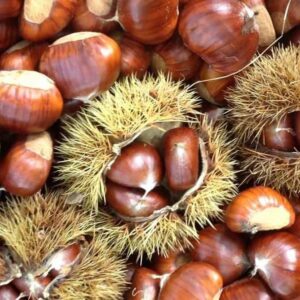
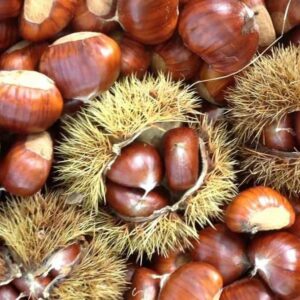
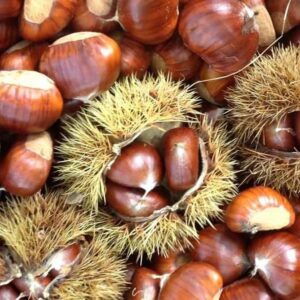
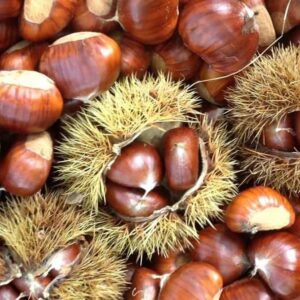
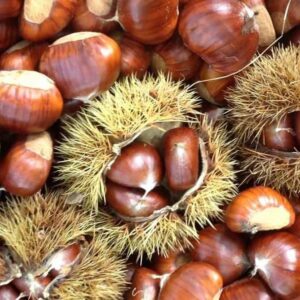
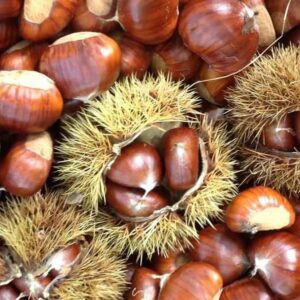
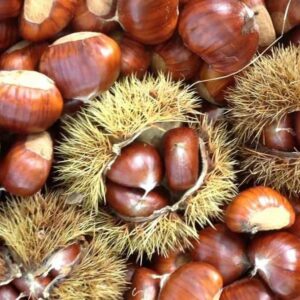
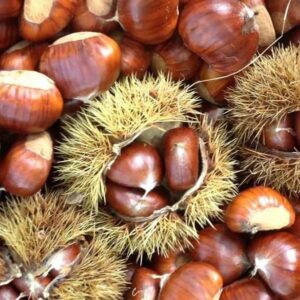
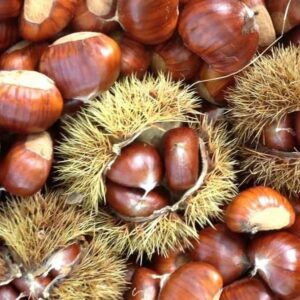
Marigoule chestnut tree, a disease-resistant hybrid producing large glossy brown-red nuts, harvested in October.
Chestnut trees
Chestnut trees
Chestnut trees
Chestnut trees
How should you choose a sweet chestnut tree?
Choosing a sweet chestnut tree involves much more than finding the cultivar that produces the largest nuts.
The soil, risk of ink disease, rootstock, long-term graft compatibility, pollen production, flowering period, harvest season and intended use of the crop must all be considered together.
Traditional cultivars of European sweet chestnut, Castanea sativa, and modern hybrids involving Asian chestnut species do not provide exactly the same qualities.
Traditional cultivars are often valued for their sweetness, dry-matter content, distinctive flavour, suitability for processing and adaptation to a particular region.
Modern hybrids were selected principally for productivity, large and uniform nuts, earlier cropping and improved tolerance of diseases such as ink disease.
Neither group is automatically superior in every respect.
A well-designed planting may combine a productive hybrid, a traditional cultivar possessing excellent eating quality and one or more genuine pollen-producing cultivars, provided that their flowering periods and growing requirements are compatible.
Sweet chestnut is not horse chestnut
The edible sweet chestnut belongs to the genus Castanea and the beech family, Fagaceae.
The horse chestnut belongs principally to the genus Aesculus and produces inedible conkers.
The two trees are not closely related despite sharing the word chestnut in English.
Edible sweet chestnuts are enclosed within exceptionally spiny burs, while horse chestnut fruits are normally contained within a less densely spined or sometimes nearly smooth husk.
Only correctly identified edible cultivars of Castanea should be planted for nut production.
Traditional cultivars shaped by European growing regions
European sweet chestnut has been cultivated for centuries across many parts of southern, western and central Europe.
Local populations gradually produced cultivars adapted to particular soils, altitudes, rainfall patterns, harvest periods and culinary traditions.
These traditional varieties generally belong to Castanea sativa and display considerable diversity in vigour, bud break, flowering, nut size, nut shape, internal partitioning and eating quality.
Some were selected for fresh consumption, while others were intended for drying, milling into flour, purée, confectionery or the production of whole candied chestnuts.
Maximum nut size was not always the principal selection criterion.
Sweetness, texture, storage behaviour, dry-matter content and ease of peeling could be substantially more important.
The principal weakness of many European cultivars is their susceptibility to ink disease when grown on a sensitive Castanea sativa seedling rootstock.
They can also be affected by chestnut blight, although susceptibility varies according to cultivar, climate and growing conditions.
Why were hybrid chestnut cultivars developed?
Ink disease, caused principally by species of Phytophthora, has caused severe decline and death in European chestnut orchards.
The organisms attack the roots and root collar, progressively restricting the tree’s ability to absorb water and nutrients.
Japanese chestnut, Castanea crenata, evolved in the presence of these pathogens and generally possesses greater tolerance than European sweet chestnut.
Breeders therefore crossed Japanese and European chestnuts in an attempt to combine the nut quality of Castanea sativa with the disease tolerance of Castanea crenata.
Several important Euro-Japanese hybrids were selected in France during the twentieth century.
Marigoule, Marsol, Maraval, Précoce Migoule and Bouche de Bétizac form part of this breeding history.
More recent programmes also use Chinese chestnut, Castanea mollissima, as a source of disease resistance, climatic adaptation and genetic diversity.
Evaluating a new chestnut selection requires many years because its longevity, graft compatibility, root behaviour and response to different soils cannot be judged from its first crops alone.
A hybrid chestnut is not a genetically modified organism.
It results from sexual crossing between compatible species of the genus Castanea, followed by selection and vegetative propagation of the chosen individual.
Traditional cultivars and modern hybrids: compare them without oversimplifying
Advantages of traditional European cultivars
Old cultivars of Castanea sativa frequently possess high dry-matter content, pronounced sweetness and a distinctive regional flavour.
Some are especially suitable for drying, flour, confectionery and preparations in which richness and texture are more important than maximum nut size.
A well-adapted local variety may also perform exceptionally well within the climate and soil in which it was selected.
This local adaptation can be more useful than theoretical resistance observed under completely different growing conditions.
The diversity of their flowering periods and male fertility can also make traditional cultivars useful pollinators, provided that they release viable pollen while the female flowers of the main cultivar are receptive.
Limitations of traditional cultivars
Traditional varieties can enter production more slowly and produce less uniform nuts than hybrids selected for the fresh market.
Some also produce a greater proportion of internally divided nuts that are difficult to peel and unsuitable for processing as complete kernels.
The principal concern remains susceptibility to ink disease, particularly where the cultivar is grafted onto a sensitive European chestnut seedling in moisture-retentive or poorly drained soil.
Grafting an old cultivar onto a tolerant hybrid rootstock can improve security, but compatibility must be documented.
Normal growth during the first years does not exclude the possibility of delayed graft incompatibility.
Advantages of Euro-Japanese hybrids
Many hybrids begin cropping relatively young and produce large, uniform nuts suited to the fresh market.
Their vigour and productivity can create more regular orchards and simplify commercial harvesting.
They generally possess better tolerance of ink disease than pure European cultivars.
Some also show improved behaviour towards chestnut blight, although they are not completely immune.
Bouche de Bétizac, for example, was selected for early cropping, productivity and large fruit.
Marsol and Maraval have become particularly important as rootstocks, although both can also produce edible nuts.
Limitations of hybrid cultivars
Large nut size does not automatically indicate superior flavour.
Some hybrids possess higher water content, lower sweetness and more delicate storage behaviour than traditional chestnuts rich in dry matter.
Internal partitioning or the development of several embryos can also occur in large-fruited hybrids.
This reduces their suitability for preparations requiring one complete peeled kernel.
Hybrids are not necessarily more tolerant of frost, dry soil or every European climate.
Some begin growth early, require deep fertile soil or show particular susceptibility to chestnut gall wasp or another pest.
Male fertility is also extremely variable.
Several modern cultivars produce little or no useful pollen and must be planted with genuine pollinators.
Chestnut or marron: what does the distinction mean?
The edible marron used in continental European horticulture is not the fruit of the horse chestnut tree.
It is an edible sweet chestnut produced by a cultivar of the genus Castanea.
In French and European chestnut production, the word marron generally describes a cultivar producing a high proportion of nuts with one undivided kernel.
The inner skin does not penetrate deeply enough to divide the kernel into several sections.
This characteristic simplifies peeling and allows the production of whole candied chestnuts and similar confectionery.
A cultivar producing exceptionally large nuts is not necessarily a good marron-type cultivar when its kernels are frequently divided.
For roasting or boiling at home, flavour, texture and ease of peeling may matter more than the commercial classification.
Male fertility is essential when choosing pollinators
A sweet chestnut tree carries separate male and female flowers on the same plant, but this does not mean that it will crop reliably alone.
The species strongly favours cross-pollination and self-pollination normally gives poor results.
Planting two different cultivar names is not sufficient by itself.
Their flowering periods must overlap and at least one cultivar must release viable pollen in sufficient quantity.
Chestnut cultivars are sometimes classified according to the length and development of their stamens.
Long-stamen cultivars generally produce abundant pollen.
Short-stamen cultivars produce much less, while astaminate cultivars possess no functional stamens and are effectively male-sterile.
Bouche de Bétizac, for example, should not be considered an effective pollinator.
Marigoule produces pollen but should not be planted as one genetically uniform block without complementary cultivars.
Marsol and Maraval can provide useful pollen where their flowering periods correspond, but accidental rootstock shoots do not constitute a properly designed pollination strategy.
How many chestnut cultivars should be planted?
For dependable production, plant at least two genetically different and compatible cultivars.
In practice, three cultivars are frequently safer because they provide a broader period of pollen release and female receptivity.
Where the principal commercial cultivar produces no useful pollen, at least one genuine pollen-producing variety must be included deliberately.
In a larger orchard, distribute pollinating trees throughout the planting rather than placing them all at one end.
Chestnut pollen is transported by wind and insects, but pollen density decreases with distance and can be disrupted by terrain, woodland and buildings.
An unidentified chestnut growing in the surrounding landscape may contribute pollen but should not replace a documented planting plan.
Its flowering period, genetic identity and male fertility may be unsuitable.
The rootstock is a decisive part of the tree
The rootstock influences soil adaptation, vigour, tolerance of ink disease, response to frost and compatibility with the grafted cultivar.
It is not a neutral support beneath the selected variety.
Unlike apples, chestnuts do not have a simple and fully standardised range of dwarfing, semi-vigorous and vigorous rootstocks.
Rootstock choice is principally a question of soil, disease risk and graft compatibility.
Castanea sativa seedling rootstock
European chestnut seedlings remain in use, particularly in traditional chestnut regions and soils where they have performed successfully for generations.
They generally produce vigorous trees and often provide good graft affinity with traditional cultivars of the same species.
Every seedling is genetically different, so vigour, rooting pattern and disease behaviour are not completely uniform.
The principal disadvantage is susceptibility to ink disease.
In deep, healthy and naturally suitable chestnut soil, a European seedling can remain a useful choice.
In wet ground, after previous ink-disease losses or where Phytophthora pressure is suspected, it presents a substantially greater risk.
Marsol
Marsol is a clonally propagated Euro-Japanese hybrid widely used as a chestnut rootstock.
It provides a useful combination of vigour, tolerance of ink disease, reasonable cold behaviour and compatibility with many cultivars.
Marsol rootstock is more expensive to produce than an ordinary seedling because it must be multiplied vegetatively, but its greater uniformity and disease tolerance can justify the difference on vulnerable sites.
Compatibility is broad but not universal.
Some European cultivars perform poorly when grafted onto hybrid rootstocks, so each combination should be validated rather than assumed.
Marsol produces a vigorous tree and is not intended to create a compact garden chestnut.
Its tolerance of ink disease also does not permit successful planting in continuously saturated and oxygen-poor soil.
Maraval
Maraval is another Euro-Japanese hybrid used for its tolerance of ink disease.
It generally induces somewhat less vigour than Marsol, which can be useful in particular orchard systems.
Its compatibility with European cultivars is more limited and must be established before grafting.
It should not be selected solely because a slightly smaller tree is desired.
Maraval produces pollen and can contribute to orchard pollination, but this characteristic does not replace the deliberate inclusion of compatible cultivars.
Marlhac and Ferosacre
Marlhac and Ferosacre are also hybrid selections developed partly for improved tolerance of ink disease.
They have been used as rootstocks but remain much less widespread than Marsol.
Their vigour, climatic behaviour and compatibility are not identical.
Tolerance of Phytophthora does not prove suitability for every cultivar, soil or region.
New rootstock selections
Current breeding work aims to broaden a rootstock range that has become heavily dependent on Marsol.
Programmes assess new interspecific hybrids and individuals of Castanea sativa showing natural tolerance of ink disease.
Evaluation must include more than survival after exposure to the pathogen.
Long-term graft compatibility, induced vigour, ease of nursery propagation, behaviour under drought and excess water and mechanical stability must also be examined.
Some hybrid cultivars can grow on their own roots
Several hybrid chestnuts can be propagated successfully by layering, cuttings or tissue culture.
The fruiting cultivar and root system then belong to the same clone and there is no graft union.
This avoids incompatibility between the rootstock and scion and can be useful for hybrids such as Marigoule when they are propagated correctly.
An own-root hybrid should not be treated automatically as a universal rootstock.
Its roots retain the characteristics and limitations of that cultivar, including vigour, water requirements, soil adaptation and actual level of tolerance to ink disease.
Traditional cultivars that root poorly normally still require grafting to reproduce the variety accurately.
Never assume long-term graft compatibility
Botanical proximity between two chestnuts does not guarantee permanent compatibility.
Some grafts begin growing normally and then develop an irregular union, restricted sap movement, mechanical weakness or progressive decline several years later.
Traditional European cultivars are frequently most compatible with Castanea sativa seedlings, while certain hybrid rootstocks accept only part of the European cultivar range.
Marsol became widely used partly because it combines useful disease tolerance with relatively broad compatibility.
Relatively broad does not mean universal.
Where a combination is poorly documented, choose a proven cultivar–rootstock pairing rather than judging compatibility from the successful growth of the first season.
Ink disease is both a root and soil problem
Chestnut ink disease is caused principally by organisms of the genus Phytophthora.
They infect the roots and root collar, progressively reducing water uptake and causing weak growth, yellow foliage, canopy dieback and eventually death.
Dark exudation can sometimes appear near the base of an affected tree, giving the disease its traditional name.
Compacted soil and prolonged saturation create highly favourable conditions for the pathogen.
A tolerant rootstock is valuable but cannot compensate for roots kept continuously without oxygen.
Do not plant a chestnut at the bottom of a basin filled with loose compost.
In heavy ground, improving general water movement, planting slightly above the surrounding level and selecting a suitable rootstock are more useful than creating one isolated pocket of soft substrate.
No cultivar or rootstock should be described as invulnerable to every species and strain of Phytophthora.
Chestnut blight enters through wounds
Chestnut blight is caused by Cryphonectria parasitica.
The fungus normally enters through wounds and cracks in the bark and forms cankers that can interrupt sap flow and kill the branch or trunk above the lesion.
Asian chestnut species generally possess greater tolerance than European sweet chestnut because they evolved alongside the pathogen.
This improved tolerance encouraged their use in breeding, but hybrid cultivars can still develop serious cankers.
Damage from brushcutters, mowers, poor pruning, broken branches and weak graft unions creates entry points.
Protecting the trunk and developing a strong framework progressively are therefore as important as cultivar choice.
Hypovirulent strains of the fungus can slow canker development and allow partial healing in certain regions, but this phenomenon should not lead to neglect of infected trees.
Hybrid does not mean resistant to every problem
Tolerance of ink disease or chestnut blight does not predict resistance to chestnut gall wasp, nut rots, chestnut weevils, codling-type moths or spring frost.
Susceptibility to chestnut gall wasp varies greatly between cultivars and can differ between genetically related hybrids.
Some formerly valuable cultivars became less attractive after the pest arrived in their growing region.
Chestnut weevil and moth larvae develop inside the nut and destroy the kernel.
Frequent harvesting, removal of infested nuts and appropriate management of the soil beneath the trees reduce the number of larvae completing their life cycle.
Each cultivar must therefore be considered through several independent characteristics rather than receiving one general resistance label because it is a hybrid.
Which soil genuinely suits sweet chestnut?
Sweet chestnut prefers deep, aerated soil that remains adequately moist during growth and drains effectively during winter.
It performs particularly well on acidic or neutral soils derived from siliceous rock, including granite, schist and sandstone.
Active lime is a major limitation.
In alkaline soil or ground rich in calcium carbonate, chestnut trees can develop severe chlorosis, weak growth and progressive decline.
A hybrid rootstock does not transform chestnut into a tree adapted to strongly calcareous soil.
Clay soils are not automatically unsuitable, but their structure and drainage must be assessed carefully.
A well-structured clay situated on a slope behaves very differently from compact soil in which water remains for several weeks.
Before planting, a soil pH test and, where necessary, analysis of active lime are more useful than adding a small quantity of acidic compost to the planting hole.
Water is required to fill large chestnuts
A mature chestnut can survive a dry period through its extensive root system, but drought during nut development reduces size and can cause premature bur drop.
Modern hybrids selected for large fruit cannot express their potential in shallow soil with little water reserve.
Their advertised productivity does not remove their need for adequate soil moisture.
Watering is particularly important during the first years while the root system is still exploring the surrounding ground.
Apply enough water to moisten the active root zone without keeping the root collar continuously wet.
A mulch reduces evaporation and grass competition but should remain away from the trunk.
Dense grass immediately around a young tree can prolong establishment and substantially reduce shoot growth.
Planting a young chestnut tree
Dormant bare-root trees should be planted between leaf fall and early spring whenever the soil is neither frozen nor waterlogged.
Container-grown plants can be installed over a longer season but require careful watering.
Prepare a broad area of ground after the soil has drained sufficiently to form a crumbly structure.
Remove couch grass, bindweed and other perennial weeds before planting.
Do not create a narrow hole filled entirely with potting compost or fresh manure.
Backfill mainly with the original soil, improved over a broad area where necessary.
Keep the graft union clearly above the final soil level.
Planting too deeply can expose the root collar and graft union to prolonged moisture and increase the risk of decay.
Water thoroughly after planting and support the tree where wind movement could damage new roots or the graft union.
Protect the trunk from rabbits, hares, deer, livestock and mechanical damage.
Chestnut trees remain large trees
A grafted sweet chestnut is not a naturally compact fruit tree.
Depending on cultivar, rootstock and soil, the mature tree can exceed 15 metres and develop an exceptionally broad crown.
Even a rootstock described as somewhat less vigorous than Marsol does not produce a dwarf tree comparable with an apple on a dwarfing rootstock.
Allow generous spacing from buildings, neighbouring trees, boundaries and overhead cables.
Within a garden or small orchard, approximately 10 to 12 metres between permanent trees is often a more realistic starting point than close fruit-tree spacing.
More space may be required for exceptionally vigorous combinations on fertile soil.
Repeated severe pruning is not a sustainable method of confining a large chestnut within a small garden.
Training and pruning a sweet chestnut
During the first years, form a strong central leader or a well-balanced framework suited to the intended orchard system.
Select main branches with broad attachment angles and remove competing leaders before they create weak forks.
Correcting the structure while branches remain small prevents the need for major wounds later.
Do not raise the crown too rapidly.
Temporary lower branches contribute to trunk growth and protect young bark before being removed progressively.
Once the framework is established, pruning should remain moderate.
Remove dead, broken, diseased and badly crossing branches.
Avoid topping or repeatedly shortening every shoot.
Large wounds provide potential entry points for chestnut blight and wood-decay fungi.
Protect the trunk carefully during mowing and vegetation management because brushcutter damage can become more serious than the absence of routine pruning.
Chestnut harvest season
Depending on cultivar and climate, harvesting can begin near the end of September and continue for several weeks during October.
Combining early, mid-season and late cultivars extends the harvest and reduces the quantity of nuts falling during one short period.
Early nut maturity can be valuable in a cool region, but an early cultivar may also begin growth or flower early and face greater spring-frost exposure.
Earliness should therefore be considered at several stages of the tree’s annual cycle.
The calendar is intended principally for comparing cultivars rather than predicting one exact date for every orchard.
Harvest periods are indicative and may vary according to the region, exposure, rootstock and the season’s weather conditions.
Recognising mature chestnuts
Chestnuts are mature when the burs begin opening and the nuts fall naturally.
Do not attempt to pull firmly closed green burs from the tree and force the nuts out prematurely.
Immature nuts contain more water, possess less flavour and store poorly.
Harvesting normally takes place from the ground, either by collecting naturally fallen nuts or by using suitable orchard equipment.
Wear thick gloves when handling burs because their spines penetrate ordinary gardening gloves easily.
Collect the crop frequently.
Chestnuts contain substantially more water than walnuts or hazelnuts and deteriorate rapidly when left on wet soil.
Frequent collection also reduces losses to rodents, wild boar, deer and nut-feeding insects.
Chestnuts behave more like fresh fruit than dry nuts
Fresh chestnuts contain a high proportion of water and remain physiologically active after harvest.
This explains their susceptibility to mould, fermentation and dehydration.
Sort the crop quickly and remove nuts that are perforated, abnormally light, soft, blackened or visibly mouldy.
Cool storage slows deterioration and limits moisture loss.
Very large hybrid nuts frequently possess high water content and may be more delicate to store than traditional varieties rich in dry matter.
For long-term preservation, chestnuts can be peeled and frozen, processed into purée or dried and milled.
The cultivar should therefore be chosen according to the intended use rather than the appearance of the fresh nut alone.
Which chestnut cultivar should you choose?
For rapid production of large nuts
A productive hybrid entering cropping relatively young is generally the most suitable option.
It still requires compatible pollination, a suitable root system, deep soil and enough water during nut development.
For flavour and processing
A traditional European cultivar can provide sweeter flesh, higher dry-matter content and superior suitability for drying, flour or regional preparations.
On a site exposed to ink disease, it should be combined with a proven and compatible tolerant rootstock.
For whole peeled marron-type kernels
Choose a cultivar with a low proportion of internally divided nuts and good peeling characteristics.
Maximum nut size does not prove suitability for confectionery.
For a humid site or ground exposed to ink disease
A tolerant hybrid rootstock such as Marsol may substantially improve planting security.
The ground must still drain correctly.
Where the site remains saturated or is strongly calcareous, reconsidering the species is more sensible than expecting one rootstock to solve every problem.
For a cold or short-season region
Choose a cultivar whose nuts mature sufficiently early, but also examine bud-break and flowering dates.
A late-leafing cultivar with an early nut harvest can provide a particularly useful combination where spring frost occurs.
For planting several trees
Combine cultivars with overlapping flowering periods, viable pollen and complementary harvest dates.
Do not select several male-sterile hybrids and assume that different names guarantee pollination.
Frequently asked questions about sweet chestnut trees
Are two chestnut trees required?
Yes, and three different cultivars are often safer. They must flower together and at least one must produce abundant viable pollen.
Can one chestnut tree pollinate itself?
Self-pollination normally gives poor results. Chestnut trees strongly favour cross-pollination between genetically different cultivars.
Will any two cultivars pollinate one another?
No. Flowering periods must overlap and at least one cultivar must possess functional male flowers producing viable pollen.
Is Bouche de Bétizac a good pollinator?
No. It is effectively male-sterile and requires pollen from another suitable cultivar.
Is Marigoule self-fertile?
No. It produces pollen but should not be planted alone or as one uniform block without complementary cultivars.
Is a hybrid chestnut always better than a traditional cultivar?
No. Hybrids are often earlier to crop, more productive and more tolerant of ink disease. Traditional cultivars can provide sweeter, more distinctive fruit and better suitability for drying or processing.
Is a marron the fruit of a horse chestnut?
No. An edible marron is a sweet chestnut cultivar producing a high proportion of undivided kernels. Horse chestnut conkers are not edible.
Why are some large chestnuts difficult to peel?
Nut size does not prevent internal partitioning. The inner skin may penetrate deeply and divide the kernel into several sections.
Which rootstock is best for a chestnut tree?
There is no universal answer. Marsol provides a widely used compromise between disease tolerance, vigour and compatibility, while a Castanea sativa seedling can remain useful in suitable disease-free soil.
Why is Marsol more expensive than a seedling rootstock?
Marsol must be propagated vegetatively to preserve the clone, while seedlings are produced more simply from nuts. Marsol also provides greater uniformity and useful tolerance of ink disease.
Does Marsol produce a small chestnut tree?
No. Marsol is vigorous and should not be considered a dwarfing rootstock.
Is Marsol compatible with every cultivar?
No. Its compatibility is broad but not universal. Each cultivar–rootstock combination should be verified.
Can a traditional cultivar be grafted onto a hybrid rootstock?
Often yes, but compatibility must be documented. Delayed incompatibility can appear several years after apparently successful establishment.
Can a chestnut grow on its own roots?
Some hybrids can be propagated by layering, cuttings or tissue culture. Many traditional European cultivars still require grafting to reproduce them reliably.
Is a hybrid chestnut immune to ink disease?
No. The best hybrids possess greater tolerance, but permanent waterlogging, high pathogen pressure and unfavourable soil conditions can still cause decline.
What are the symptoms of ink disease?
Symptoms include weak growth, yellow leaves, thinning of the crown, branch dieback and progressive decline associated with damaged roots and the root collar.
Can a chestnut tree grow in clay soil?
Only where the clay remains structured, aerated and adequately drained. Compact soil saturated during winter creates a high risk of root suffocation and ink disease.
Does sweet chestnut tolerate calcareous soil?
Poorly. Active lime and high pH can cause severe chlorosis and weak growth regardless of the rootstock.
Can acidic compost make calcareous soil suitable?
No. A small amended planting hole cannot permanently alter the chemistry of the surrounding soil explored by a large tree.
Do chestnut trees require watering?
Young trees require regular water during establishment. Mature trees also need sufficient soil moisture during nut filling to produce large and well-developed chestnuts.
How large does a chestnut tree become?
It remains a large tree and can exceed 15 metres in favourable conditions. It requires an orchard, park or genuinely large garden rather than a restricted space.
When are chestnuts ready to harvest?
They are mature when the burs open and the nuts fall naturally. Collect them frequently because fresh chestnuts deteriorate rapidly on wet ground.
Why do chestnuts become mouldy so quickly?
They contain much more water than walnuts or hazelnuts and remain physiologically active after harvest. Cool storage and rapid sorting are essential.
How should chestnuts be stored?
Keep sound nuts cool and inspect them regularly. For longer storage, peel and freeze them or dry them for flour and other processing.
Why does my chestnut flower without producing nuts?
The tree may lack a compatible pollinator, produce little viable pollen, flower at a different time from neighbouring trees or experience unfavourable weather during flowering.
Can a chestnut tree be kept small through pruning?
Not sustainably. Severe pruning stimulates strong regrowth, creates large wounds and increases the risk of chestnut blight and structural weakness.