
Pre-orders are open No payment today. Stock will be checked during the inventory in early August, then you will receive a payment link for the available trees.
Choosing the right apricot tree

In cool and humid regions, successful apricot growing depends mainly on flowering time, the planting position and the variety's tolerance of bacterial canker and brown rot. Also compare self-fertility and harvest season before choosing.

View harvest calendar

Apricot trees

Apricot trees

Luizet

A traditional French apricot variety producing large juicy fruit with sweet-sharp flavour and good cold tolerance.
From 33,75 

Apricot trees

Manera

Manera is an apricot variety adapted to the cooler climates of northern Europe.
From 33,75 

Apricot trees

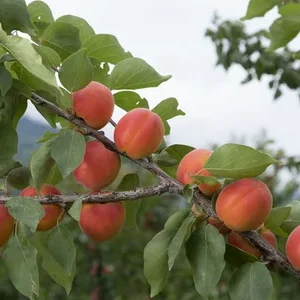
Mediva

Mediva apricot tree, a late-flowering self-fertile variety with aromatic bicoloured fruit, harvested in late July.
From 33,75 

Apricot trees

Mia

Mia is an apricot variety well-suited to growing in the cooler climates of northern Europe.
From 33,75 

Apricot trees

Pêche de Nancy

A traditional self-fertile apricot variety producing large juicy fruit with fine flesh and excellent flavour.
From 29,75 

Apricot trees

Polonais

Polonais is one of the most cold-hardy of all apricots, and a good choice for growing in northern Europe.
From 33,75 

Apricot trees

Precoce de Saumur

Precoce de Saumur is an early-season apricot with good cold-hardiness.
From 33,75 

Can apricots be grown in cool climates?

Apricot trees can withstand considerable winter cold, but their early flowering makes fruit production less reliable than that of apple or pear trees. A tree may remain perfectly healthy after a cold winter yet produce no fruit if its blossom is damaged by a late spring frost.

To improve the chances of a successful crop, several factors must be considered together: a sufficiently late-flowering variety, a carefully chosen position, well-drained soil and a tree that remains healthy under humid conditions.

No variety can guarantee a crop every year in an area regularly affected by late frosts. Some cultivars are nevertheless much more reliable than early-flowering or poorly adapted varieties.

The main criteria when choosing an apricot tree

Flowering as late as possible

Flowering time is one of the first characteristics to consider. A late-flowering variety reduces the likelihood of the blossom opening during the earliest periods of spring frost.

Late flowering does not remove the risk completely. When several cold nights occur after growth has started, even a well-chosen variety may lose some or all of its flowers.

Good tolerance of bacterial canker and brown rot

In a humid climate, the health of the tree is just as important as the frost resistance of its blossom. An apricot tree weakened by cankers, dieback or repeated brown rot infections will flower and crop less consistently.

When reliable information is available, we indicate any particular disease tolerance on our product pages. A variety with good tolerance of wood diseases or fruit rot may be a more suitable choice than one selected solely for the size or appearance of its fruit.

Self-fertility and pollination

Many traditional apricot varieties are self-fertile, but this is not true of every modern cultivar. Some are self-sterile or crop much more heavily when planted near another compatible apricot tree.

Self-fertility and flowering time should therefore be checked before planting a single isolated tree. A self-sterile variety requires another compatible apricot that flowers at the same time.

Ripening period

Apricots ripen during summer, but harvest dates can differ by several weeks between varieties. Combining early, mid-season and late cultivars extends the picking period and avoids exposing every crop to the same spell of wet weather.

Where should an apricot tree be planted?

Apricot trees prefer a bright, warm and well-ventilated position. However, it is important to distinguish between the warmth needed to ripen the fruit and excessive winter heat that may cause the tree to start growing too early.

Avoid low-lying areas where cold air collects on still nights. A gentle slope or an open position that allows cold air to drain away is generally safer than a sheltered hollow surrounded on all sides.

Planting close to a wall can protect the tree from wind and improve fruit ripening. However, a very warm south-facing wall may bring growth and flowering forward, increasing the blossom’s exposure to late frosts.

In colder regions, a bright position that does not warm excessively quickly at the end of winter may sometimes be safer than a location exposed to intense sunshine from the first mild days.

Well-drained soil is essential

Apricot trees do not tolerate soil that remains waterlogged during winter. Prolonged moisture around the roots and root collar weakens the tree and encourages canker and dieback.

In heavy soil, the tree should not be planted at the bottom of a hole filled with compost or potting soil. It is better to improve drainage over a wider area, plant slightly raised when necessary and avoid keeping the soil permanently wet around the trunk.

The soil must nevertheless be able to supply sufficient moisture during summer. A newly planted apricot tree should not be allowed to suffer severe drought while its root system is becoming established.

Bacterial canker and apricot dieback

Bacterial canker can cause sunken lesions, gumming and the death of shoots or entire branches. Infection is favoured by wounds and by cold, wet conditions.

Avoid damaging the trunk, allowing branches to break under the weight of fruit or making unnecessary large pruning cuts. A tree that is carefully trained during its first years will require fewer major interventions later.

Affected branches should be removed back to healthy wood. Tools must be kept clean and infected material removed from the orchard. A tolerant variety, a well-drained position and pruning carried out under suitable conditions greatly reduce the risk of dieback.

Blossom wilt and brown rot

Brown rot fungi can infect flowers and young shoots in spring, before causing the fruit to rot as it approaches maturity. The risk increases when flowering or harvest coincides with a period of frequent rain.

Infected fruit turns brown and may develop small rings or patches of spores. These fruits should not be left on the tree, as mummified fruit remains an important source of infection for future seasons.

An open, well-ventilated crown, the removal of infected wood, the collection of diseased fruit and the prevention of unnecessary wounds all help to maintain a healthier tree.

When and how should an apricot tree be pruned?

Apricot trees heal poorly when pruned during cold and wet weather. Large winter cuts can provide entry points for bacteria and fungi responsible for canker and dieback.

It is preferable to train the tree gradually and prune during dry weather while it is actively growing, generally in summer or immediately after harvest. The wounds then have more time to begin healing before the return of autumn rain.

Pruning should remain moderate: remove dead or diseased wood, thin out crossing branches and maintain a sufficiently open crown so that the foliage dries quickly after rain.

Thin the fruit to protect the tree

When the blossom escapes frost, an apricot tree may set a very heavy crop. Overcropping produces smaller fruit and can cause branches to break.

Thinning improves fruit size and distribution while reducing the risk of branch damage that could later become an entry point for wood diseases.

Extend the apricot harvest season

The earliest varieties ripen several weeks before the latest cultivars. By combining different ripening periods, it is possible to harvest apricots over a much longer part of the summer.

This is also useful in humid climates, as not every variety will be exposed to the same spell of rain when the fruit is most vulnerable to brown rot and splitting.

View the apricot harvest calendar

Harvest periods are indicative and may vary according to the region, exposure, rootstock, crop load and weather conditions during the season.

Which rootstock should be chosen for an apricot tree?

The rootstock influences tree vigour, soil adaptation, tolerance of moisture and compatibility with the grafted variety. It should be selected primarily according to the soil rather than solely according to the desired final size of the tree.

Some variety and rootstock combinations can develop incompatibility that only becomes visible after several years. It is therefore important to use proven combinations suited to the intended growing conditions.

Which form of apricot tree should be chosen?

An apricot tree can be grown as a free-standing tree or trained against a wall. A trained form makes protection, harvesting and vigour management easier, but requires regular maintenance.

A maiden tree allows the grower to build a form suited to the available space. A tree that has already been shaped saves time, but its future size must still be taken into account before planting.

Frequently asked questions about apricot trees

Why does my apricot tree flower but produce no fruit?

The most common causes are frost during or after flowering, poor pollination, wet weather reducing pollinating insect activity or a variety that is poorly suited to the local climate.

Do I need to plant two apricot trees?

It depends on the variety. Many apricot trees are self-fertile, but some cultivars are self-sterile or crop better when planted with a compatible pollinator.

What is the best position for an apricot tree?

Choose a bright, well-ventilated position protected from cold winds, but avoid low-lying ground where cold air collects. The soil must be properly drained.

Can an apricot tree be planted against a south-facing wall?

A warm wall improves ripening and provides shelter from the wind, but it may also bring flowering forward. In areas affected by late frost, an exceptionally warm position at the end of winter is therefore not always the safest choice.

When should an apricot tree be pruned?

Avoid heavy winter pruning. Work during dry weather while the tree is actively growing, generally in summer or immediately after harvest.

Why is gum coming from the branches of my apricot tree?

Gumming may follow a wound, branch breakage, environmental stress or a canker infection. It is a symptom rather than a single disease. Inspect the condition of the wood and look for any dead or sunken areas.

Can an apricot tree crop every year in a cool climate?

An annual crop cannot be guaranteed because of the risk of spring frost. Choosing a late-flowering variety, a suitable position and a healthy tree can nevertheless greatly increase the frequency of productive years.