Cornelian cherry trees
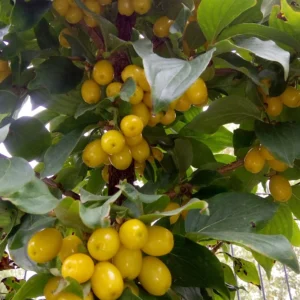
Alosza Cornelian cherry tree, an early Ukrainian yellow variety with sweet, mild fruit ripening from early August.
Cornelian cherry trees
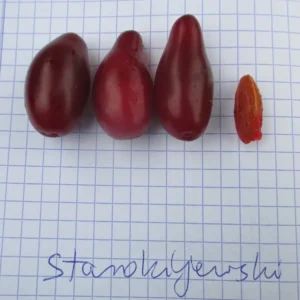
Ekzotichese Cornelian cherry tree, with very large pear-shaped fruits for fresh eating and preserves, ripening in early September.
Cornelian cherry trees
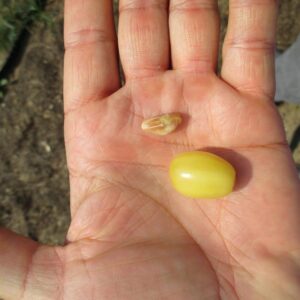
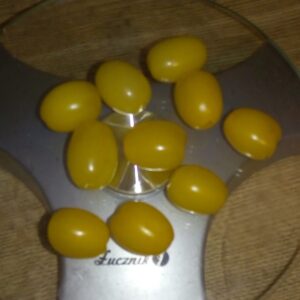
Flava Cornelian cherry tree, an early yellow-fruited variety with mild, tasty fruit suitable for many uses.
Cornelian cherry trees
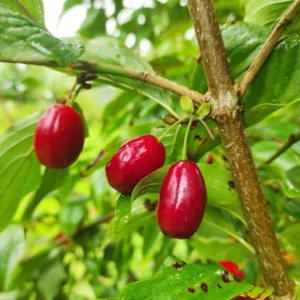
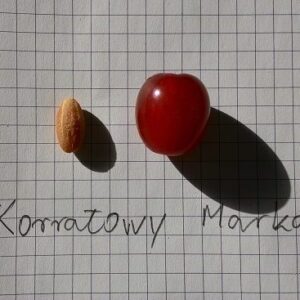
Korralowij Marka Cornelian cherry tree, a productive Ukrainian variety with sweet red fruit ripening in mid-August.
Cornelian cherry trees
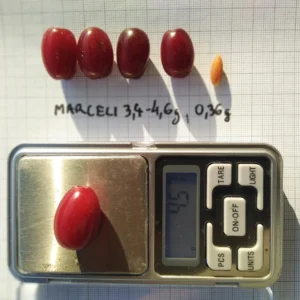
Marceli Cornelian cherry tree, a productive variety with sweet, aromatic red oval fruit, ripening from late August to early September.
Cornelian cherry trees
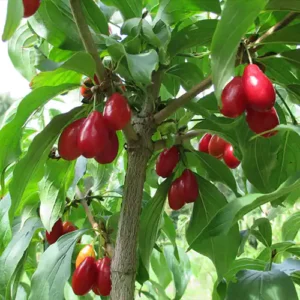
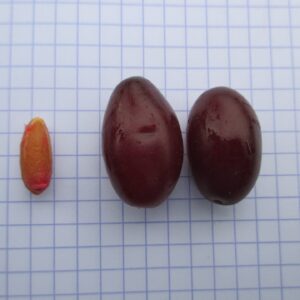
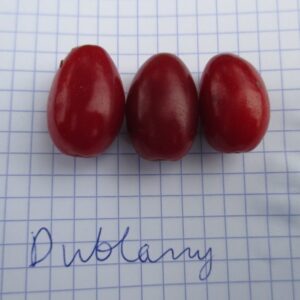
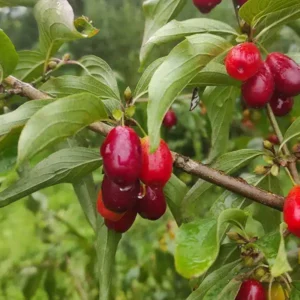
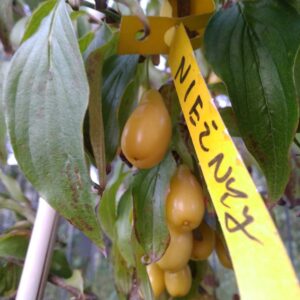
Matador Cornelian cherry tree, a French variety with large dark red, juicy oval fruits, ripening gradually in early September.
Cornelian cherry trees
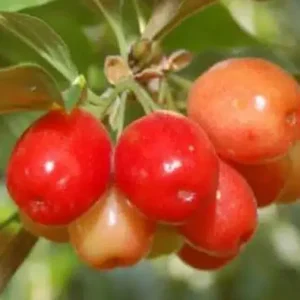
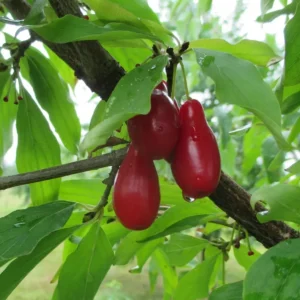
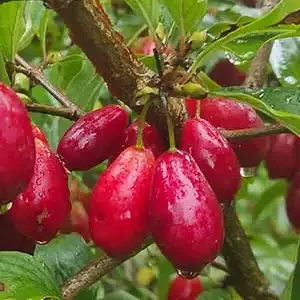
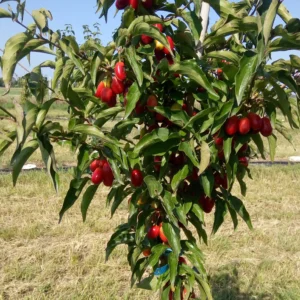
Panchavero Cornelian cherry tree, a Bulgarian variety with large red cylindrical fruits, ripening gradually in early September.
Cornelian cherry trees
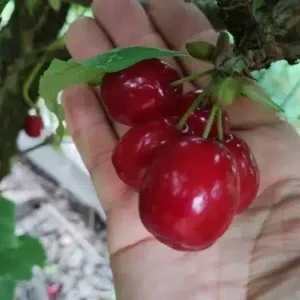
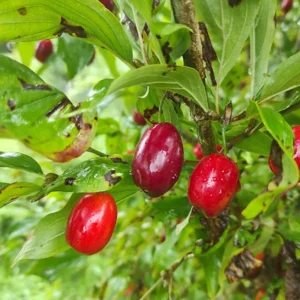
Shan Cornelian cherry tree, a Bulgarian variety with large dark red, juicy spherical fruits, ripening in early September.
Cornelian cherry trees
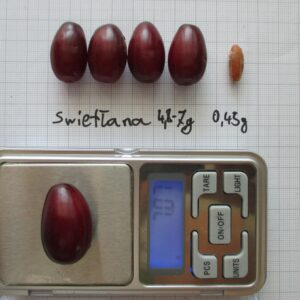
Swietlana Cornelian cherry tree, with dark red, sweet fruits for fresh eating and preserves, ripening evenly in late August.
Cornelian cherry trees
Is Cornelian cherry a genuine fruit tree?
The Cornelian cherry, Cornus mas, is a large deciduous shrub or small tree native to parts of Europe and western Asia and cultivated for its fruit for many centuries.
Its fruit is an elongated drupe containing one hard stone. Despite the English name and its occasional resemblance to a tart cherry, it is not botanically related to cherry trees of the genus Prunus.
Wild plants and unselected seedlings generally produce relatively small, acidic and variable fruit.
Breeding and selection programmes, particularly in central and eastern Europe, have produced cultivars with substantially larger fruit, a greater proportion of flesh, higher sugar levels and a wide range of ripening periods.
Cornelian cherry also possesses considerable ornamental value.
Its clusters of small yellow flowers appear before the leaves, sometimes near the end of winter, while the dense foliage and increasingly decorative bark provide interest later in the year.
The plant can be trained as a small fruit tree, maintained as a large multi-stemmed shrub or included within a productive hedge.
Plant two different cultivars for reliable crops
The flowers of Cornus mas contain both male and female reproductive organs.
There are therefore no separate male and female Cornelian cherry trees that must be paired.
Hermaphrodite flowers do not necessarily provide effective self-fertilisation.
Cornelian cherry is generally self-incompatible or only weakly self-fertile, meaning that pollen from the same genetic individual does not fertilise its flowers reliably.
For regular cropping, plant two genetically different cultivars whose flowering periods overlap.
Two trees grafted with the same cultivar are clones and do not form a genuine cross-pollinating pair.
A seedling is genetically different and may pollinate a grafted cultivar, but planting two named cultivars is normally preferable because both trees then produce fruit of known size, flavour and ripening season.
Where space permits, three cultivars provide additional flowering overlap and can extend the harvest period.
Very early flowers with useful frost tolerance
Cornelian cherry flowers before the leaves and often begins blooming when few other fruit trees are active.
This exceptionally early flowering might suggest that crops are lost regularly to frost, but the flower buds and reproductive structures possess useful cold tolerance.
Flowering is also spread over time.
Not every flower within one cluster or every cluster on the tree opens simultaneously.
A frost may therefore damage part of the blossom without necessarily destroying the complete potential crop.
The extended flowering period improves climatic security but also contributes to a progressive ripening season.
Several harvesting rounds may be required because fruit on the same tree does not always mature at the same time.
Pollination depends on insects active during the first mild days of late winter and early spring.
Planting compatible cultivars close together and maintaining other early-flowering plants nearby encourages more regular fruit set.
Grafted cultivar or seedling Cornelian cherry?
A seedling creates a new and unpredictable tree
A Cornelian cherry grown from a stone is genetically different from the tree that produced the fruit.
Its fruit size, colour, acidity, ripening season, stone size and proportion of edible flesh cannot be predicted accurately.
A seedling can eventually produce excellent fruit, but it may also produce small, highly acidic fruit containing proportionally large stones.
This genetic diversity is valuable for breeding but represents considerable uncertainty for a gardener seeking fruit of known quality.
Seedlings also remain juvenile for longer and generally require several additional years before their first meaningful crop can be assessed.
Grafting reproduces the selected cultivar accurately
A grafted Cornelian cherry preserves the genetic identity of the selected parent tree.
Its approximate harvest period, fruit colour, average size, flavour and flesh-to-stone ratio are therefore much more predictable.
Grafted plants also normally begin flowering and cropping considerably sooner than seedlings.
For dependable fruit quality and a shorter wait before harvest, plant two different grafted cultivars rather than two unidentified seedlings selected only for their price or vigour.
Important characteristics when comparing cultivars
Ripening season
The earliest cultivars can begin ripening during summer, while late selections may continue into September or early autumn.
Fruit maturity is rarely a major climatic limitation across northern and central Europe, although early cultivars benefit more consistently from warm and bright summer conditions.
Combining early, mid-season and late cultivars extends the harvest and prevents every fruit becoming soft and falling during the same short period.
Fruit size
Selected cultivars can produce fruit several times larger than ordinary wild Cornelian cherries.
Large fruit is easier and quicker to harvest and process, but total weight should not be considered in isolation.
A large fruit may also contain a proportionally large stone.
Flesh-to-stone ratio
The proportion of edible flesh in relation to the stone is often more useful than the total weight of the fruit.
For juice, jam, sauce and other processing, a slightly smaller but fleshy cultivar can provide a substantially higher useful yield.
A favourable flesh-to-stone ratio also makes fruit intended for fresh eating more pleasant.
Sugar, acidity and astringency
Cornelian cherries are naturally acidic and contain tannins.
Before full maturity, the fruit can be exceptionally firm, tart and astringent.
As it ripens, the acidity becomes less aggressive, the astringency decreases and the aroma becomes richer.
Cultivars still differ considerably at full maturity.
Some remain distinctly sharp and are particularly suitable for juice, syrup and jelly, while others become sweet, tender and pleasant to eat directly.
Fruit retention on the tree
Some cultivars remain attached for a useful period after becoming ripe.
Others fall rapidly as soon as the flesh begins softening.
Good retention simplifies selective hand picking for fresh consumption.
A cultivar that drops readily can still be harvested efficiently over a sheet or collecting net, but requires frequent collection to prevent crushing and fermentation on wet ground.
Concentrated or progressive ripening
Some cultivars mature over a relatively short period, while others continue ripening for several weeks.
Concentrated maturity is convenient when a substantial quantity of fruit is required for juice or preserves.
Progressive maturity extends fresh consumption but requires repeated harvesting rounds.
Red, dark purple and yellow Cornelian cherries
Cornelian cherries are not all bright red.
Cultivars can produce yellow, orange, scarlet, dark red, purple or almost black fruit at full maturity.
Dark-fruited cultivars normally create intensely coloured juice, syrup, jam and sauces and generally contain higher levels of anthocyanin pigments.
Yellow cultivars produce much paler preparations and can possess a mild and pleasant flavour when fully ripe.
Colour alone does not predict sugar, acidity, astringency or eating quality.
A ripe yellow cultivar will never become red.
Conversely, a red cultivar harvested while still orange or pale red will usually remain too immature and astringent for enjoyable fresh eating.
How can a fully ripe Cornelian cherry be recognised?
The final skin colour does not always correspond with eating maturity.
A Cornelian cherry can be completely red while remaining hard, exceptionally acidic and strongly astringent.
For fresh eating, the fruit should generally become softer, develop a more noticeable aroma and detach readily from its stalk.
On many cultivars, the best stage occurs shortly before natural fruit fall or when the first fully mature fruit begins dropping.
Do not expect every fruit on one branch to reach this stage simultaneously.
The extended flowering period means that several stages of maturity can occur together on the same tree.
Tasting remains the most reliable guide.
A ripe fruit retains refreshing acidity but no longer produces the intense drying sensation associated with an immature Cornelian cherry.
Harvest for fresh eating or processing
Fresh consumption
Fruit intended for eating directly should be harvested at complete maturity when it is tender, aromatic and substantially less astringent.
Its storage life is then naturally short.
A cultivar selected for sweetness, large fruit and a high proportion of flesh is much more suitable than an ordinary wild seedling collected from a hedge.
Jam, juice and syrup
Fruit intended for processing can be picked slightly firmer, especially when it must be transported or held for several days.
It then retains more acidity and withstands handling more successfully.
The stage of maturity has a major effect on the colour, texture and flavour of the finished preparation.
Fruit harvested too green introduces excessive astringency, while exceptionally soft fruit becomes difficult to sort and separate from the stones.
Harvesting over a sheet
Where mature fruit falls readily, spread a clean sheet or harvesting net beneath the tree.
A gentle movement of the branches releases the most advanced fruit without removing every immature Cornelian cherry.
Collect the crop promptly because soft fruit bruises easily and should not remain in contact with wet soil.
Cornelian cherry harvest season
Early cultivars can begin ripening during summer, while late varieties may continue into early autumn.
Actual dates vary according to cultivar, country, exposure, crop load, soil moisture and seasonal temperatures.
The calendar is intended principally for comparing cultivars rather than predicting one exact harvest date for every garden.
Harvest periods are indicative and may vary according to the region, exposure, rootstock and the season’s weather conditions.
An exceptionally robust fruit tree
Cornelian cherry possesses remarkable general resistance to pests and diseases.
In a diversified garden, it can normally be cultivated without the protection programmes sometimes required by susceptible peaches, apples or pears.
This robustness does not mean that diseases are completely absent.
Leaf spots, anthracnose, fruit rots and root problems associated with Phytophthora have been recorded, particularly in dense nursery production, specialised orchards or persistently wet conditions.
These problems remain substantially less frequent than those affecting many conventional fruit species.
A bright and open position, soil that does not remain continuously saturated and frequent harvesting of ripe fruit are normally sufficient to keep the tree healthy.
The principal limitations are more often slow initial growth, poor pollination or the use of unselected seedlings rather than serious disease.
A robust species does not make every cultivar identical
The general health of the species should not lead to unsupported claims that every cultivar has precisely the same disease behaviour.
A very dense crown dries slowly after rainfall, while exceptionally soft fruit ripening during wet weather may develop decay after falling.
Cultivars may also differ in crop regularity, fruit retention and their ability to maintain healthy foliage.
These differences remain less thoroughly documented than those of apples or pears because Cornelian cherry is still cultivated relatively rarely in specialised western European orchards.
It is therefore more accurate to describe the species as naturally robust than to assign an unverified resistance rating to every individual cultivar.
Which soil suits Cornelian cherry?
Cornelian cherry adapts to a remarkably broad range of soils.
It can grow in light, loamy or clay ground and tolerates conditions ranging from slightly acidic to strongly alkaline.
It is particularly tolerant of calcareous soil and normally performs much more successfully in lime-rich ground than blueberries, chestnuts and several pear rootstocks.
This tolerance makes it valuable where more lime-sensitive fruit trees develop chlorosis.
Soil quality still influences growth and fruit production.
For regular crops of large and fleshy fruit, the tree benefits from deep, fertile ground that retains useful summer moisture while remaining adequately drained during winter.
An established tree tolerates periods of drought, but prolonged water shortage reduces shoot growth, fruit size and the proportion of edible flesh.
Drought survival should not be confused with optimum fruit production without water.
Cornelian cherry has poor tolerance of salt spray and is not the best choice for an exposed coastal position receiving direct maritime salt.
Full sun or partial shade?
Cornelian cherry can survive, flower and remain attractive in woodland edges, open hedges and partial shade.
For fruit production, a sunny position is preferable.
Direct light improves flower-bud formation, fruit colour, sugar accumulation and drying of the foliage after rain.
In partial shade, the tree can remain ornamental but may form a more open crown and produce a smaller crop.
A late cultivar can also require longer to reach complete maturity where it receives insufficient warmth.
In cooler European regions, reserve the brightest positions for cultivars intended principally for fresh eating.
A less exposed position can remain acceptable for fruit intended mainly for cooking and processing.
Water directly influences fruit size
The reputation of Cornelian cherry as a drought-tolerant species refers mainly to the survival of a well-established tree.
Regular production of large fruit requires sufficient water during shoot growth and fruit development.
Young trees should be watered during their first growing seasons because their natural initial growth can be slow and grass competition can prolong establishment considerably.
Maintain a broad weed-free area around the plant.
An organic mulch helps conserve moisture and limits competition, but should remain slightly away from the trunk so that the bark is not kept continuously damp.
On a heavily cropped mature tree, drought produces smaller fruit with a proportionally larger stone and can cause irregular ripening.
Planting a young Cornelian cherry tree
Dormant bare-root plants can be planted between leaf fall and early spring whenever the ground is neither frozen nor waterlogged.
Container-grown trees can be planted over a longer season, but an actively growing plant requires closer attention to water and late frost.
Prepare a broad planting area after the soil has drained sufficiently to form a crumbly structure.
Remove couch grass, bindweed and other perennial weeds before planting.
Do not create a narrow hole filled entirely with potting compost.
Backfill mainly with the original garden soil, improved across a broad area with mature compost where necessary.
Position the root collar correctly and keep the graft union clearly above the finished soil level.
Water thoroughly after planting and maintain regular moisture during the first growing season.
Protect young trees from rabbits, hares, deer and damage caused by mowers or brushcutters.
Which rootstock is used for Cornelian cherry?
Named fruiting cultivars are generally grafted or budded onto seedlings of Cornus mas.
The rootstock therefore normally belongs to the same species as the grafted cultivar.
Every seedling is genetically different, so root vigour and architecture can vary slightly between individual trees.
There is no standard commercial range of dwarfing, semi-vigorous and vigorous Cornelian cherry rootstocks comparable with the rootstock systems available for apples.
Other dogwood species have been tested experimentally.
Cornus amomum, for example, has produced less vigorous trees in certain trials without an obvious loss of fruit quality, but this remains an unusual and marginal use rather than a standard recommendation.
The practical choice is therefore generally between a grafted cultivar with predictable fruit and earlier cropping and an unselected seedling with variable characteristics.
The rootstock should not be expected to create a genuinely dwarf Cornelian cherry tree.
Train Cornelian cherry as a shrub or small tree
Multi-stemmed shrub
The natural growth habit of Cornus mas frequently includes several trunks emerging from the base.
This form creates a dense, robust and long-lived shrub particularly suited to productive hedges.
It requires little formative pruning, although fruit in the centre becomes more difficult to harvest when too many branches are retained.
Small single-trunk tree
To form a single trunk, select the principal stem early and remove competing basal growth progressively.
This form simplifies mowing, placement of a collecting sheet and access to fruit beneath the crown.
Cornelian cherry remains naturally low and well branched.
Do not attempt to create an exceptionally tall clear trunk through severe removal of useful branches, as this can delay cropping and weaken the natural structure.
Shoots beneath the graft union
New shoots can appear at the base of the plant or beneath the graft union.
On a grafted tree, these belong to the seedling rootstock and do not reproduce the purchased cultivar.
Remove them while young where a single-trunk tree is required.
Even in a multi-stemmed form, distinguish replacement branches belonging to the cultivar from suckers emerging beneath the graft.
Does Cornelian cherry require pruning?
Cornelian cherry tolerates pruning, but regular hard cutting is not required for fruit production.
Repeated shortening stimulates vegetative shoots and removes part of the wood carrying flower buds.
This treatment is suitable for a formal hedge but less appropriate for a productive fruit tree.
Use pruning principally to establish the chosen form during the first years, remove dead wood, eliminate rootstock suckers and open branches that cross or shade the centre heavily.
On an old tree that has become too dense, renew the structure gradually over several seasons.
Removing one or two old branches near their base is generally preferable to shortening every branch tip indiscriminately.
Storage and uses
Completely ripe Cornelian cherries keep for only a short period at room temperature.
They should be eaten, refrigerated, frozen or processed promptly after harvest.
Firm fruit withstands several days of handling more successfully but remains sharper and more astringent.
It can soften after harvest, although it does not always develop the same flavour as fruit allowed to mature completely on the tree.
Freezing is particularly suitable for fruit intended for sauce, compote, juice and jam.
Softening during thawing can make separation of the pulp and stone easier.
Cornelian cherries can be used for jelly, jam, syrup, coulis, juice, compote, sweet-and-sour sauces, pickled fruit and fermented drinks.
Their natural acidity is particularly useful in savoury preparations and should not be regarded only as a disadvantage.
Which cultivar should you choose?
For fresh eating
Choose a cultivar producing large and fleshy fruit that becomes relatively sweet and low in astringency at full maturity.
A small stone and useful retention on the tree make harvesting ripe soft fruit easier.
For juice and syrup
Choose a productive and deeply coloured cultivar with abundant juice, pronounced acidity and relatively concentrated maturity.
Juice yield may be more important than the maximum size of each individual fruit.
For jam and sauces
Prioritise an aromatic cultivar with a high proportion of flesh and a distinctive balance between sugar, acidity and tannins.
For an extended harvest
Combine an early cultivar, a mid-season cultivar and, where space permits, a late variety.
This combination also provides cross-pollination when their flowering periods overlap.
For a low-maintenance garden
Most named fruiting cultivars of Cornus mas are naturally robust.
Selection can therefore focus principally on fruit quality, flesh-to-stone ratio and harvest period rather than poorly documented differences in disease resistance.
Frequently asked questions about Cornelian cherry trees
Are two Cornelian cherry trees required?
For regular cropping, plant two genetically different cultivars with overlapping flowering periods. Two trees of the same named cultivar are clones and do not form an effective cross-pollinating pair.
Does Cornelian cherry require a male and a female tree?
No. Each flower contains male and female organs. The need for two trees results from self-incompatibility rather than the existence of separate male and female plants.
Why does my tree flower without producing fruit?
The absence of a compatible second genotype is the first possibility to investigate. Young tree age, low insect activity during early flowering and pruning that removed flower buds can also reduce cropping.
Are the early flowers resistant to frost?
They possess useful cold tolerance and open progressively. Severe frost can damage part of the blossom, but the complete flowering period is rarely at exactly the same stage.
Can Cornelian cherries be eaten raw?
Yes, but they should be fully ripe. Immature fruit can be exceptionally acidic and astringent, while good cultivars become soft, aromatic and pleasant at full maturity.
Why is my fruit small?
The tree may be an unselected seedling rather than a grafted fruiting cultivar. Shade, drought and an exceptionally heavy crop also reduce fruit size.
Is Cornelian cherry resistant to disease?
Yes, the species is generally exceptionally robust. Leaf spots, anthracnose and fruit rots can occur under prolonged humidity or dense cultivation but are normally secondary problems.
Does Cornelian cherry tolerate calcareous soil?
Yes. It tolerates lime-rich and alkaline ground particularly well, provided that the roots are not kept continuously waterlogged and deprived of oxygen.
Can it be planted in partial shade?
Yes, but fruit production, sugar concentration and colour are normally better in a sunny position.
How long does it take to produce fruit?
A grafted cultivar can flower and begin cropping while relatively young. A seedling normally requires considerably more time and its fruit will not reproduce the parent tree accurately.
How can a ripe Cornelian cherry be recognised?
It reaches the mature colour of the cultivar, becomes soft, detaches readily and loses much of its intense astringency. Tasting is the most reliable indicator.
Do Cornelian cherries ripen after picking?
Firm mature fruit can soften after harvest, but fruit picked too early does not always develop the flavour and reduced astringency of fruit ripened completely on the tree.
Can the fruit be frozen?
Yes. Freezing is particularly useful for fruit intended for juice, jam, compote and sauce and can simplify separation of the softened pulp from the stone.
Does the tree require heavy pruning?
No. Formative pruning and occasional thinning are sufficient. Repeated hard cutting removes flower-bearing wood and produces a vegetative hedge rather than a productive fruit tree.
Can Cornelian cherry be maintained as a hedge?
Yes, but a regularly clipped hedge produces less fruit than a free-growing shrub because repeated trimming removes part of the flowering wood.
Is the fruit a true cherry?
No. It is a drupe produced by a dogwood of the genus Cornus, not by a cherry tree of the genus Prunus.