Pre-orders are open No payment today. Stock will be checked during the inventory in early August, then you will receive a payment link for the available trees.
Choosing the right kiwi or kiwiberry plant

Successful kiwi growing depends on the planting position, protection from spring frost, suitable pollination and a regular water supply. Plant pot-grown vines after the main frost risk has passed, in prepared, warm and weed-free soil, and water throughout the first growing season whenever rainfall is insufficient.

Kiwi plants

Kiwi plants

Hayward

Hayward is a popular large-fruited female kiwi variety,
From 19,00 

Kiwi plants

Issai

Issai is a smooth-skinned self-fertile kiwi, adapted to cooler climates.
From 19,00 

Kiwi plants

Ken

An exceptional red-fleshed hardy kiwi producing sweet aromatic mini kiwis with smooth edible skin.
From 19,00 

Kiwi plants

Tomuri

Tomuri is a male kiwi variety. It does not produce fruit, but is used as a pollinator for female kiwi plants.
From 19,00 

Kiwi or kiwiberry: what is the difference?

Kiwis and kiwiberries are produced by climbing vines belonging to the genus Actinidia. They share vigorous growth, the need for a strong support and, in most cases, separate male and female plants for pollination. Their fruit and climatic requirements, however, differ considerably.

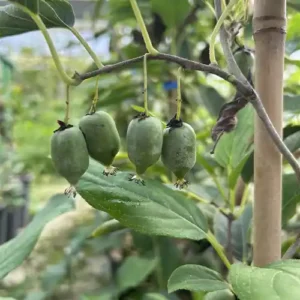
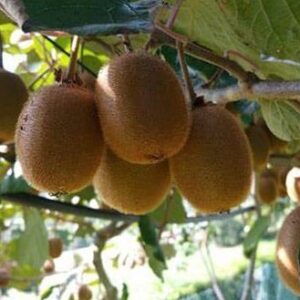
The familiar kiwi produces large fruit with skin that is usually hairy and removed before eating. Kiwiberries produce much smaller fruit, closer in size to a large berry, with thin, smooth and entirely edible skin.

Kiwiberries are considerably hardier during winter dormancy. This does not mean that they can be planted anywhere: their early bud break makes the young shoots particularly vulnerable to spring frost.

For reliable fruit production, the quality of the planting position is often more important than the theoretical minimum temperature stated for the variety.

The main cultivated Actinidia species

Green kiwi, Actinidia deliciosa

Actinidia deliciosa produces the familiar large green kiwis with hairy skin. ‘Hayward’ belongs to this group, along with several self-fertile selections developed for gardens.

This species requires a long growing season and a sufficiently mild autumn for the fruit to reach physiological maturity. It can crop in cooler parts of northern and western Europe, but it needs a warm, bright position protected from strong winds.

The fruit may be picked while still firm once it has reached sufficient maturity, then ripened indoors. Fruit harvested much too early will soften poorly and remain low in sugar and flavour.

Yellow and red kiwis, Actinidia chinensis

Actinidia chinensis includes many cultivars with yellow, orange or partly red flesh. Their skin is often less hairy, and their flavour is generally sweeter or more aromatic than that of traditional green kiwis.

These varieties often require more summer heat and are generally less winter hardy than kiwiberries. Some are also more sensitive to alternating mild periods and sudden returns of cold weather.

In cool regions, they should be reserved for the best microclimates: a well-exposed wall, sheltered courtyard, urban garden or warm slope protected from cold winds.

Kiwiberry or hardy kiwi, Actinidia arguta

Actinidia arguta produces small green, red or purple berries whose smooth skin is eaten with the flesh. The fruit is often very sweet, aromatic and more concentrated in flavour than large kiwis.

The dormant vine can withstand severe winter cold. It nevertheless starts growing early, and a spring frost may destroy its young shoots without damaging the trunk or permanent framework.

The kiwiberry is therefore well adapted to cold winters, but it still requires a position protected from late frost if it is to crop regularly.

Actinidia kolomikta

Actinidia kolomikta is even hardier and usually less vigorous than Actinidia arguta. Its foliage may develop attractive white and pink variegation, particularly on male plants.

Its fruit is smaller and yields are generally lower. It also starts growing very early, which can expose the fruiting shoots to frost despite the plant’s excellent winter hardiness.

It is mainly suited to very cold climates or to gardens looking for a vine that is both ornamental and productive.

The planting position is the first condition for success

An Actinidia should not simply be planted in whatever unused space remains at the back of the garden. Its vigour may allow it to survive in an unsuitable position, but fruiting will remain irregular or absent.

Choose a sunny, warm position protected from prevailing winds and away from hollows where cold air collects. A gentle slope or slightly elevated position is preferable to low-lying ground.

Wind damages young shoots, tears the large leaves and may break fruit-laden branches. It also increases water loss from the soil while the plant is becoming established.

In cool climates, a south-, south-east- or south-west-facing wall can provide the additional warmth required by large-fruited kiwis. The vine should nevertheless be trained on a structure set slightly away from the wall so that air can circulate.

An exceptionally warm position may bring bud break forward. In an area regularly affected by late frost, a slightly cooler site protected from cold-air accumulation may be more productive than a wall that heats up rapidly at the end of winter.

A very hardy variety planted in a frost pocket may lose the shoots that were due to carry flowers every spring. Winter hardiness of dormant wood and spring frost resistance of young shoots are two different characteristics.

Our advice for planting pot-grown Actinidia

For pot-grown plants that have already started into growth, we recommend waiting until the main risk of late frost has passed before planting them in the ground.

This does not mean that the roots of a dormant Actinidia cannot tolerate cold. The purpose is to protect tender young shoots produced in the nursery, which may be severely damaged by frost immediately after planting.

A leafy pot-grown plant should not be treated like a dormant bare-root plant. Moving it from a protected container environment into cold soil exposed to wind and frost represents a sudden change.

Prepare the ground before the plant arrives. Loosen the soil over a sufficiently wide area, create a fine and workable structure around the planting position, remove perennial weeds and allow the soil to warm naturally.

Avoid planting into cold, waterlogged or sticky soil, or soil consisting of large compacted clods. Fine new roots must be able to make immediate contact with aerated, warmed soil.

The soil should not be reduced to dust, particularly in clay ground. The objective is a crumbly, permeable structure around the root ball, not a pocket of compost surrounded by compacted soil.

Careful preparation allows the vine to begin rooting into the surrounding ground immediately instead of remaining confined to its original root ball for weeks.

How should a kiwi or kiwiberry be planted?

Install the support before planting or immediately afterwards. A young Actinidia shoot can extend very quickly and may snap if it has no stake or secure attachment point.

Dig a hole wide enough to accommodate the root ball, but not unnecessarily deep. The top of the root ball should remain level with the surrounding ground.

Do not bury the root collar or mound soil against the stem. Planting too deeply keeps the bark damp and increases the risk of decay.

Do not place manure, concentrated fertiliser or very rich compost directly against the roots. Young Actinidia roots are sensitive to high concentrations of fertiliser salts.

Backfill with the prepared soil, firm gently by hand or foot to remove large air pockets, then water thoroughly.

Tie the main stem without constricting it. Check the ties regularly, as the trunk can thicken quickly.

Keep the soil weed-free while the plant establishes

Young Actinidia vines compete poorly with grass. Grasses take water and nutrients from the same layer of soil occupied by the vine’s developing roots.

The area around the plant should be completely cleared before planting and kept free from competing vegetation during the first few years.

Removing grass only within the diameter of the original pot is not enough. A reasonably wide area should remain clear so that new roots can expand into the surrounding soil.

Perennial weeds should be removed before planting. Eliminating them later from among the vine’s shallow roots becomes much more difficult.

An organic mulch may be applied once the soil has warmed. It helps retain moisture and suppress new weeds, but it must be kept away from the stem.

Avoid deep cultivation around an established vine. Actinidia roots are relatively shallow and can be damaged by a spade or mechanical cultivator.

Water throughout the first year whenever necessary

Watering should not stop after the first week following planting. A pot-grown Actinidia still has most of its roots concentrated in a small volume of compost and can dry out quickly, even when the surrounding soil appears moist.

Monitor soil moisture throughout the first growing season and water whenever rainfall is insufficient. The requirement depends on soil texture, temperature, wind and the amount of foliage produced.

Each watering should moisten both the root ball and the surrounding soil, rather than simply wetting the surface. A thorough watering encourages roots to grow outwards.

The soil should remain consistently moist but never waterlogged. Alternating severe drying with excessive watering slows establishment and may cause wilting or leaf fall.

A rapidly growing shoot consumes a considerable amount of water. The more foliage the vine produces during its first year, the more carefully it must be monitored.

Even after a successful spring planting, irrigation may still be required during summer and early autumn so that the plant retains its foliage and ripens its new wood before winter.

Deep, moisture-retentive and perfectly drained soil

Kiwis and kiwiberries prefer deep, fertile soil rich in organic matter and capable of retaining an even supply of moisture during summer.

They are, however, very intolerant of stagnant water. Waterlogged soil can destroy the roots and encourage root rots, particularly those associated with Phytophthora.

In heavy soil, improve the overall movement of water before planting or position the vine on a slightly raised area. Adding gravel only to the bottom of a deep planting hole will not correct ground that remains saturated as a whole.

Actinidia generally prefers slightly acidic soil. Highly calcareous ground may cause chlorosis, weak growth and yellowing leaves despite nutrients being present in the soil.

Fertile soil does not need constant feeding. Excess nitrogen produces long, difficult-to-control shoots, delays the ripening of new wood and may reduce fruiting quality.

Winter hardiness does not protect young shoots from frost

A dormant kiwiberry can withstand a much colder winter than many yellow or traditional green kiwis. This difference becomes far less important once the buds begin to open.

Young shoots of all Actinidia species are tender and sensitive to temperatures below freezing. A brief frost can blacken the leaves, destroy flower buds and remove the entire crop without killing the vine.

Kiwiberries may be particularly exposed because they can start growing early. Their excellent winter hardiness allows the permanent framework to survive, but does not guarantee that the fruiting shoots will escape frost.

Avoid low points, areas enclosed by very dense hedges and the base of slopes where cold air becomes trapped.

A young plant may be given temporary protection when exceptional frost is forecast. The protection should be removed during the day and must not crush the fragile shoots.

Most Actinidia varieties are male or female

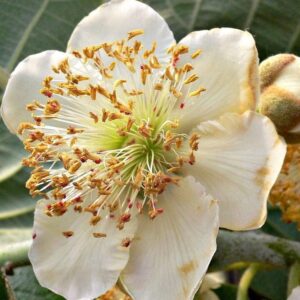
Actinidia plants are generally dioecious, meaning that male and female flowers are carried on separate plants.

The female plant produces the fruit. The male plant supplies pollen but does not produce kiwis or kiwiberries.

One male can pollinate several females when the plants are sufficiently close and their flowering periods overlap.

Any male plant should not be chosen at random. Its flowering time must correspond with that of the female varieties, and it is safer to use a pollinator recommended for the same species or cultivar group.

A male kiwiberry is not automatically the ideal pollinator for a large-fruited kiwi, and the reverse is also true. Cross-pollination between species may sometimes occur, but should not be relied upon as a general recommendation.

Distance, obstacles and weather during flowering also influence pollen transfer. The male should not be isolated at the opposite end of a large property.

What does self-fertile really mean in a kiwi?

Some selections are capable of setting fruit without a separate male plant. They are particularly useful where there is room for only one vine.

Self-fertility does not always mean that the plant will reach its maximum production when grown alone. A compatible pollinator may increase seed number, fruit size and cropping regularity.

The kiwiberry ‘Issai’, for example, can produce fruit by itself, but cross-pollination may improve fruit size.

A self-fertile cultivar is therefore a useful choice for a small garden, while a male-and-female combination is generally preferable where sufficient space is available and fruit production is the main objective.

Claims of self-fertility must be checked for each individual cultivar. They cannot be assumed simply because a plant is a kiwi or kiwiberry.

Pollination quality influences fruit size

A kiwi contains a large number of small seeds, each corresponding to an ovule that has been successfully fertilised.

When a flower receives insufficient pollen, the resulting fruit may remain small, uneven or flattened on one side.

Heavy flowering does not therefore guarantee a crop of large fruit. Flowering periods must overlap, a suitable male must be present and pollinating insects must be sufficiently active.

Cold, windy or continuously wet weather during flowering can reduce bee activity and limit fertilisation.

In a planting containing several females, the male must retain enough flowering wood. Severe winter pruning of the male can remove much of the blossom required for pollination.

Install a strong support before the vine becomes unmanageable

Kiwis and kiwiberries are not small ornamental climbers. A mature vine can cover a substantial area and carry a considerable weight of wood, foliage and fruit.

A lightweight decorative trellis, flexible mesh or guttering is not a suitable support. The structure must withstand wind and the weight of wet vegetation.

A strong pergola or T-shaped training system allows the permanent arms to be distributed evenly and the fruiting shoots to hang down.

When training against a wall, use wires fixed to robust supports and positioned sufficiently far from the masonry.

The support should be designed to allow pruning, tying and harvesting. A very high pergola may look impressive but can become difficult to maintain.

Train a single trunk during the first few years

The objective during the first year is not to cover the entire pergola immediately. It is to establish a straight, strong trunk securely tied up to the level of the main support.

Select the strongest shoot and guide it vertically. Remove or shorten competing shoots so that growth is concentrated into this main leader.

When the stem reaches the main wire, two extensions can be trained in opposite directions to form permanent arms.

These arms form the framework of the vine. Fruiting laterals will subsequently be renewed from this structure.

A plant that is not trained correctly from the beginning quickly develops a tangle of stems that is difficult to reorganise without losing several years of growth.

On which wood do kiwis and kiwiberries produce fruit?

Flowers and fruit develop on new spring shoots arising from canes that formed during the previous year.

Older wood creates the permanent framework but does not carry fruit directly. It must continually produce well-lit, healthy one-year-old canes.

Pruning away all of the previous year’s wood would therefore remove the next crop. Conversely, an unpruned vine accumulates too many shoots, becomes heavily shaded and produces numerous small fruit that are difficult to harvest.

Buds near the base of long canes are not always the most fruitful. Excessively short pruning can therefore greatly reduce production in some varieties.

Gradually renewing fruiting canes is more important than retaining the greatest possible quantity of wood.

Winter pruning female vines

Winter pruning removes canes that have already fruited, renews productive wood and distributes future fruiting canes along the permanent framework.

A properly trained mature vine may lose a very large proportion of the growth it produced during the year. This may appear severe, but it is necessary to prevent an impenetrable canopy from developing.

Retain vigorous, well-exposed and evenly spaced one-year-old canes. These will produce the shoots carrying flowers the following spring.

Remove weak, tangled or wind-damaged stems, together with shoots growing into an area that is already too dense.

Prune during dormancy, sufficiently early before sap flow resumes. Late pruning can cause substantial bleeding from the cut ends.

Male vines are not pruned in the same way as female vines

The male vine must produce as many flowers as possible while the female flowers are receptive. Severe winter pruning would remove much of the pollen required for the crop.

During winter, remove only wood that is damaged, badly positioned or genuinely unnecessary.

The main pruning of the male vine should take place after flowering. Shoots that have completed their role can then be shortened or renewed without compromising pollination that year.

Summer pruning also prevents the often vigorous male plant from invading the female vines and depriving them of light.

Clearly identify male and female plants from the time of planting so that a female pruning system is not mistakenly applied to the pollinator.

Summer pruning keeps light around the fruit

Actinidia vines produce long shoots during summer. Without intervention, several layers of foliage develop and leave the fruit in permanent shade.

Excessively long, unproductive or badly positioned shoots can be shortened to maintain routes for light and air.

Foliage should not be removed suddenly or excessively. The leaves feed the fruit and protect the skin from abrupt exposure to intense sunlight.

Balanced pruning supports the quality of the current crop and the formation of future flower buds on the canes intended to produce the following year.

Retained canes should remain securely attached to the support, as their weight and wind resistance increase during summer.

Water remains important after establishment

Actinidia vines develop a very large leaf area and lose considerable quantities of water during hot or windy weather.

A mature vine may survive a temporary shortage, but drought during active growth reduces fruit size and the length of the canes that will carry the following crop.

Kiwiberries and large-fruited kiwis crop best in soil that retains consistent moisture. Their reputation for winter hardiness should not be confused with drought tolerance.

Irrigation should moisten the useful depth of soil while still allowing excess water to drain away. Frequent watering in permanently saturated ground encourages root rot.

Mulching and maintaining a weed-free area reduce moisture fluctuations and make irrigation more effective.

Avoid excessive fertiliser and uncontrolled vigour

A very vigorous vine can produce several metres of growth without carrying any more fruit.

Excess nitrogen encourages large leaves, heavy shade, late-growing shoots and wood that fails to ripen properly before winter.

Feeding should be adjusted according to the growth actually observed. A vine already producing long, vigorous shoots generally does not need further stimulation.

Young plants must first develop their root system and permanent structure. Concentrated fertiliser applied immediately after planting is more likely to damage the roots than to create lasting growth.

Properly prepared soil, a regular water supply and freedom from competition are often more important than abundant fertiliser during the first year.

Kiwis and kiwiberries are harvested differently

Large-fruited kiwis

Large kiwis can be harvested while still firm once they have reached physiological maturity. Some of their starch is then converted into sugars during ripening.

They should remain on the vine long enough to complete their development, but be picked before a severe frost that could damage the fruit.

After harvest, they may be stored in a cool place and brought to room temperature in small quantities so that they soften progressively.

Keeping them near apples or pears accelerates ripening because of the ethylene released by these fruits.

Kiwiberries

Kiwiberries develop their best flavour when allowed to ripen on the vine. They then become soft, sweet and highly aromatic.

Fruit within the same cluster or on the same plant does not always ripen at exactly the same time. Check for softening and taste the fruit regularly.

A fully ripe kiwiberry has a short storage life. To extend its keeping period, it may be harvested physiologically mature but still firm, then ripened gradually.

Its small size and edible skin make it easy to eat directly, but it is also more delicate at full ripeness than a large kiwi.

Generally robust vines that remain sensitive to soil problems

In gardens, Actinidia vines generally suffer from fewer foliar diseases than many traditional fruit trees.

The most serious risk is root rot in poorly drained ground. A mature vine may decline rapidly when a significant part of its root system is destroyed by waterlogging or Phytophthora.

Bacterial canker of kiwifruit can also affect buds, shoots and branches. Pruning wounds, cold weather and prolonged humidity may aggravate the damage.

Protect young trunks from mower damage, tight ties and rubbing against the support.

In cool climates, failures are nevertheless very often caused by an unsuitable position, late frost, insufficient water during establishment, the absence of a compatible pollinator or incorrect pruning, rather than by a leaf disease.

Which Actinidia should you choose?

For an open position exposed to frost

No Actinidia will perform at its best in a cold hollow. A kiwiberry will be hardier during winter, but its young shoots must still be protected from spring frost by choosing the site carefully.

For large, traditional kiwi fruit

Choose an early or locally suitable Actinidia deliciosa and plant it in a warm, sheltered position. Make sure that an appropriate pollinator is present when the selected variety is female.

For cropping in a colder climate

Choose an early kiwiberry and plant it away from frost pockets. Its winter hardiness is greater and its small fruit generally requires less heat than late-ripening, large-fruited kiwis.

For fruit that can be eaten with the skin

Kiwiberries are the best choice. Their thin, smooth skin is eaten with the flesh, and their flavour can be exceptionally sweet and aromatic.

When there is room for only one vine

Choose a cultivar clearly identified as self-fertile. Production may nevertheless be improved by the presence of a compatible pollinator.

For covering a large pergola

Both kiwis and kiwiberries are suitable, but the structure must be designed for the weight of a mature vine. Annual pruning will be essential to keep it productive and accessible.

Frequently asked questions about kiwis and kiwiberries

What is the difference between a kiwi and a kiwiberry?

A kiwi generally produces large fruit with hairy skin, while a kiwiberry produces small fruit with thin, smooth and edible skin. Kiwiberries are hardier in winter but remain sensitive to frost after bud break.

When should a pot-grown Actinidia be planted?

For a plant that has already produced leaves, we recommend waiting until the main risk of late frost has passed. Plant it in prepared, warmed, finely cultivated and weed-free soil.

Why should a leafy pot-grown plant not be planted immediately?

Young shoots developed in the nursery can be destroyed by late frost. Waiting a few weeks also allows planting into warmer soil that is more favourable to new root growth.

Must the plant be watered throughout its first year?

Yes, whenever rainfall is insufficient. Neither the root ball nor the surrounding soil should be allowed to dry out during establishment, even several months after planting.

Do I need to plant a male and a female?

Yes, for most cultivars. Only selections clearly described as self-fertile can produce without a separate male plant.

Does a male plant produce fruit?

No. It produces flowers that supply the pollen required by female plants.

Can one male pollinate several females?

Yes. One male can generally pollinate several female plants when their flowering periods overlap and they are planted sufficiently close.

Can a male kiwiberry pollinate a large-fruited kiwi?

This should not be assumed. Choose a pollinator recommended for the species and flowering period of the female cultivar.

Will a self-fertile variety crop better when grown alone?

It can crop by itself, but cross-pollination may improve fruit set and fruit size.

Why has my hardy kiwiberry been damaged by frost?

The stated hardiness mainly applies to the dormant vine in winter. Young shoots emerging in spring are much more vulnerable and can be destroyed by a relatively light frost.

Why does my Actinidia grow vigorously without producing fruit?

The plant may still be young, may lack a pollinator, may have been pruned incorrectly or may receive too little light. Excess nitrogen can also encourage shoot growth at the expense of flowering.

What position should be chosen in a cool climate?

Choose a bright, warm position protected from wind and located away from frost pockets. A well-exposed wall is particularly helpful for large-fruited kiwis.

Can Actinidia be planted in heavy soil?

Only when drainage is adequate. Actinidia vines are very sensitive to stagnant water and root rot.

Can they be grown in calcareous soil?

Highly calcareous soils are unsuitable and may cause chlorosis. Deep, organic-rich and slightly acidic soil is preferable.

Is a strong support required from the beginning?

Yes. Growth soon becomes substantial and a mature vine carries considerable weight. The support must be durable and allow access for pruning and harvesting.

Do kiwis and kiwiberries require a great deal of pruning?

A mature vine requires genuine winter pruning and some summer management. Without pruning, it develops a dense, shaded canopy that is difficult to harvest.

Why are the fruit small or misshapen?

Poor pollination may limit seed formation and therefore fruit development. Overcropping, insufficient water and an excessively dense canopy can also reduce fruit size.

Do kiwiberries keep as long as large kiwis?

No. Ripe kiwiberries are more delicate and generally have a much shorter storage life than large kiwis harvested while firm.