
Fig trees
Fig trees
Fig trees
Fig trees
Fig trees
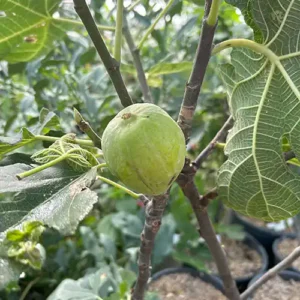
Chernyy Lebed fig tree, a hardy Russian variety with small melting, aromatic figs ripening early from mid-August.
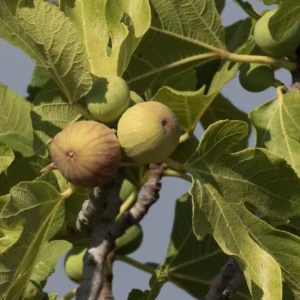
Fig trees
Fig trees
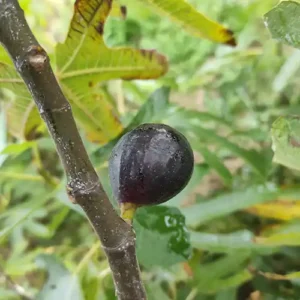
Lebedinaya Sheya fig tree, a hardy Russian variety with large sweet, fragrant figs ripening early from mid-August.
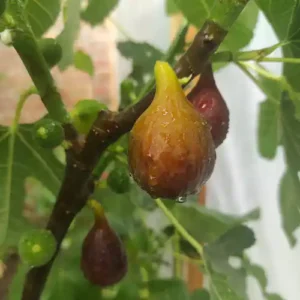
Fig trees
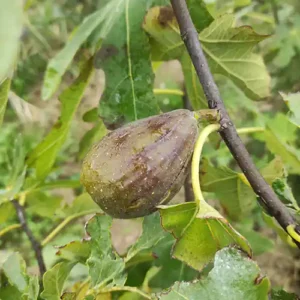
Mitchurinska 10 fig tree, an early Bulgarian variety with small beige, balanced figs and two crops from late June and late August.
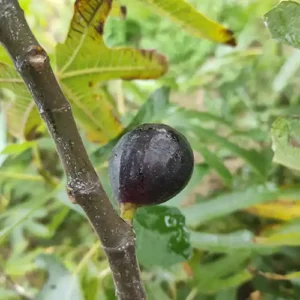
Fig trees
Fig trees
Choose the position and plant your fig tree carefully
Fig trees are often described as fruit trees capable of growing almost anywhere. This reputation applies mainly to the survival of a mature and well-established tree.
To obtain fully ripe figs regularly in a cool European climate, the planting position, cultivar earliness and quality of establishment are decisive.
Choose a bright and warm position protected from cold winds and situated outside hollows where cold air accumulates.
A south-, south-east- or south-west-facing wall can improve fruit maturity and protect the one-year-old shoots carrying the following season’s breba figs.
In northern and frost-prone regions, we recommend planting container-grown fig trees during spring.
Where the plant is already in leaf, wait until the principal risk of late frost has passed before planting it permanently.
Prepare a broad area of soil, remove perennial weeds carefully and work the ground only after it has drained sufficiently and begun to warm.
Maintain a weed-free root zone and monitor moisture throughout the first growing season.
Water whenever rainfall is insufficient, including several months after planting.
A quoted hardiness temperature generally refers to a mature, dormant and well-rooted fig tree exposed to cold for a limited period. A young container-grown plant can be damaged at a substantially higher temperature.
A young fig tree is less cold-hardy than an established tree
A young fig tree possesses little mature wood, limited reserves and a root system still concentrated within the volume of its former container.
A severe frost can therefore affect almost its complete structure.
Shoots produced late in the growing season are particularly vulnerable.
Green, water-rich and incompletely matured wood is much less frost-resistant than a properly hardened branch.
A mature fig may lose its shoot tips or even part of its crown and then regenerate from older framework branches or from the base.
The same frost can destroy the complete above-ground structure of a recently planted tree.
The duration of the cold, wind exposure, soil moisture and previous acclimatisation are as important as the minimum temperature.
A brief frost following several weeks of cool weather is generally less damaging than a sudden temperature fall after a mild period that has encouraged the buds to swell.
The first years should therefore be treated as an establishment phase.
Temporary protection around the base and young framework can be useful during exceptionally cold periods, even for a cultivar regarded as hardy.
Tree survival does not guarantee ripe figs
A fig tree can survive winter without visible damage and still produce fruit that never receives enough warmth to ripen.
In northern, maritime, elevated or otherwise cool regions, earliness is frequently more important than the lowest temperature tolerated by the dormant wood.
A highly winter-hardy but late-ripening cultivar may remain covered with green fruit when autumn arrives.
The final stage of fig maturity is rapid but demanding.
During the last days, the fruit expands, softens and accumulates a substantial proportion of its sugar and aroma.
Cold, wet or overcast weather can interrupt this development.
A fig may increase in size and change colour slightly without developing the concentration obtained during warm and bright late-summer conditions.
For a cool climate, prioritise cultivars whose main crop begins sufficiently early or whose breba crop ripens reliably in a sheltered position.
A fig is not an ordinary fruit
The fig is a syconium: a hollow, fleshy structure enclosing numerous tiny flowers.
The flowers are situated inside the fig and cannot be seen from the outside.
The small crunchy structures commonly called seeds are the individual fruits formed by these flowers or, in an unpollinated parthenocarpic fig, undeveloped ovaries.
The opening opposite the stalk is known as the ostiole or eye.
Its width, shape and degree of closure differ considerably between cultivars.
A narrow or tightly closed eye generally limits the entry of rainwater, insects, yeasts and other microorganisms.
This is an important characteristic in humid and maritime climates.
Some cultivars form a thick drop of nectar at the eye as they ripen.
This does not necessarily indicate disease and can temporarily help seal the opening.
Most garden fig trees require no pollinator
The cultivars best suited to gardens across northern and western Europe usually belong to the common fig type.
They develop their figs parthenocarpically, without fertilisation and without pollen from a caprifig.
The term self-fertile is frequently used in catalogues, although it is botanically approximate.
The flowers are not fertilising themselves: the fig develops without fertilisation.
One plant of a common-type cultivar can therefore produce fruit alone.
Planting several varieties can extend the season and provide different flavours, colours and fruit types, but is not required for pollination.
The presence of small seed-like structures in the flesh does not prove that the fig was pollinated.
These structures are also present in parthenocarpic common figs.
Where a common fig fails to produce, investigate tree age, frost damage, cultivar earliness, pruning, excessive vigour, insufficient light and water stress before assuming that a pollinator is missing.
Common, Smyrna and San Pedro fig types
Common figs
Common fig cultivars form edible fruit without pollination.
This is the most suitable group for regions where the fig wasp and caprifigs are absent or unreliable.
Common figs may be uniferous or biferous and differ greatly in earliness, fruit quality, vigour and tolerance of rain.
Caprifigs
The caprifig is commonly described as the male fig.
Its syconia support the male flowers, pollen and reproductive cycle of the specialist fig wasp responsible for caprification.
Caprifig fruit is generally not the fleshy dessert fig sought by gardeners.
Its principal horticultural function is to provide pollen to cultivars that depend on caprification.
Smyrna figs
Smyrna-type cultivars require pollination by the fig wasp using pollen from a caprifig.
Without caprification, the young figs generally fall before maturity.
These cultivars can produce fruit of exceptional quality in their traditional growing regions.
Their production should not be assumed in a garden where suitable caprifigs and the associated insect are not permanently established.
San Pedro figs
San Pedro cultivars can normally produce their first or breba crop without pollination.
Their main crop generally depends on caprification.
In a region without reliable fig-wasp pollination, the tree may produce several breba figs and then drop most of its second crop.
For a cool European garden, choose a cultivar clearly identified as a common fig and known to mature its fruit without caprification.
Uniferous or biferous fig tree?
Uniferous cultivars
A uniferous fig cultivar produces principally one crop, normally on shoots formed during the current growing season.
This main crop can be highly reliable in a cool climate where the cultivar begins ripening sufficiently early.
Even when winter cold damages part of the old wood, new shoots may still form fruit.
A late uniferous cultivar remains risky because its figs may not receive enough warmth before autumn.
Biferous cultivars
A biferous cultivar is genetically capable of producing a breba crop on the previous season’s wood followed by a main crop on current-season shoots.
The term biferous does not guarantee that two crops will ripen every year.
Winter cold can destroy the breba buds, while a short summer can prevent the main crop from ripening.
Actual performance depends on position, winter temperature, pruning and the length of the growing season.
A cultivar described as biferous in a Mediterranean region may produce only one dependable crop in northern Europe.
The breba crop forms on the previous season’s wood
A breba fig begins developing near the end of the previous growing season.
It remains over winter as a very small embryonic fig situated on a one-year-old shoot.
These figs resume growth during spring and can ripen relatively early.
Breba figs are often larger but less numerous than the main crop.
The first crop depends directly on the survival of the one-year-old shoots and their embryonic figs.
Severe frost, hard pruning or cutting every branch back annually can remove the complete breba crop.
In a warm and sheltered position, breba figs may provide the most reliable harvest because they have the first part of summer in which to ripen.
Where the branches freeze frequently, it is safer to choose a cultivar capable of producing a very early main crop on new growth.
The main crop develops on new shoots
Main-crop figs appear progressively in the leaf axils of shoots produced during the current growing season.
The fruit closest to the base of a shoot normally begins developing before figs situated nearer its tip.
Maturity is therefore naturally spread over time.
An early cultivar can ripen a large proportion of this crop during summer.
On a late cultivar, the final figs remain green as light and temperatures decline.
Large but hard green figs left on the tree during autumn do not normally become the following season’s early crop.
They generally fall or deteriorate during winter.
Only the very small embryonic figs formed on one-year-old wood are capable of becoming breba fruit.
Large immature main-crop figs can be removed once the season has finished.
Biferous does not necessarily mean more productive
A cultivar theoretically capable of producing two crops is not automatically more useful than a good uniferous variety.
The breba crop may be small or possess lower eating quality than the main crop.
It may also disappear after a cold winter or pruning that removed the productive shoot tips.
The main crop of a biferous cultivar may be too late for a cool climate.
The gardener then obtains several early breba figs followed by many green fruits that never ripen.
An early, productive and rain-tolerant uniferous cultivar can ultimately provide a much larger quantity of usable fruit.
Choose according to the reliability of each crop in the intended climate rather than the biferous description alone.
Useful characteristics when comparing fig cultivars
Actual ripening season
In a cool climate, maturity date is the first criterion.
An early cultivar uses the warmest and brightest part of the season to accumulate sugar and aroma.
Compare observations from a reasonably similar climate rather than relying solely on harvest dates recorded in southern Europe.
Fruiting type
Determine whether the cultivar is valued mainly for its breba crop, its main crop or both.
This information affects cultivar choice, pruning and the need to protect one-year-old wood.
Eye closure
A narrow or closed ostiole reduces the entry of water, insects and microorganisms.
This characteristic is particularly valuable in humid and maritime climates.
Resistance to rain and splitting
Some figs split or begin fermenting rapidly after rainfall.
Others possess skin and internal structure that allow them to remain sound for longer under similar conditions.
No cultivar is completely unaffected by prolonged rain at full maturity.
Fruit size
A very large fig is not necessarily superior.
In a cool climate, moderately sized fruit can ripen more quickly and develop a greater concentration of sugar and flavour.
Large fruit can also be more watery or susceptible to splitting where warmth is insufficient.
Skin texture
Fig skin may be exceptionally fine and tender, thick, elastic or slightly resistant.
Fine skin can be pleasant to eat but may be more fragile during wet weather and handling.
A slightly stronger skin can improve rain tolerance and transportability.
Flavour profile
Fig flavours may be dominated by honey, sugar, melon, berries, red fruit or more complex resinous and spicy notes.
External skin colour does not predict this aromatic profile.
Tree vigour
Some cultivars form compact bushes, while others produce several metres of growth and eventually become substantial trees.
For a restricted space, choose a naturally compact cultivar rather than relying on severe annual cutting to restrain a vigorous variety.
Skin colour does not describe maturity or flavour
Fig cultivars may produce green, yellow, brown, red, purple, black, striped or bicoloured fruit.
This colour is a characteristic of the cultivar and is not a quality classification.
A green fig can contain deep red flesh and possess an intense berry flavour.
A dark purple fig can contain amber flesh and develop a milder honeyed taste.
Some cultivars change colour substantially during ripening, while others look almost unchanged until their final softening.
Colour must therefore be interpreted according to the individual cultivar.
A green fig is not necessarily unripe and a completely black fig is not automatically ready to pick.
Choose a genuinely warm position in a cool region
Fig trees crop most successfully in full sun with warmth reflected from a wall, paved surface or other mineral material.
A south- or south-west-facing position generally accelerates maturity.
A south-east-facing wall receives sunlight earlier and can help leaves and fruit dry quickly after dew.
Avoid planting directly beneath a wide roof overhang where the soil remains permanently dry.
Reflected warmth is useful only where the roots receive enough water.
A gentle slope is preferable to low ground.
Cold air should be able to continue moving downhill without being trapped by a solid fence, wall or dense evergreen hedge.
In an open but cool position, choose a very early cultivar.
Reserve more heat-demanding varieties for warm courtyards, urban gardens, sheltered façades and favourable microclimates.
Plant container-grown fig trees during spring
Spring planting gives a young fig tree a complete growing season in which to establish roots before its first winter.
Where the plant is already in leaf, wait until the main late-frost risk has passed.
Young foliage developed in a nursery, greenhouse or tunnel can be considerably more tender than leaves emerging naturally on an established outdoor tree.
Prepare a broad area rather than a narrow planting hole filled with potting compost.
The roots must be able to move easily from the original root ball into the surrounding garden soil.
Work the ground when it is moist but no longer saturated or sticky.
Wet clay cultivated too early forms large clods and smooth compacted surfaces around the planting hole.
Remove perennial weeds and their rhizomes before planting because later cultivation can damage the fig’s shallow roots.
How should a container-grown fig tree be planted?
Water the root ball before removing the container.
It should be evenly moist but not saturated.
Where roots are circling tightly, loosen them carefully and direct them outwards.
Position the top of the root ball approximately level with the surrounding ground.
Planting too deeply keeps the base of the stems wet and can delay establishment.
Backfill with the prepared garden soil, firm moderately and water thoroughly to establish contact between the root ball and surrounding ground.
Do not place fresh manure or concentrated fertiliser directly against the roots.
Excessively stimulated growth produces tender shoots that mature poorly and suffer greater winter damage.
In a windy position, install a temporary stake to prevent repeated movement of the root ball.
The tie should remain flexible and must be inspected as the trunk grows.
Keep the ground around a young fig free from grass
A mature fig develops an extensive root system, but a newly planted tree remains highly sensitive to competition from grass.
Maintain a weed-free area substantially wider than the original container.
This allows the roots to expand without competing immediately with dense grasses for water and nutrients.
An organic mulch can reduce evaporation and suppress annual weeds.
Keep it slightly away from the stems so that the bark is not held continuously wet.
Avoid deep cultivation around an established fig because a significant proportion of its active roots develops close to the surface.
Water throughout the first season when required
An established fig tree can tolerate drought, but this ability does not apply to a young plant whose roots remain largely confined within its former root ball.
Monitor soil moisture throughout the first year and not only during the first weeks after planting.
Water sufficiently to moisten both the original root ball and the surrounding soil.
Small quantities applied only to the surface may leave the centre of the root ball dry.
The soil should then begin to regain air between waterings.
Continuously saturated ground deprives the roots of oxygen and weakens the tree.
Water demand increases when the fig develops its large leaves and carries a crop.
Serious drought can cause leaf drop, fruit drop and an interruption of fruit growth.
Fig trees tolerate different soils but not stagnant water
Fig trees adapt to light, stony, clay and moderately calcareous soils where the roots retain access to oxygen.
Deep and fertile ground encourages powerful growth.
This vigour can be valuable in poor conditions but excessive where a compact and rapidly productive tree is required.
Heavy soil is not automatically unsuitable.
It must nevertheless allow winter water to drain away.
Where the ground remains saturated, plant in a genuinely raised and drained area or improve the general movement of water.
A layer of gravel at the bottom of one planting hole does not correct an impermeable site and may simply create a basin around the roots.
Fig trees generally tolerate lime more successfully than blueberries, chestnuts and several pear rootstocks.
Exceptionally calcareous, compacted or oxygen-poor soil can still limit growth and cause chlorosis.
Should the roots of a fig tree be restricted?
Root restriction is traditionally used to control vigour and encourage fruiting, especially in fertile ground and cool climates.
It can be achieved with a large container, a partially enclosed planting pit or a root-control barrier that still allows surplus water to escape.
Root restriction should not be applied automatically in every situation.
In poor, shallow or dry ground, it can create permanent water stress and weaken the tree.
A freely rooted fig can crop extremely well where the cultivar is suitable, the crown receives enough light and nitrogen supply remains moderate.
Restriction is most useful where a tree produces excessive shoots and leaves without ripening a satisfactory crop or where the available space is genuinely limited.
A restricted root system requires more careful watering because it cannot explore distant soil during drought.
Most fig trees grow on their own roots
Fig trees root readily from cuttings and layers.
Most nursery plants therefore grow on their own roots rather than on a separate rootstock.
When an own-root fig regenerates from its base after frost, the new shoots belong to the same cultivar as the destroyed crown.
This is a significant advantage in cold regions.
Even where the branches are damaged, the surviving root system can recreate a plant true to the variety.
Grafted fig trees do exist, particularly where several cultivars are combined or where a difficult-to-root variety is being propagated.
On a grafted plant, a shoot emerging beneath the graft union does not necessarily belong to the purchased cultivar.
A fig tree grown from seed is a new genetic individual.
Its fruit quality, maturity period, flower type and ability to crop without caprification remain unpredictable.
Bush, small tree or fan-trained fig?
Multi-stemmed bush
A low, multi-stemmed bush is particularly suitable for cold climates.
It keeps the structure close to the ground, simplifies protection and allows one frost-damaged stem to be replaced by another.
Limit the number of main stems so that light can still penetrate the crown and reach the fruit.
Small tree
A single trunk provides easier access beneath the crown and can form an attractive small tree.
This structure places greater dependence on the survival of one principal trunk during an exceptional frost.
In a cold region, a relatively low crown remains easier to protect, prune and harvest than a tall standard.
Fan-trained fig
Training against a wall allows the branches to be distributed in one plane and uses the warmth released by the masonry.
It improves exposure of the fruit, facilitates protection and allows a vigorous tree to be managed within a relatively narrow space.
Attach the branches to wires positioned slightly away from the wall to maintain airflow and provide room for pruning.
Understand fig production before pruning
Pruning depends on the crop being protected.
Breba figs are carried on the previous season’s shoots, while the main crop appears on new growth.
Severe cutting removes the breba crop completely.
It also stimulates long and vigorous shoots that may form numerous late figs unable to ripen.
Where the cultivar is grown for its early crop, retain enough one-year-old shoots carrying small embryonic figs.
Where the tree is regenerating after frost, new shoots may produce a main crop provided that the cultivar is sufficiently early.
Pruning should balance preservation of productive wood, entry of light and gradual renewal of ageing branches.
When and how should a fig tree be pruned?
Wait until spring and the end of the principal severe-frost risk before making the main corrections.
New growth then makes the difference between living and genuinely dead wood easier to identify.
Remove frost-damaged wood, crossing branches, shoots growing towards the centre and several old stems where a bush has become too dense.
Avoid shortening every branch uniformly.
This removes breba figs and provokes a strong vegetative response.
Where an old bare branch needs renewal, a lower cut can stimulate a suitably positioned replacement shoot.
Renew the structure progressively rather than cutting the complete tree down in one season.
During early summer, pinching selected excessively long shoots can encourage branching and limit the formation of very late fruit.
The white fig latex can irritate the skin and eyes.
Wear gloves and wash exposed skin after pruning.
Avoid excessive nitrogen and vigour
A heavily fertilised fig can produce exceptionally large leaves and several metres of new growth without increasing the quantity of ripe fruit.
Excess nitrogen delays the maturation of the shoots, increases shade and encourages late-forming figs.
In fertile soil maintained with an organic mulch, a freely rooted fig normally requires little additional fertiliser.
Where growth is weak, investigate the soil, drainage, moisture, frost damage and root condition before adding fertiliser automatically.
In cold regions, avoid late nitrogen applications that produce shoots remaining tender when the first autumn frosts arrive.
Consistent moisture improves fig quality
A mature fig survives drought, but producing fleshy and juicy fruit requires enough water during development.
Water shortage can cause young fruit to fall, reduce final size and interrupt shoot growth.
A sudden irrigation or heavy rainfall following a dry period can cause nearly ripe figs to split.
Container-grown trees, root-restricted plants and figs growing directly beneath a wall require particularly careful monitoring.
Relatively consistent moisture is preferable to repeated alternation between complete drying and saturation.
Why do figs split or ferment on the tree?
Splitting depends on cultivar, skin structure, maturity and fluctuations in soil moisture.
Heavy rain can cause the pulp to expand faster than the skin can stretch.
Cracks and wide open eyes then allow water, yeasts, fungi and insects to enter.
The fig may become sharp, foamy, watery or develop a fermented smell.
Cultivars with a closed eye and useful resistance to splitting are generally better suited to humid climates than varieties selected in exceptionally dry regions.
Harvest frequently during rainy weather and remove split, sour or fermenting fruit from the crown.
Fig trees are robust but not completely free from problems
Fig trees generally require little plant-health intervention in a garden.
Climate and failure of the fruit to ripen are often more important than disease.
Mosaic-like leaf patterns, distortions, leaf spots, cankers and fruit rots can nevertheless occur.
Premature fruit drop can result from cold, drought, insufficient warmth, excessive vigour, caprification dependence or pest damage.
It should not automatically be attributed to one disease.
Scale insects and mites are especially troublesome on plants maintained under protection or overwintered in a location that is too warm.
An open crown, adequately drained soil and removal of rotten or mummified fruit limit many of the problems encountered in gardens.
Protect young fig trees during their first winters
In a cold or exposed position, protect the base, young trunk and one-year-old branches carrying embryonic breba figs.
Winter fleece can be placed around a framework that keeps the material slightly away from the branches.
Dry leaves or straw can provide additional insulation without holding the stems continuously wet.
Open or ventilate the protection during mild periods to prevent excessive humidity and premature growth.
A mulch protects part of the root system and the base of the plant but should not form a wet mass against the stems.
Preserving the above-ground wood is especially important for cultivars valued principally for their breba crop.
What should be done after severe frost damage?
Do not cut the complete tree down immediately after the frost.
The boundary between living and dead wood becomes much clearer when growth restarts.
During spring, cut damaged branches back to healthy tissue and retain shoots emerging from living sections.
An own-root fig can regenerate from the base without losing its cultivar identity.
During the first season after severe frost, the tree may produce abundant vegetative growth.
A cultivar with a very early main crop may still produce several figs on the replacement shoots.
A cultivar dependent principally on breba figs normally requires another year before cropping.
Avoid excessive feeding of the regrowth.
The priority is to recreate a strong structure whose shoots mature properly before the following winter.
Container cultivation substantially reduces hardiness
A fig tree can be grown in a container on a terrace and moved according to the season.
Its roots are then much more exposed to frost than those of the same cultivar planted in open ground.
The complete root ball can freeze while an outdoor tree retains living roots below the soil surface.
Use a large, stable and adequately drained container.
A small pot dries rapidly and produces the moisture fluctuations responsible for fruit drop and splitting.
During winter, a dormant container-grown fig can be placed in a cool, unheated and frost-protected building.
The room can be dark or only lightly illuminated because the deciduous tree carries no leaves.
Do not attempt to maintain active growth in a warm room.
Winter dormancy is normal and beneficial.
Return the tree outdoors progressively during spring and protect the first leaves from late frost.
Fig harvest season
Breba figs may ripen during early or midsummer, while the main crop develops later on current-season shoots.
Actual dates vary according to cultivar, country, position, tree form, crop load and seasonal temperatures.
The calendar is intended principally for comparing cultivars rather than predicting one exact harvest date for every garden.
No product in this category has a recognised harvest period yet.
How can a fully ripe fig be recognised?
A ripe fig becomes soft and heavy and its neck begins to bend so that the fruit hangs downwards.
The skin develops the characteristic mature colour of the cultivar and may form small superficial cracks.
Some figs remain green or yellow even when completely ripe.
The fruit detaches readily and releases less white latex from the stalk.
A firm upright fig has generally not reached its best eating quality.
Depending on the cultivar, a drop of nectar may appear at the eye and the aroma becomes more noticeable.
Tasting remains the most reliable indicator.
A fig picked one or two days too early can lack much of the sugar and aromatic richness it would have developed on the tree.
Figs soften after picking but should be harvested almost ripe
A fig can continue softening after harvest.
This process cannot transform a hard green fruit into an excellent ripe fig.
Fruit intended for fresh eating should be harvested close to complete maturity.
Most of its sugar concentration, aroma and melting texture develop while it remains attached to the tree.
A fig picked too firm can soften while remaining low in sugar, weakly flavoured or slightly rubbery.
This explains why a garden-grown fig harvested at the correct stage often possesses far better eating quality than fruit picked early to withstand long-distance transport.
Harvest frequently and handle the fruit carefully
Ripe figs are exceptionally delicate.
Support the complete fruit and detach the stalk gently.
A soft fig bruises easily beneath the pressure of the fingertips.
Use shallow trays and avoid stacking several heavy layers.
During the main season, inspect the tree every day or two.
A ripe fig can quickly become over-soft, ferment or be consumed by birds, wasps and other insects.
Harvest preferably when the fruit is dry.
Wet figs keep poorly and are more susceptible to decay.
Damaged, split or exceptionally ripe fruit should be eaten or processed immediately.
Fresh figs have a naturally short storage life
A completely ripe fig keeps for only a short period at room temperature.
Its tender flesh, thin skin and high metabolic activity cause rapid deterioration.
Cool the harvest promptly when it will not be eaten on the same day.
Even under refrigeration, the fruit should be inspected and used quickly.
Figs can be frozen, dried or processed into jam, compote, chutney, fruit paste, cakes and savoury dishes.
Cultivars intended for drying should combine high sugar content, suitable flesh texture and good resistance to decay.
A very large and watery fig is not necessarily the best choice for drying.
Which fig tree should you choose?
For a cool European climate
Choose a common-type cultivar that ripens very early and either produces a dependable main crop on new shoots or retains a reliable breba crop in a protected position.
For a warm wall
A biferous cultivar can be particularly useful where the wall protects one-year-old wood and allows the breba figs to ripen early.
Where branches are damaged regularly by frost
Choose a cultivar capable of producing a very early main crop on current-season growth.
Root hardiness must be combined with the genuine ability to ripen fruit after regrowth.
For a humid climate
Look for a cultivar with a closed eye, useful resistance to splitting and skin capable of withstanding rainfall close to maturity.
For exceptionally large figs
Compare fruit size with earliness and concentration.
A large fig may require more warmth and remain watery when it cannot ripen fully.
For container cultivation
Choose a naturally compact and sufficiently early cultivar.
Plan regular watering and protect the root ball from severe winter freezing.
For planting only one tree
Choose a parthenocarpic common fig.
It will produce without a second cultivar, a caprifig or a pollinating fig wasp.
Frequently asked questions about fig trees
When should a container-grown fig tree be planted?
In cool and frost-prone regions, spring planting is generally safest. Where the plant is already in leaf, wait until the principal late-frost risk has passed.
Should a fig tree be watered throughout its first year?
Yes, whenever rainfall is insufficient. The original root ball can dry rapidly until the roots have colonised a much larger volume of soil.
Are two fig trees required for fruit?
No for common-type cultivars. They form fruit parthenocarpically and require neither a second cultivar nor a caprifig.
What is a biferous fig tree?
It is capable of producing a breba crop on the previous season’s wood followed by a main crop on new shoots. Both crops do not necessarily ripen every year in a cool climate.
What is a breba fig?
It is a fig that began developing during the previous season and passed the winter as a small embryonic fruit on one-year-old wood.
Why does my biferous fig produce only one crop?
Cold or pruning may remove the breba figs, while an insufficiently long season can prevent the main crop from ripening.
Why does my tree carry many figs that remain green?
The cultivar may be too late, the position may lack warmth or the tree may be excessively vigorous. Fruit formed late near the shoot tips frequently runs out of time.
Will large green figs survive winter and ripen the following year?
Generally not. Only the very small embryonic figs carried on one-year-old shoots are capable of becoming the following breba crop.
Does an exceptionally hardy fig necessarily crop in a cold climate?
No. The root system and trunk may survive severe cold while the cultivar remains too late to ripen its fruit.
Why did my young tree freeze when the cultivar was described as hardy?
Maximum hardiness normally refers to a mature and dormant tree. Young plants, fresh green shoots and recently established roots are much more sensitive.
Does a fig regenerating from the base retain its cultivar?
Yes when the tree grows on its own roots, as most fig plants do. On a grafted tree, check that the new shoot originates above the graft union.
Should fig roots always be restricted?
No. Restriction can control excessive vigour in fertile ground but becomes harmful in dry, shallow or poor soil.
Does a fig tree require heavy pruning?
No. Pruning is used mainly to admit light and renew several ageing branches. Severe cutting removes breba figs and stimulates vigorous regrowth.
Why do figs split after rain?
The pulp expands rapidly and the skin cannot always accommodate the increase. Susceptibility depends on cultivar, maturity and fluctuations in soil moisture.
Why do some figs ferment on the tree?
Cracks and an open eye allow water, yeasts and insects to enter. Fully ripe fruit is especially vulnerable during warm and humid weather.
How can a ripe fig be recognised?
It becomes soft, heavy and hanging, detaches readily and develops the mature colour and aroma characteristic of the cultivar.
Do figs ripen after picking?
They can continue softening, but a hard green fig does not develop the richness of fruit allowed to become almost fully ripe on the tree.
Can fig trees grow in calcareous soil?
They generally tolerate moderately calcareous ground where it remains drained and aerated. Extremely chlorotic or waterlogged soil can still restrict growth.
Can a fig tree be grown in a container?
Yes, but water supply must be monitored carefully and the root ball protected in winter. A container-grown fig is considerably less cold-hardy than the same cultivar planted in open ground.
Why is my fig producing leaves but very little ripe fruit?
Possible causes include excessive nitrogen, severe pruning, insufficient sunlight, a late cultivar, unrestricted vigour in fertile soil or a main crop forming too late.
Do common figs contain seeds?
They contain small seed-like structures, but these do not prove that pollination occurred. Common figs can develop without fertilisation.
Can a Smyrna fig crop without a fig wasp?
Normally not. Smyrna-type cultivars depend on caprification and generally drop their fruit where compatible pollen and the specialist fig wasp are absent.
Why should figs not be planted immediately beneath a roof overhang?
The wall may provide useful warmth, but the soil can remain exceptionally dry because rainfall does not reach the roots. Regular irrigation then becomes essential.
Is fig latex harmful?
The white latex can irritate skin and eyes. Wear gloves during pruning and avoid touching the face before washing exposed skin.