

Doctor Jules Guyot is a useful pear for starting the season very early. I particularly like its juicy, melting flesh and reliable cropping. Fruit needs to be picked at the right stage because it ripens quickly, but its relatively low scab susceptibility is a useful advantage in low-input orchards.
Doctor Jules Guyot
Price range: 26,50 € through 59,75 €
A very early French dessert pear with medium to large yellow fruit and tender, melting, exceptionally juicy flesh. Productive and useful for extending the pear season into midsummer.
Pear ‘Doctor Jules Guyot’ is an old French cultivar of Pyrus communis, raised by the Baltet nursery at Troyes around 1870 and named after the French physician and horticulturalist Jules Guyot.
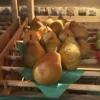
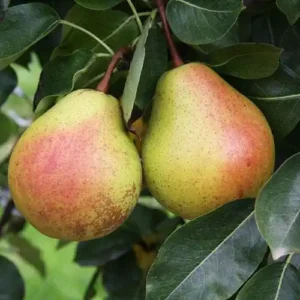
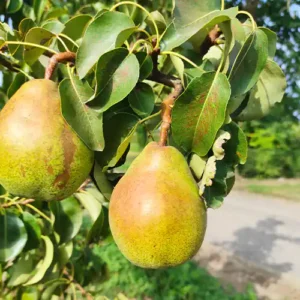
The fruit is medium to large and typically pear-shaped, with pale green skin turning lemon yellow when ripe and sometimes developing a light pink blush on the sunny side. The creamy-white flesh is fine, melting and particularly juicy. Its flavour is sweet and pleasant, although generally less strongly aromatic than ‘Williams’.
‘Doctor Jules Guyot’ is one of the earliest important European pears, usually picked from late July into early August, around ten to fifteen days before ‘Williams’. Fruit should be harvested while still firm because it ripens quickly afterwards. For such an early pear, storage ability is relatively good and fruit can keep for around one to two months under suitable refrigerated conditions.
The tree has moderate vigour, an upright habit and comes into production quickly. It is partially self-fertile and can also set some parthenocarpic fruit, but crops improve with compatible pears such as ‘Williams’, ‘Conference’ or ‘Doyenné du Comice’. Its pollen is good. The cultivar is fairly resistant to pear scab but is susceptible to fire blight.
Variety characteristics
Raised by the Baltet nursery at Troyes, France, around 1870 and named after Doctor Jules Guyot.
Origin and identity
Parents unknown
Guyot|Jules Guyot|Dr Jules Guyot|French Bartlett|Limonera|Llimonera|William Précoce
Growth and adaptation
Moderate vigour with an upright habit, rapid entry into bearing and good regular productivity.
Poor to moderate compatibility with quince rootstocks. Pear rootstock or a compatible interstem is preferable where long-term graft compatibility is important.
Disease behaviour
Fairly resistant to scab, susceptible to fire blight
Pollination
Compatible pollinating varieties
For reliable fruit set, plant at least one variety with a compatible flowering period nearby. Flowering period: 3 - mid season.
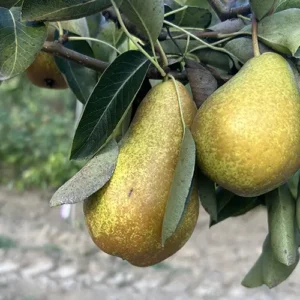 Beurré Durondeau Price range: 26,50 € through 59,75 €View this variety
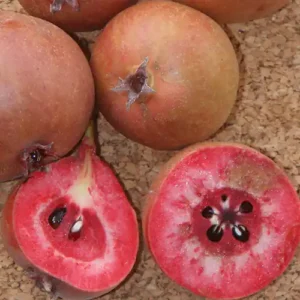 Kravnicka Price range: 26,50 € through 59,75 €View this variety
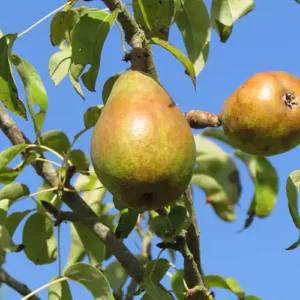 Beurre d’Anjou Price range: 26,50 € through 59,75 €View this variety
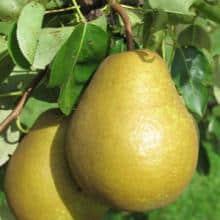 Clement’s Price range: 26,50 € through 59,75 €View this variety
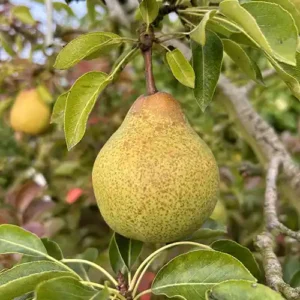 Packam’s Triumph Price range: 26,50 € through 59,75 €View this variety
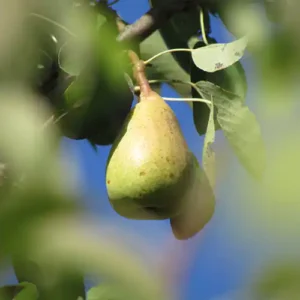 Morettini Price range: 26,50 € through 59,75 €View this variety
Related products
Dessert pear trees
Dessert pear trees
Pear trees
Dessert pear trees