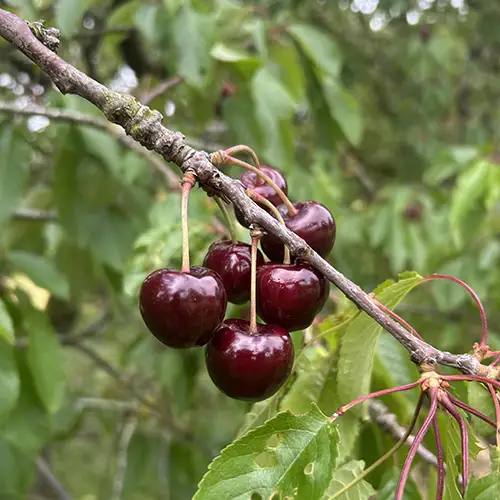
Schneiders suits gardens and orchards with enough room for a vigorous tree. We recommend it to growers seeking spectacular cherries: the very large reddish-brown fruit is firm, crisp, mild and aromatic, with a late harvest. A compatible pollinator is required. Its main limitations are susceptibility to rain cracking and brown rot during wet conditions.
Schneiders Späte Knorpelkirsche
Price range: 26,50 € through 64,50 €
A very large, late-ripening German bigarreau cherry with dark reddish-brown fruit and exceptionally firm, crisp, mild and pleasantly aromatic flesh.
‘Schneiders Späte Knorpelkirsche’ is an old German variety renowned for the remarkable size, firmness and quality of its fruit.
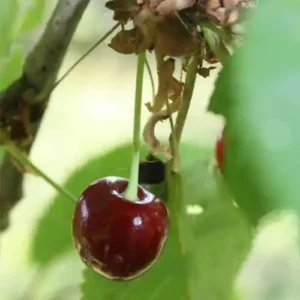
The cherry is exceptionally large, broadly heart-shaped with a blunt tip, and has thick, glossy skin that withstands handling well. Initially red, it turns dark reddish brown when fully ripe and remains dotted with numerous small pale spots.
The flesh is exceptionally firm, crisp and fleshy. Initially pale, it gradually develops more colour as the fruit ripens. It is moderately juicy, richly sweet, mild and pleasantly aromatic, making it an excellent dessert cherry. The fruit is also suitable for preserves, jams, compotes and baking.
Harvest is late and generally takes place during July, sometimes continuing into early August in cooler regions. The fruit should be eaten or processed soon after picking, as its natural storage life is short.
The tree is very vigorous and forms a tall crown, initially pyramidal and becoming broader with age. Cropping can be good, but depends heavily on favourable conditions during flowering and the presence of abundant pollinating insects. The fruit is susceptible to rain cracking and may subsequently be affected by brown rot.
‘Schneiders Späte Knorpelkirsche’ is self-sterile and has the incompatibility genotype S3S12. It must be planted with a compatible late-flowering variety such as ‘Kassins Frühe’, ‘Büttners Rote Knorpelkirsche’, ‘Hedelfinger’ or ‘Regina’.
Variety characteristics
An old German variety originating from a chance seedling discovered around 1850 in Guben, Brandenburg, on the property of a grower named Schneider.
Origin and identity
Chance seedling, parents unknown
Schneiders Späte Knorpel, Schneiderkirsche, Schwarze Knorpelkirsche, Nordwunder, Germersdorfer, Zeppelin, Höfchenkirsche, Kaukasische, Nürtinger Riesenkirsche, Schneiders Späte Knorpelkirsche
Growth and adaptation
Very vigorous, tall and initially pyramidal habit, becoming broader with age
Pollination and fertility
S3S12
Pollination
Compatible pollinating varieties
For reliable fruit set, plant at least one variety with a compatible flowering period nearby. Flowering period: 4 - late.
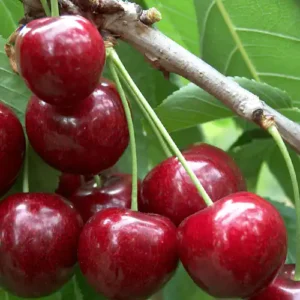 Sunburst Price range: 26,50 € through 64,50 €View this variety
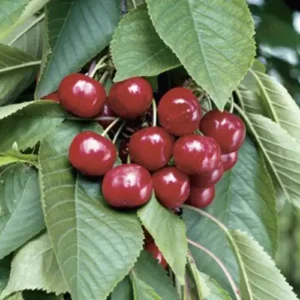 Stella Price range: 26,50 € through 64,50 €View this variety
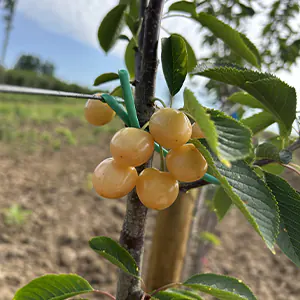 Verchocq Price range: 26,50 € through 64,50 €View this variety
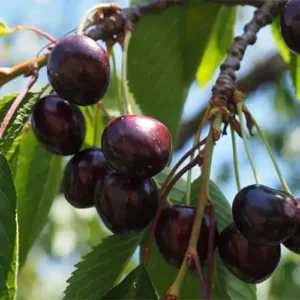 Kordia Price range: 26,50 € through 64,50 €View this variety
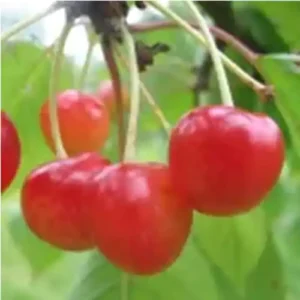 Gascogne Tardive from Seninghem Price range: 26,50 € through 64,50 €View this variety
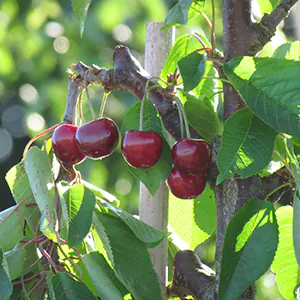 Coeur de Pigeon Price range: 26,50 € through 64,50 €View this variety
Harvest calendar
Extend your harvest season
Discover varieties from the same category harvested just before, at the same time or just after.
About 15 days earlier
June 15-30
Related products
Cherry trees
Cherry trees
Cherry trees
Cherry trees