
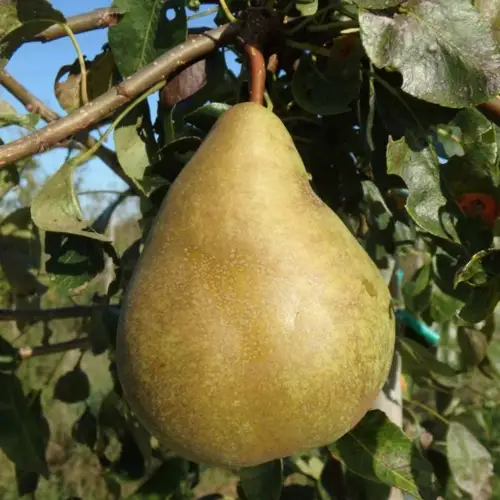
Material circulated as Nicolas Panaché is described as a rare bronze-skinned sport of Alexandrine Douillard. Its elongated pears develop attractive copper-yellow colouring and sweet, aromatic flesh after ripening. The unusual appearance is its main attraction. Independent documentation remains scarce, so we would regard it as a collector’s cultivar whose long-term behaviour still deserves observation.
Nicolas Panaché
Price range: 26,50 € through 59,75 €
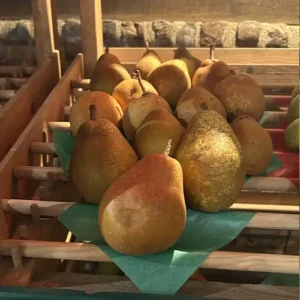
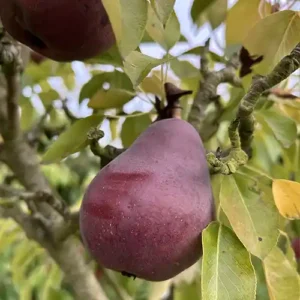
A rare bronze-skinned sport of Alexandrine Douillard, producing elongated, copper-coloured pears with firm, very sweet and pleasantly aromatic flesh.
‘Nicolas Panaché’ is a rare coloured sport of ‘Alexandrine Douillard’, sharing the original variety’s productivity and eating qualities while differing through its more extensively bronze and copper-coloured skin.
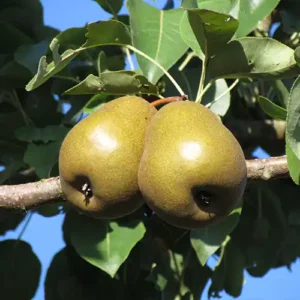
The medium to large fruit has an elongated pear shape, sometimes irregular and slightly ribbed. Its thin skin becomes bronze yellow at maturity and is extensively covered with russet, giving the fruit a distinctive and particularly decorative appearance.
The white flesh is moderately fine and initially quite firm, becoming melting when fully ripe. It is very sweet, juicy and pleasantly aromatic. The fruit should be eaten before it becomes overripe, as the flesh may then turn slightly mealy.
Harvest takes place from the second half of September into early October. The pears continue to ripen after picking and can be stored for around two months under suitable conditions.
The tree has moderate vigour, is heavily branched, fertile and quick to begin cropping. Its generally good compatibility with quince allows it to be grown in a range of forms. Like the original variety, it is self-sterile and must be planted with a compatible pear flowering at a similar time.
Variety characteristics
A bronze-skinned sport of Alexandrine Douillard, a French variety raised in Nantes by Constant Douillard and first fruited in 1849; the date when the ‘Nicolas Panaché’ sport appeared is undocumented.
Origin and identity
Coloured sport of Alexandrine Douillard
Bronze Alexandrine Douillard
Growth and adaptation
Moderately vigorous, open and heavily branched habit
Good compatibility with quince; avoid highly calcareous soils and very hot positions
Disease behaviour
Susceptible to scab
Pollination
Compatible pollinating varieties
For reliable fruit set, plant at least one variety with a compatible flowering period nearby. Flowering period: 3 - mid season.
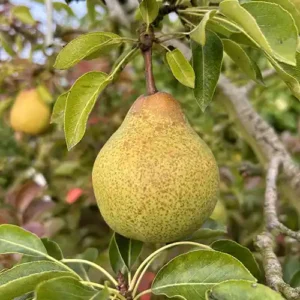 Packam’s Triumph Price range: 26,50 € through 59,75 €View this variety
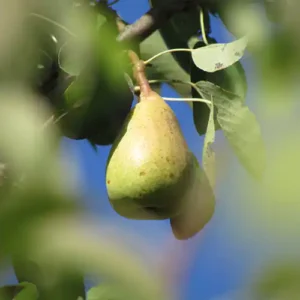 Morettini Price range: 26,50 € through 59,75 €View this variety
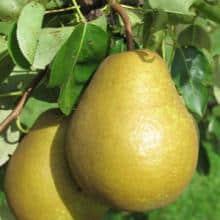 Clement’s Price range: 26,50 € through 59,75 €View this variety
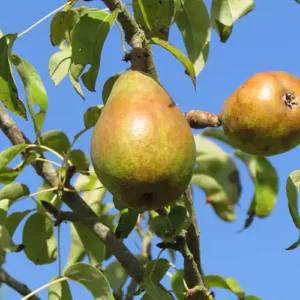 Beurre d’Anjou Price range: 26,50 € through 59,75 €View this variety
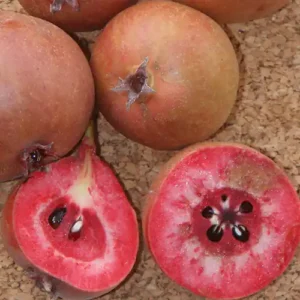 Kravnicka Price range: 26,50 € through 59,75 €View this variety
 President Heron Price range: 26,50 € through 59,75 €View this variety
Harvest calendar
Extend your harvest season
Discover varieties from the same category harvested just before, at the same time or just after.
About 15 days earlier
September 1-15
Related products
Dessert pear trees
Pear trees
Dessert pear trees
Bollwiller pear trees