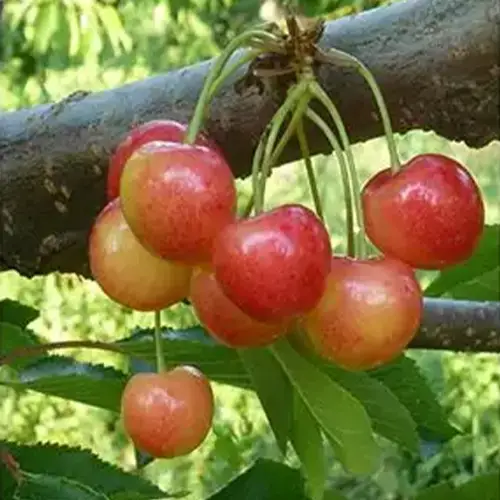
Stardust is particularly suited to gardens wanting a late, self-fertile cherry. Its large cream-yellow fruit, heavily blushed red, is firm, exceptionally juicy, sweet and distinctive, and the tree crops heavily. We recommend it for extending the season with a single tree. The fruit ripens progressively and remains susceptible to cracking and surface rubbing marks.
Stardust
Price range: 26,50 € through 64,50 €
A late-ripening, self-fertile Canadian cherry with large, two-coloured cream-yellow fruit blushed red and firm, exceptionally juicy, sweet flesh.
‘Stardust’ is a late-ripening Canadian variety selected at the Summerland Research Station in British Columbia. It is distinguished by its large, two-coloured fruit, high productivity and self-fertility.
The large to very large cherry is rounded to slightly heart-shaped. Its skin has a cream-yellow background, extensively dotted and blushed with bright red, with the colour becoming more intense according to sun exposure and stage of ripeness.
The cream-coloured flesh is firm, fleshy and exceptionally juicy, with clear juice. Its flavour is richly sweet, mild and aromatic, sometimes with a subtle spicy note. The fruit is excellent for eating fresh, while its distinctive colouring also makes it particularly attractive in desserts, fruit salads and preserves.
Harvest is late and generally takes place during the second half of July, approximately one to two weeks after ‘Van’. Several pickings may be required to harvest each fruit when its colour and sugar content are at their best.
The tree has moderate to strong vigour and develops a broad, spreading habit, with naturally fairly horizontal branches. It begins cropping relatively quickly and produces exceptionally heavy, regular crops while generally maintaining good fruit size.
The fruit has moderate to fairly high susceptibility to rain cracking. Its pale skin can also be marked by rubbing caused by wind, so a sheltered position is preferable.
‘Stardust’ is self-fertile and has the S-allele genotype S1S4′. Its late flowering and pollen compatibility with many varieties also make it a useful pollinator for other cherry trees flowering at the same time.
Variety characteristics
A Canadian variety resulting from a cross made in 1976 by David W. Lane at the Summerland Research Station in British Columbia; selected in 1985 under the number 13N-07-70 and released for commercial trials in 2002.
Origin and identity
2N-63-20 × Stella
13N0770, 13N-07-70, Stardust
Growth and adaptation
Moderate to strong vigour, broad and spreading habit, exceptionally heavy and regular cropping
Pollination and fertility
S1S4′
Pollination
Compatible pollinating varieties
For reliable fruit set, plant at least one variety with a compatible flowering period nearby. Flowering period: 4 - late.
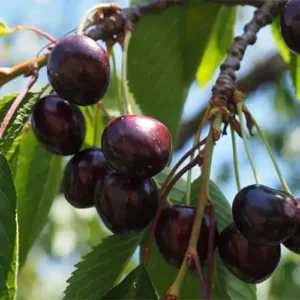 Kordia Price range: 26,50 € through 64,50 €View this variety
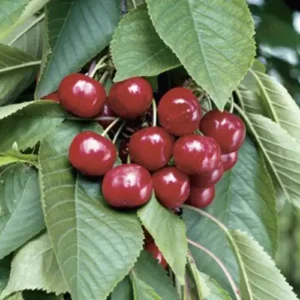 Stella Price range: 26,50 € through 64,50 €View this variety
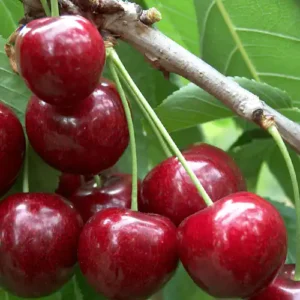 Sunburst Price range: 26,50 € through 64,50 €View this variety
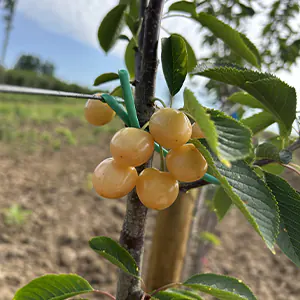 Verchocq Price range: 26,50 € through 64,50 €View this variety
 Blanc Nez Price range: 26,50 € through 64,50 €View this variety
 Hedelfingen Price range: 26,50 € through 64,50 €View this variety
Harvest calendar
Extend your harvest season
Discover varieties from the same category harvested just before, at the same time or just after.
Related products
Cherry trees
Cherry trees
Cherry trees
Cherry trees