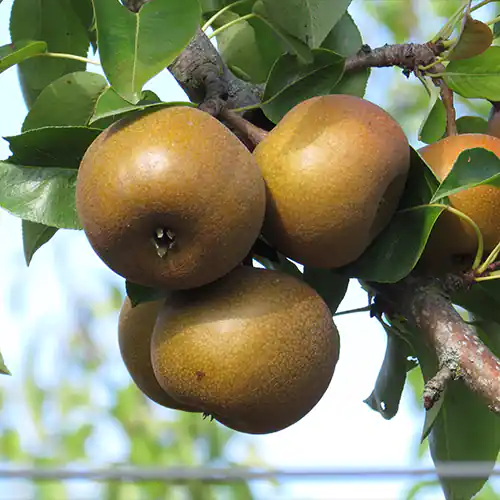
Grise Notre Dame is a genuine regional cooking pear with little value when eaten raw. Its hard, brittle flesh withstands prolonged cooking and is particularly well suited to candied pears and traditional vinegar preserves. The tree is hardy, long-lived and shows useful resistance to pear scab. We would plant it to preserve the culinary traditions of Hainaut and Avesnois rather than as a multipurpose dessert pear.
Grise Notre Dame
Price range: 26,50 € through 59,75 €
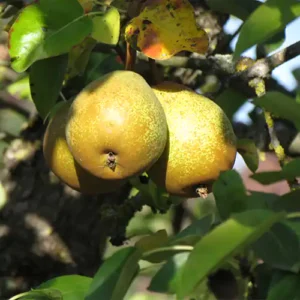
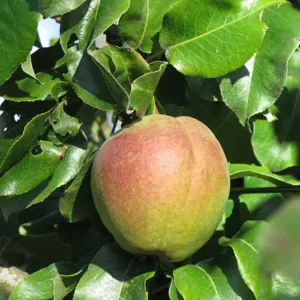
Grise Notre Dame pear tree, a hard cooking pear for candied pears or vinegar preparations, harvested in late September.
Grise Notre Dame pear tree produces medium-sized pears especially suited to cooking, candied pear preparations and pears cooked or preserved with vinegar.
The flesh is very crisp, hard and breaking in texture. Like other cooking pears, its full culinary value is revealed through preparation rather than fresh eating.
The fruit is picked or collected during the second half of September and is eaten from October. It can be kept cool, although this is not among the longest-keeping cooking pears.
Grise Notre Dame has no particular disease sensitivity and shows good-quality vegetation. The tree is noted for growing healthily, with very little scab, and for its good longevity.
Flowering is mid-season. It pollinates well with Beurré Superfin and Beurré Lebrun.
Grise Notre Dame is a well-known variety for culinary use in northern France and Belgian Hainaut. It was praised by the horticulture professor Mr Pamart in a work dating from 1900, making it a fairly old variety.
This pear is also known under the simpler name Notre Dame.
We produce this grafted pear tree on rootstocks that influence the vigour and final size of the mature tree. It is available in several tree forms depending on availability.
Variety characteristics
Origin and identity
Growth and adaptation
Disease behaviour
Pollination
Compatible pollinating varieties
For reliable fruit set, plant at least one variety with a compatible flowering period nearby. Flowering period: 3 - mid season.
Related products
Cooking pear trees
Cooking pear trees
Cooking pear trees
Cooking pear trees