saskatoon plants
saskatoon plants
saskatoon plants
saskatoon plants
saskatoon plants
saskatoon plants
Saskatoon berry and serviceberry plants: choosing a cultivar for fruit
Serviceberries belong to the genus Amelanchier in the rose family, alongside apples, pears, quinces and hawthorns. Their blue-purple fruit resembles a berry, but botanically it is a small pome constructed on the same principle as a miniature apple.
The commonly cultivated species produce edible fruit, but they are not equally valuable as fruit plants. Some serviceberries have been selected mainly for their spring blossom, habit or autumn colour, while cultivars derived primarily from Amelanchier alnifolia, known as Saskatoon berries in Canada, have been selected for productivity, fruit size and eating quality.
Saskatoon berry plants are exceptionally winter hardy and their fruit does not require an intensely hot summer to ripen. Successful cropping depends more on cultivar quality, sunlight, protection of the blossom from late frost, adequate moisture while the fruit develops, renewal of productive young stems and protection from birds.
Saskatoon berry or ornamental serviceberry?
Amelanchier alnifolia: the principal fruiting species
Amelanchier alnifolia is native to a large area of North America, from Alaska, Yukon and the Canadian Prairie provinces to northern and western parts of the United States. This origin explains its excellent winter hardiness and adaptation to cold continental climates.
The species generally forms a multi-stemmed shrub, occasionally developing into a small tree, and may spread gradually through basal shoots or rhizomes.
Cultivars such as ‘Smoky’, ‘Northline’, ‘Thiessen’, ‘Martin’, ‘Pembina’ and ‘Honeywood’ were selected primarily for fruit production rather than ornamental value alone.
These cultivars differ significantly in fruit size, firmness, sugar concentration, flavour, habit, vigour, suckering and the concentration of their ripening period. Saskatoon cultivars should not therefore be treated as interchangeable.
Amelanchier canadensis, A. laevis, A. arborea and A. lamarckii
These serviceberries generally form tall shrubs or small ornamental trees valued for their white spring blossom, copper-coloured young leaves and autumn colour.
Their fruit is edible, but it is often smaller, less uniform or less abundant than that of cultivars specifically selected for fruit production.
They remain excellent choices where the objective is to combine an attractive small tree with an occasional harvest. For regular fresh consumption or processing, a named fruiting cultivar of Amelanchier alnifolia is normally more suitable.
Species that can be difficult to identify
Serviceberry species are closely related, naturally variable and capable of hybridising. Identification based only on leaf or fruit shape can therefore be uncertain, and some long-established horticultural names cover plants of complex origin.
When choosing a fruiting plant, the known characteristics of a correctly identified cultivar are often more useful than an overly confident species name. A named clonal cultivar provides greater predictability than an unnamed seedling sold simply as serviceberry.
Can one Saskatoon berry plant produce fruit?
Fruiting Saskatoon cultivars are generally self-fertile, or more precisely capable of setting fruit with their own pollen. A single plant can therefore produce without a second cultivar being essential.
The flowers are visited by bees, bumblebees and other pollinating insects. A second cultivar flowering at the same time may improve fruit set and cropping regularity, particularly when flowering weather is less favourable.
It is therefore inaccurate to state either that two plants are always required or that a second cultivar provides no benefit. One self-fertile cultivar is normally sufficient for a small garden, while two distinct cultivars can be useful where a heavier crop is desired.
Flowering occurs early in spring, often as the leaves are beginning to unfold. Cold, rainy or windy weather may reduce insect activity, while frost affecting open flowers can remove part or all of the crop despite the excellent winter hardiness of the shrub itself.
Winter hardiness and blossom frost are different issues
Saskatoon berries are among the most winter-hardy fruiting shrubs. The cold tolerance of dormant wood does not mean that flowers, young leaves and fresh shoots tolerate the same temperatures.
A spring frost may blacken open flowers, scorch young foliage or cause newly formed fruit to drop. The plant normally survives without difficulty, but the harvest for that season may be reduced.
The risk depends strongly on the local microclimate. A shrub planted in a hollow, at the bottom of a slope or behind an obstacle that traps cold air may suffer more damage than a plant only a few metres higher.
In cool regions, a very warm wall is not automatically the safest position. A sunny, slightly elevated site with good air movement is often preferable to an enclosed position that encourages the buds to open prematurely.
Useful characteristics when comparing Saskatoon cultivars
Fruit size
Fruiting cultivars generally produce larger and more uniform fruit than wild or ornamental forms. Large fruit is pleasant to eat directly and makes harvesting quicker, but size should not be the only selection criterion.
A slightly smaller fruit may have a more concentrated flavour, retain its shape better when cooked or ripen more uniformly. Fruit size also varies according to crop load, pruning, sunlight and water availability.
Flavour
A Saskatoon berry does not taste exactly like a blueberry. The fruit is generally less acidic and firmer, with a texture influenced by several very small, soft seeds.
Depending on the cultivar and stage of maturity, the flavour may suggest blueberry, plum, sweet cherry or almond.
Some cultivars are sweet but relatively mild, while others have a more concentrated aroma. Sunlight, soil moisture, crop load and seasonal conditions also influence sugar content and flavour intensity.
Firmness and intended use
Firm fruit tolerates handling, freezing and cooking more successfully. This is useful for pies, preserves, drying and harvesting in quantity.
For eating directly from the shrub, a softer and juicier texture may be preferred. A naturally tender cultivar should nevertheless be distinguished from fruit that has become soft through over-ripening or excessive heat after harvest.
Concentrated or extended ripening
The fruit within a single cluster does not always ripen at exactly the same time. Concentrated ripening makes harvesting and processing easier, while a more gradual season extends the period for eating fresh fruit.
Colour alone can be misleading. A fruit that has already turned purple may still be firm, low in sugar and slightly astringent.
For the fullest flavour, wait until the fruit is dark blue-purple to almost black, slightly yielding and easy to detach.
Habit and suckering
Some cultivars form a strongly upright clump, while others develop a more spreading habit or produce numerous suckers.
An upright plant is easier to walk around, net and harvest. A strongly suckering cultivar may quickly form a productive hedge or small colony.
Suckering is not a disease. It is part of the natural renewal strategy of Amelanchier alnifolia. It can be useful in a fruiting hedge but requires regular control where a single isolated shrub is preferred.
Seedling or named clonal cultivar?
A seed-grown plant is not a copy of the plant that produced the seed. Vigour, habit, fruit size, flavour, firmness and ripening period may all vary between seedlings.
Seedling populations can be useful for a wildlife hedge, a breeding project or fruit production where uniformity is unimportant. They are less suitable when the characteristics of a recognised cultivar are required.
Fruiting cultivars are propagated by cuttings, layering, division of suckers or tissue culture so that their genetic identity is preserved.
These plants normally grow on their own roots, meaning that suckers arising from the root system usually belong to the same cultivar.
There is no standardised range of dwarfing serviceberry rootstocks comparable with that available for apples. Species, cultivar and training method have a greater influence on final dimensions than the search for a particular rootstock.
Where should a Saskatoon berry be planted?
Serviceberries tolerate partial shade and can grow at the edge of woodland, but fruit production is normally better in full sun.
Strong light encourages flower formation, sugar accumulation, fruit colour and the renewal of productive young wood.
In northern and western Europe, choose a position receiving direct sunlight for most of the day. Light shade late in the afternoon is acceptable, but planting beneath the crown of mature trees often produces more foliage than fruit.
The shrub should remain accessible. Birds begin watching the crop before full maturity, and a plant that has become excessively tall or mixed into a dense hedge is difficult to net and harvest.
Allow for the mature dimensions of the cultivar. Some Saskatoon berries remain close to two metres, while others may reach three to five metres and spread progressively through suckers.
Which soil suits Saskatoon berry plants?
Serviceberries prefer deep, fertile soil that retains moisture but drains correctly. Loamy or clay-loam ground with a useful water reserve provides favourable conditions for growth and fruit development.
Unlike blueberries, serviceberries are not acid-loving heathland plants and do not require strongly acidic soil.
Many species tolerate a relatively broad pH range. Slightly acidic to neutral soil is generally ideal, while moderately calcareous ground can also be suitable when it remains deep and sufficiently moist.
The least favourable conditions are permanently waterlogged ground and extremely sandy, poor and drought-prone soil. Consistent moisture is useful, but water should not remain continuously around the root collar and root system.
In heavy ground, cultivate only once the soil has drained sufficiently. Working wet clay creates compact blocks and glazed surfaces that restrict establishment.
In light soil, incorporate mature organic matter over a broad area and monitor watering more carefully during dry weather.
Planting a young container-grown serviceberry
A dormant serviceberry may be planted in autumn or winter whenever the ground is neither frozen nor waterlogged.
For a container-grown plant that is already in leaf, spring planting after the main risk of late frost avoids immediately exposing tender foliage and flowers to cold conditions for which they are not yet acclimatised.
A mature dormant shrub is considerably hardier than a young nursery plant carrying soft new growth. This does not reduce the general hardiness of the species; it concerns only tissues that have already begun growing.
Prepare a broad area rather than a small planting hole filled with potting compost. Loosen the soil, create a crumbly structure once it has drained and, for spring planting, allow the soil to begin warming.
Remove couch grass, bindweed, docks and other perennial weeds carefully. Serviceberries develop many feeding roots near the surface and compete poorly with dense grass during establishment.
Position the root collar at soil level and backfill mainly with the original soil. A moderate quantity of mature compost can be incorporated over a broad area where the soil is poor, but a pocket of pure compost or fresh manure does not provide better long-term establishment.
Water thoroughly after planting to settle the soil around the roots. Keep the surrounding area weed-free and water throughout the first year whenever rainfall is insufficient, not only during the first few weeks.
Organic mulch can conserve moisture, but it should not be piled against the stems. Keep the root collar visible and check the moisture beneath the mulch rather than watering according to a fixed timetable.
Watering and feeding
An established serviceberry tolerates moderately dry periods, but fruit production is sensitive to a lack of water.
Drought during flowering, fruit set or fruit swelling may reduce fruit size and cause part of the crop to drop.
Water young plants deeply whenever rainfall is insufficient. Frequent shallow watering encourages roots to remain near the surface and makes the shrub more dependent on future irrigation.
Serviceberries are not particularly demanding feeders. Excessively soft growth caused by heavy nitrogen applications may increase vulnerability to fire blight, aphids and foliar diseases.
A moderate addition of mature compost combined with healthy soil and suitable mulch is normally sufficient in a garden.
Before treating an apparent nutrient deficiency, first check drainage, grass competition and the actual moisture level of the soil.
Which wood carries the best crop?
Fruit production is concentrated on young, well-lit branches. In commercial Saskatoon plantings, stems approximately two to four years old generally produce the best-quality fruit.
An unmanaged clump gradually accumulates old, tall stems that are shaded near their base. The crop then moves towards the outside and top of the shrub, making the fruit more difficult to pick and protect.
Repeatedly cutting back every shoot removes wood capable of flowering and stimulates vigorous leafy growth at the expense of fruit production.
Pruning should create gradual renewal rather than forcing the shrub into a rigid geometric shape.
Pruning and renewing a fruiting clump
During the first few years, allow the shrub to develop several strong, well-spaced stems. Remove only damaged wood, badly crossing branches and suckers extending beyond the area allocated to the plant.
Once the clump becomes dense, remove a small number of the oldest stems at ground level each year to encourage vigorous replacements.
This method maintains regular production while allowing light and air to reach the centre of the plant.
Do not shorten every branch tip as though trimming a formal hedge. This creates a dense outer shell of small shoots, pushes fruit towards the edge and makes harvesting more difficult.
An old and unproductive clump can be rejuvenated by cutting it back close to the ground because serviceberries are capable of regrowing from the base. This temporarily removes the crop and should be reserved for genuinely old or badly neglected plants.
Serviceberries trained as small trees require lighter pruning. Maintain a balanced framework, remove basal shoots where a clear trunk is desired and avoid large cuts that damage the naturally elegant shape of the tree.
How to recognise fully ripe Saskatoon berries
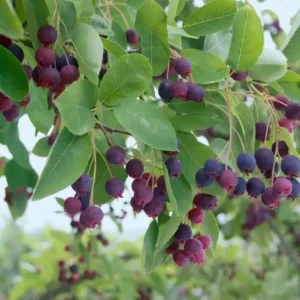
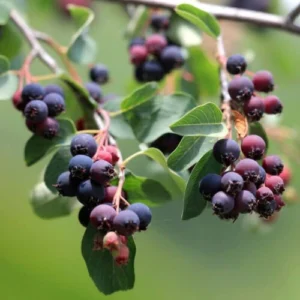
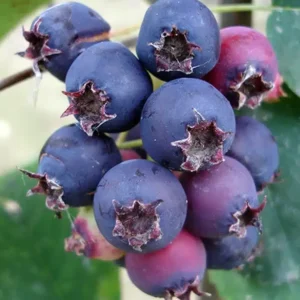
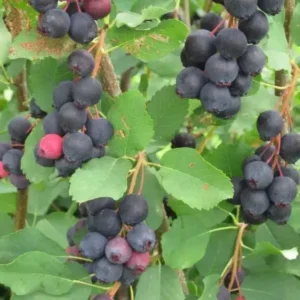
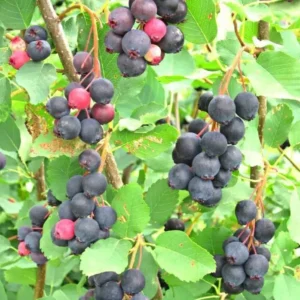
The fruit normally changes from green to pink or red and then to dark purple. It is not fully ripe as soon as it begins to colour.
At the early purple stage, the flesh may still be firm, low in sugar and slightly astringent.
Fully ripe fruit has the characteristic colour of the cultivar, usually blue-purple to almost black with a light waxy bloom. It becomes slightly softer, develops its aroma and detaches without needing to be pulled firmly from the cluster.
Fruit within one cluster may not ripen simultaneously. For fresh eating, several picking rounds allow each fruit to be harvested at its best stage.
For cooking or freezing, a small proportion of slightly less mature fruit is normally acceptable.
Birds often begin eating the crop before the gardener considers it completely ripe. A rapidly disappearing harvest does not therefore necessarily indicate poor fruit set or premature fruit drop.
Protecting the crop from birds
Blackbirds, starlings and other birds are among the principal competitors for Saskatoon berries. Once they have identified the food source, they may remove the crop within a very short period.
The most effective protection is a properly supported net or fruit cage installed before the fruit reaches full colour.
Do not simply throw loose netting over the branches. It is difficult to remove and may trap birds.
Choosing a cultivar of manageable height and maintaining an open clump makes protection considerably easier. Complete netting soon becomes impractical when a serviceberry is trained as a large tree.
In a large garden, planting several shrubs may provide enough fruit to share part of the crop with wildlife, but this does not guarantee that birds will leave the best fruit within easy reach.
Flavour, uses and storage
Saskatoon berries can be eaten fresh, but their texture and flavour are often particularly well expressed after cooking.
They are suitable for pies, compotes, preserves, jellies, muffins, sauces and fruit desserts.
Their flesh generally retains its shape more effectively during cooking than a blueberry. This is useful in baking, where the fruit can remain partly intact rather than releasing all of its juice.
The fruit can also be dried or made into fruit leather. Its mild sweetness can benefit from being combined with a sharper fruit such as redcurrant, raspberry or a tart apple.
After picking, cool the fruit promptly. Fully ripe Saskatoon berries keep for only a few days in the refrigerator.
Freezing is a simple method of longer preservation and maintains their suitability for cooking and baking.
Diseases to monitor in humid climates
Entomosporium leaf spot and other foliar diseases
Entomosporium leaf spot, which also affects quinces and some hawthorns, may produce numerous small brown or reddish marks on the leaves.
During wet seasons, severely affected foliage may turn yellow and fall prematurely.
An open canopy, avoidance of overhead watering and removal of heavily affected fallen leaves reduce favourable conditions. Susceptibility varies between species and cultivars.
Juniper-associated rust diseases
Several rust fungi in the genus Gymnosporangium alternate between serviceberries or other members of the rose family and different juniper species.
They may produce yellow-orange leaf spots, distorted growth and occasionally orange structures on the fruit.
Nearby junipers may increase infection pressure, but removing every juniper in the surrounding area is rarely realistic or effective because spores can travel considerable distances.
Choosing a cultivar with useful tolerance and maintaining good air movement are more practical long-term measures.
Fire blight
Like apples, pears and hawthorns, serviceberries can be affected by fire blight. Young shoots may wilt and blacken rapidly, with dead leaves remaining attached and the shoot tip sometimes bending into a characteristic hook.
A blackened shoot is not automatically fire blight. Late frost, cankers and physical injury can produce similar symptoms. Rapid and unusual dieback should be identified reliably before action is taken.
Powdery mildew and stem cankers
Powdery mildew may create a white coating on leaves, particularly on young growth and in poorly ventilated positions.
It is often not severe but may weaken or reduce the appearance of susceptible cultivars.
Cankers and stem dieback may also occur on old, wounded or poorly drained plants. Remove dead wood with clean tools and avoid allowing the clump to become excessively dense.
Which serviceberry should you choose?
For regular fruit production, choose a named cultivar of Amelanchier alnifolia. Compare flavour, fruit size, firmness, vigour, habit and suckering rather than selecting only the cultivar advertised as producing the largest fruit.
For eating fresh, choose a sweet, aromatic and large-fruited cultivar.
For pies, preserves or freezing, a productive cultivar with firm fruit and relatively concentrated ripening may be more practical.
For a fruiting hedge, a vigorous and freely suckering cultivar can quickly form a productive line of shrubs.
For a small garden or a plant intended to remain beneath netting, a compact cultivar that can be kept below two or three metres is easier to manage.
Where the primary objective is an ornamental small tree with an occasional crop, forms of Amelanchier laevis, A. canadensis, A. arborea, A. lamarckii and ornamental hybrids remain excellent choices.
Do not confuse the winter hardiness of the plant with security of the harvest. A serviceberry may be completely adapted to the climate yet produce little because of frost on the flowers, insufficient sunlight, ageing stems or birds removing most of the crop.
Frequently asked questions about Saskatoon berry and serviceberry plants
Are the fruits of all serviceberries edible?
Yes, the commonly cultivated species produce edible fruit, but fruit size, flavour and abundance vary considerably. Cultivars of Amelanchier alnifolia are generally the most suitable for regular fruit production.
What is the difference between a Saskatoon berry and a serviceberry?
The name Saskatoon berry principally refers to Amelanchier alnifolia and its North American fruiting cultivars. It is therefore a type of serviceberry rather than a completely separate genus.
Is a Saskatoon berry a blueberry?
No. Despite its colour and appearance, it is a small pome belonging to the rose family. Blueberries belong to the heather family and generally require much more acidic soil.
Are two Saskatoon berry plants required for fruit?
No. Fruiting cultivars are generally self-fertile and one plant can produce. A second cultivar and active pollinating insects may nevertheless improve fruit set.
Are serviceberry flowers resistant to late frost?
The dormant wood is exceptionally hardy, but open flowers and young shoots can be damaged. A spring frost may remove the crop without threatening the survival of the shrub.
Do serviceberries tolerate calcareous soil?
They generally tolerate neutral or moderately calcareous soil better than blueberries. Very calcareous, shallow and dry ground may still restrict growth.
Can a Saskatoon berry grow in partial shade?
Yes, but yield and sugar concentration are generally higher in full sun. In deep shade, the shrub may remain healthy while flowering and cropping poorly.
Why does my serviceberry flower without producing fruit?
The flowers may have been damaged by frost, poorly pollinated during cold weather or affected by disease. Small young fruit may also be removed by birds before it is noticed.
Why do the fruits remain red and acidic?
They are not yet fully ripe. Wait until they become dark purple, slightly soft and easy to detach. Insufficient sunlight or an excessive crop can also delay sugar accumulation.
Why does my Saskatoon berry produce so many suckers?
Suckering is natural in Amelanchier alnifolia. Remove unwanted shoots at ground level or allow them to develop into a fruiting hedge.
Can a serviceberry be maintained as a small tree?
Yes, with suitable species and cultivars. Retain one or more main trunks and remove basal shoots regularly. Strongly suckering cultivars are normally easier to manage as multi-stemmed shrubs.
When should a fruiting serviceberry be pruned?
The main pruning can be carried out during dormancy. Gradually remove old stems, dead wood and branches closing the centre while retaining sufficient productive young wood.
Can an old serviceberry be cut back hard?
Yes. An old clump can regrow after being cut close to the ground, but cropping will be interrupted while it rebuilds. Gradual annual renewal is generally preferable.
How can the fruit be protected from birds?
Install a properly supported net or fruit cage before full maturity. A shrub maintained at a manageable height is much easier to protect than a large tree.
How long do Saskatoon berries keep?
Fully ripe fruit keeps for only a few days in the refrigerator when cooled promptly after harvest. It freezes well and can also be dried or processed.