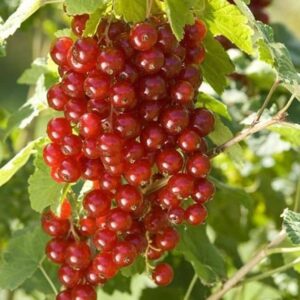
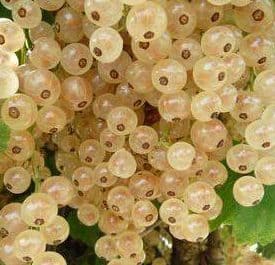
Pre-orders are open No payment today. Stock will be checked during the inventory in early August, then you will receive a payment link for the available trees.

Redcurrant

Autumn 2026

Redcurrant

Blanka

Blanka white currant bush, self-fertile with long clusters of aromatic, tangy white berries and full powdery mildew resistance.

9,50 
Autumn 2026

Redcurrant

Jonkheer Van Tets

An early productive redcurrant variety producing large sweet-tart berries with good disease resistance.
9,50 
Autumn 2026

Redcurrant

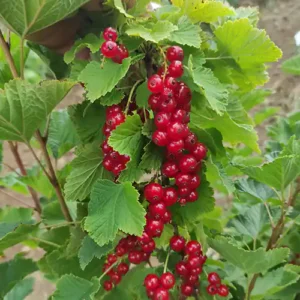
Junifer

Junifer red currant bush, an early self-fertile variety with sweet red berries, good yield and easy production.
9,50 
Autumn 2026

Redcurrant

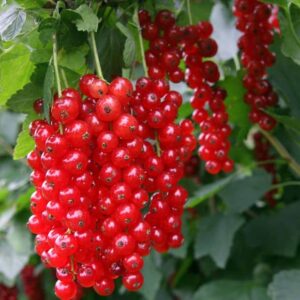
Red Versaillaise

Versaillaise Rouge red currant bush, an early self-fertile variety with large, glossy, sweet-tart berries.
9,50 
Autumn 2026

Redcurrant

Rovada

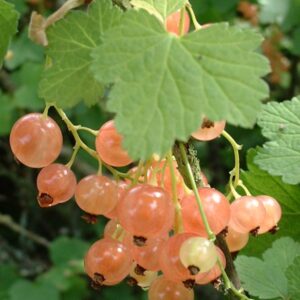
Rovada red currant bush, a late self-fertile variety with long red clusters, good flavour and strong disease resistance.
9,50 
Autumn 2026

Redcurrant

White Versaillaise

Versaillaise Blanche white currant, a late self-fertile variety with sweet, low-acid white berries when fully ripe.

9,50 

Redcurrant plants: red, white and pink varieties

Redcurrants are cultivated principally within the species Ribes rubrum and closely related European currants. They produce strings of small translucent berries that may be red, white, cream or pink according to the cultivar.

Whitecurrants and pink currants are not separate fruit species. They are forms of redcurrant with little or modified skin pigmentation and are planted, pollinated and pruned in the same way.

Redcurrants are well suited to cool temperate climates across northern, western and central Europe. Dormant plants tolerate cold winters and their fruit does not require an exceptionally hot summer to ripen.

Success depends more on soil quality, moisture during fruit development, protection of the flowers from late frost and pruning that preserves the correct fruiting wood.

Redcurrants should not be pruned like blackcurrants. Blackcurrants crop mainly on relatively young branches, whereas redcurrants produce much of their fruit on short spurs carried by branches that are two years old or older.

What is the difference between red, white and pink currants?

Redcurrants

Redcurrant cultivars generally provide a clear acidity, strong fruit colour and a distinctive fresh aroma.

They are particularly suitable for jelly, jam, coulis, juice, sauces, tarts and desserts in which their acidity and bright colour are valuable.

Cultivars differ in berry size, string length, ripening season, sweetness, acidity and ease of picking.

A long string makes harvesting quicker and looks attractive in desserts, but does not by itself guarantee better flavour or a heavier crop.

Whitecurrants

Whitecurrants have translucent skin and berries ranging from cream to pale yellow.

They often taste milder and less sharp than red cultivars, although they are not necessarily much higher in sugar.

The reduced acidity and astringency can make them particularly pleasant for eating directly from the plant.

They can also be used to make pale jellies, desserts and mixed-fruit preparations in which a strong red colour is not required.

Their pale fruit may be less immediately visible to birds, but valuable crops may still require protection.

Pink currants

Pink currants are visually intermediate between redcurrants and whitecurrants.

Good cultivars combine an attractive translucent pink colour with a relatively mild flavour and a more pronounced aroma than many white selections.

They are especially useful for fresh eating, fruit salads and decorating desserts.

Their cultivation, pollination and pruning requirements remain the same as those of other redcurrant-type plants.

Useful characteristics when choosing a redcurrant cultivar

Flavour and intended use

For fresh eating, choose a cultivar with sufficient sweetness, moderate acidity, relatively fine skin and fruit that can remain healthy on the plant until fully ripe.

For jelly, coulis and juice, stronger acidity and a concentrated aroma are advantages because sugar and cooking soften the sharpness of the fruit.

A cultivar should therefore be assessed according to its intended use rather than placed in one universal ranking of flavour.

String length

Long strings are attractive and quicker to harvest, especially when the berries ripen evenly from the base to the tip.

Shorter strings may still be numerous, productive and highly flavoured.

String length should be considered together with berry size, number of strings, ease of detachment and crop regularity.

Berry size

Large berries are convenient for fresh eating and reduce picking time, but fruit size is influenced by more than the cultivar.

Water availability, pollination, pruning, sunlight and crop load all affect the final size of the berries.

A variety known for large fruit will still produce small berries when the plant is dry, overcrowded or carrying too many poorly illuminated strings.

Ripening season

Early cultivars advance the beginning of the currant season, while late varieties extend harvesting into the second half of summer.

Late cultivars may hold ripe fruit on the plant for a useful period where the berries remain healthy and can be protected from birds.

Combining early, mid-season and late cultivars spreads both harvesting and processing without creating additional pollination requirements.

Growth habit

Some cultivars form compact and upright bushes, while others develop longer or more arching branches.

An open and upright habit makes fruit easier to pick and improves airflow around the foliage.

Long branches may require support when heavily laden, particularly in windy positions or after rain increases the weight of the crop.

Disease behaviour

Redcurrants are generally robust, but cultivars differ in their susceptibility to leaf spots, mildew, premature leaf fall and stem diseases.

In humid regions, a cultivar retaining healthy foliage into late summer can replenish its reserves more effectively and prepare a better crop for the following season.

One redcurrant plant is normally sufficient for fruit

Red, white and pink currant cultivars are generally self-fertile. One plant can therefore produce fruit without another cultivar nearby.

The flowers are nevertheless visited by bumblebees, honeybees and other insects, whose activity helps produce well-filled and regular strings.

Self-fertility means that pollen from the same cultivar can fertilise its flowers. It does not mean that pollinating insects and favourable flowering weather are unimportant.

Cold, wind, prolonged rain or frost during flowering can reduce fruit set even on a healthy self-fertile plant.

Several cultivars can be planted to obtain different colours, flavours and harvest periods, but they are not normally required to pollinate one another.

There are no separate male and female redcurrant plants that must be paired.

Winter hardiness and late spring frost

Dormant redcurrant wood is very winter hardy and withstands the cold conditions found across much of temperate Europe.

Open flowers and newly formed berries are much more vulnerable than dormant branches.

A spring frost may destroy part of the crop without causing lasting damage to the plant itself.

Avoid frost pockets, enclosed hollows and the bottom of slopes where cold air accumulates during clear nights.

Redcurrants do not need the warmest wall in the garden. An exceptionally warm south-facing position can advance bud break and flowering, increasing exposure to late frost.

A bright but relatively cool and well-ventilated position is often particularly suitable in northern and maritime climates.

Sun or partial shade?

Full sun generally increases crop size, berry colour and sugar concentration.

Redcurrants nevertheless tolerate partial shade better than many fruit crops and can produce against an east- or north-facing wall.

With less direct sunlight, the fruit normally ripens later and retains more acidity.

Light afternoon shade may be beneficial in hot and dry regions, where intense sun can scorch exposed berries and accelerate soil drying.

Avoid deep shade beneath large trees. Root competition and insufficient light produce weak growth, short strings and fruit with limited sweetness.

A bright woodland edge or a position receiving sun for a substantial part of the day can remain suitable.

Soil, moisture and drainage

Redcurrants prefer deep and fertile soil containing useful organic matter, remaining moist during fruit development while draining adequately in wet weather.

Structured clay soil can produce excellent results because it stores water during spring and early summer.

Compacted clay that remains continuously saturated restricts oxygen around the roots and weakens the plant.

Redcurrants tolerate soils ranging from slightly acidic to moderately calcareous.

Very calcareous, shallow and dry ground may limit growth, while sandy soil requires more organic matter, mulching and regular watering.

The root system is relatively shallow and competes poorly with dense grass.

A plant may remain alive in dry ground while producing short strings of small and exceptionally acidic berries.

Maintain a weed-free or mulched area around the plant, especially during establishment and fruit swelling.

Planting a young redcurrant

Dormant bare-root and container-grown plants are preferably planted between autumn and early spring whenever the ground is neither frozen nor waterlogged.

Autumn planting is particularly suitable in drained soil because the roots can begin establishing before the following growing season.

A container-grown plant already carrying leaves or flowers is less resistant to late frost than a dormant established bush.

Where the plant has started growing under protection, wait until the principal frost risk has passed or provide temporary protection during cold nights.

Prepare a broad area of soil rather than a narrow hole filled with potting compost.

Work the ground only when it has drained sufficiently to form a fine crumbly structure and remove couch grass, bindweed and other perennial weeds carefully.

Plant the redcurrant at approximately the depth at which it grew in the nursery, retaining a short clear stem above the ground.

Unlike a bush-form blackcurrant, it does not normally need to be planted deeply to encourage numerous new stems from below soil level.

Backfill mainly with the original soil, improved across a broad area with mature compost where required.

Avoid placing fresh manure, concentrated fertiliser or a small pocket of pure compost directly against the roots.

Water thoroughly after planting and maintain a weed-free root zone.

Continue watering throughout the first growing season whenever rainfall is insufficient, rather than caring for the plant only during the first few weeks.

Which wood carries the redcurrant crop?

Redcurrants produce fruit near the base of shoots formed during the previous season and on short fruiting spurs carried by branches that are two years old or older.

These spurs can remain productive for several years when they continue to receive sufficient light.

Branches should therefore not be removed simply because they have already carried fruit.

This distinguishes redcurrants from blackcurrants, whose best crops are associated more strongly with younger wood and which require faster branch renewal.

As redcurrant branches age, they eventually become weak, heavily branched, shaded or strongly arching.

These old framework branches should then be replaced progressively by strong and well-positioned younger shoots.

How should a bush redcurrant be pruned?

Maintain a short clear base and an open framework containing several main branches of different ages.

Light and air should be able to reach the centre of the bush.

During dormancy, remove dead, diseased and broken wood, branches lying on the soil, crossing growth and shoots directed towards the congested centre.

Gradually remove the oldest framework branches when their growth and fruiting decline.

Retain strong young branches capable of renewing the structure.

There is no need to replace a large proportion of the bush every year because redcurrant branches remain productive for longer than blackcurrant canes.

Lateral shoots can be shortened to maintain compact and well-lit fruiting spurs.

Avoid excessive pruning on a weak or recently planted bush, as the plant requires enough leaf area to establish and produce replacement wood.

Do not trim a redcurrant like a hedge by cutting every shoot to the same outline.

Hedge trimming creates dense external growth, shades the centre and makes the strings more difficult to see and harvest.

Bush, cordon or fan-trained redcurrant?

Bush form

A bush is the simplest and generally the most productive form where sufficient space is available.

Allow approximately 1.2 to 1.5 metres between plants according to cultivar vigour and the intended width of the mature bush.

Annual pruning consists mainly of keeping the centre open and renewing the oldest branches gradually.

Cordon

A cordon consists of one or more permanent vertical or oblique stems carrying short fruiting spurs.

This form allows several cultivars to be grown along a wire or wall within a relatively narrow space.

It also presents the strings clearly and makes harvesting and bird protection easier.

Cordons require accurate winter and summer pruning to keep the lateral growth compact.

Fan training

A fan-trained redcurrant carries several permanent branches spread against a wall, fence or wire support.

It can make productive use of an east- or north-facing boundary and keeps the fruit accessible.

The branch framework and fruiting spurs must be renewed carefully to prevent the whole surface from becoming crowded.

Watering, mulching and feeding

Water availability is particularly important between flowering and harvest.

Drought reduces berry size, shortens the strings and increases the perceived acidity of the fruit.

Water sufficiently to moisten the complete root zone rather than applying small quantities to the surface every day.

Allow the soil to regain air between waterings and adjust the frequency according to weather, soil texture and mulch depth.

An organic mulch applied to already moist soil reduces evaporation and competition from weeds.

Keep the mulch slightly away from the base of the branches so that the short clear stem remains visible and relatively dry.

A moderate annual application of mature compost is normally sufficient in good garden soil.

Excessive nitrogen produces long tender shoots, dense foliage and greater susceptibility to aphids and fungal diseases.

How can fully ripe currants be recognised?

The berries should have developed the characteristic colour of the cultivar throughout the string.

Redcurrants become translucent and glossy, while white cultivars develop an ivory or pale yellow colour and pink currants acquire their final blush.

Skin colour may appear before full eating maturity.

Where birds and weather allow, leaving the strings on the plant for several additional days often reduces acidity and develops a fuller aroma.

Fully ripe berries are juicy, slightly softer and detach more readily from the string.

Currants do not become significantly sweeter or more aromatic after picking.

Harvest at the stage suited to the intended use: slightly firmer for handling and jelly, or completely ripe for eating directly and preparing desserts.

Redcurrant harvest season

Early cultivars begin ripening near the start of the currant season, while the latest varieties can extend harvesting for several additional weeks.

Actual dates vary according to cultivar, country, exposure, crop load and seasonal temperatures.

A harvest calendar is therefore most useful for comparing cultivars rather than predicting one exact picking date for every garden.

Variety
June 1–15 16–30
July 1–15 16–31
Available Available on backorder Currently unavailable

Harvest periods are indicative and may vary according to the region, exposure, rootstock and the season’s weather conditions.


Harvesting and storing currants

Pick during dry weather and remove the complete string rather than detaching every berry individually.

Keeping the fruit attached to the string reduces crushing and allows the berries to be stripped immediately before use.

Place the crop in shallow containers and cool it promptly.

Avoid deep bowls or buckets in which the weight of the upper fruit crushes the berries beneath.

Currants generally keep for several days under refrigeration when they are dry, healthy and remain attached to their strings.

Do not wash them until shortly before use because surface moisture encourages deterioration.

Currants freeze very successfully. Strings can be frozen whole, after which the hardened berries are easily removed with a fork.

Uses for red, white and pink currants

Redcurrants are especially valuable for jelly because their juice combines acidity, colour and natural pectin.

They are also suitable for coulis, syrups, sauces, juices, tarts, cakes and desserts requiring a fresh and sharp fruit.

Whitecurrants and pink currants are often milder and particularly attractive for fresh eating, fruit salads and decoration.

Their pale or pink colour allows them to be combined with other berries without producing an intensely red preparation.

Currants can also be mixed with sweeter fruit such as strawberries, raspberries, apples or pears to provide acidity and improve the balance of jams and compotes.

Important pests and diseases

Birds

Birds can remove a large proportion of the crop as soon as the berries begin changing colour.

A fruit cage or properly tensioned net provides the most reliable protection.

Do not place a loose net directly over the plant because birds may become trapped and fruit close to the mesh remains accessible.

Currant blister aphid

Currant blister aphid causes conspicuous red, purple or yellow blisters on the leaves.

The symptoms frequently appear more serious than the actual effect on the crop of a mature plant.

A heavy infestation can nevertheless restrict the growth of a young bush.

Examine the undersides of distorted leaves to confirm the presence of aphids before deciding whether action is necessary.

Sawfly larvae

Sawfly larvae resemble small caterpillars and can remove the foliage of redcurrants and gooseberries very quickly.

They frequently begin feeding within the lower or inner parts of the bush, where early damage is easily missed.

Inspect the undersides of the leaves regularly from spring onwards and remove the first colonies before they spread.

Leaf spots and mildew

Several fungi can cause leaf spots, yellowing and premature leaf fall during humid weather.

Mildew produces a pale powdery coating on young leaves and shoots.

Maintaining an open centre, removing severely affected leaves and avoiding repeated irrigation over the foliage reduce the conditions favourable to these diseases.

Currant clearwing moth

The caterpillar of the currant clearwing moth tunnels inside branches.

An affected stem becomes weak, dries out or breaks and may contain a dark central gallery.

Cut damaged branches back to healthy wood and remove them from the growing area.

Progressive renewal of old framework branches also reduces the quantity of ageing wood available to the pest.

Which redcurrant plant should you choose?

For jelly, juice and coulis, choose a productive red cultivar with concentrated flavour and sufficient acidity.

For eating directly from the plant, consider a mild redcurrant, whitecurrant or pink currant with fine skin and good flavour at full maturity.

For quick harvesting and attractive desserts, choose a cultivar carrying long and evenly filled strings.

For an extended season, combine early, mid-season and late varieties.

For a small garden, choose a compact cultivar or train the plant as a cordon.

For abundant production with straightforward maintenance, a conventional bush remains the simplest form.

In dry soil, cultivar choice cannot replace improving water retention, mulching and irrigation.

In a humid position, an open and regularly renewed framework reduces the persistence of moisture within the foliage.

Above all, preserve the adult branches carrying productive spurs rather than pruning redcurrants according to the faster renewal system used for blackcurrants.

Frequently asked questions about redcurrant plants

Are two redcurrant plants required for fruit?

No. Red, white and pink currant cultivars are generally self-fertile and one plant can produce fruit. Pollinating insects remain useful for obtaining full and regular strings.

Are whitecurrants a different species?

No. They are lightly pigmented forms of redcurrant and are planted, pollinated and pruned in the same way.

Are whitecurrants sweeter than redcurrants?

They often taste milder because their acidity and astringency are usually less pronounced. Actual sugar concentration still depends on cultivar, sunlight and maturity.

What are pink currants?

They are currant cultivars with translucent pink fruit, generally derived from the same cultivated group as redcurrants and whitecurrants.

Can redcurrants grow in partial shade?

Yes. They tolerate light partial shade and can produce against a north- or east-facing wall, although fruit normally ripens later and remains more acidic than in full sun.

Can redcurrants grow in clay soil?

Yes, provided that the clay remains structured and drains adequately. Moist clay can be highly suitable, while continuously saturated and compacted ground weakens the roots.

Do redcurrants tolerate calcareous soil?

They tolerate moderate lime more successfully than blueberries. Very calcareous, shallow and dry ground may nevertheless restrict growth and cause nutrient deficiencies.

Should redcurrants be planted deeply like blackcurrants?

No. Redcurrants are normally planted at approximately their original depth with a short clear stem. Deep planting to encourage numerous basal shoots is used mainly for bush-form blackcurrants.

Which wood carries the fruit?

Redcurrants crop near the base of the previous season’s shoots and on short fruiting spurs carried by branches that are at least two years old.

Why should redcurrants not be pruned like blackcurrants?

Blackcurrants require rapid renewal of young branches, whereas redcurrant spurs remain productive on older wood for several years. Removing too much adult wood substantially reduces the crop.

Why are the leaves covered with red blisters?

These swellings are normally caused by currant blister aphids feeding beneath the leaves. The symptoms are conspicuous but do not always cause serious damage to an established bush.

Which larvae are eating all the leaves?

They are often sawfly larvae. They resemble caterpillars, begin feeding within the lower parts of the plant and can defoliate a bush rapidly.

When are redcurrants fully ripe?

The berries should be uniformly coloured, translucent, juicy and easy to detach. Leaving them for several days after colour develops often improves sweetness and aroma.

Do redcurrants ripen after picking?

They do not improve significantly after harvest. Fruit intended for fresh eating should be allowed to develop its full flavour on the plant.

Why are the strings short and the berries small?

Common causes include drought, shade, dense old growth, poor pollination, heavy crop load or the natural characteristics of the cultivar.

Can redcurrants be grown in containers?

Yes, in a large container with sufficient water-holding capacity and effective drainage. Regular watering and protection from summer drying are essential.

Can redcurrants be frozen?

Yes. They freeze particularly well for jelly, coulis, baking and desserts. The strings can be frozen whole and the berries removed once firm.