
I mainly value Early Laxton for its season. It gives proper European plums from late July, several weeks before many of the classic late-summer cultivars. The fruit is juicy and pleasantly sweet rather than exceptionally rich, and heavy crops are worth thinning to protect the branches and improve fruit size.
Early Laxton
Price range: 26,50 € through 64,50 €
One of the earliest European plums, producing yellow fruit heavily flushed pink-red with sweet, juicy golden flesh. A productive dual-purpose English cultivar for eating and cooking.
Pre-orders are open
No payment today. You are reserving your trees before the inventory in early August.
After inventory, we will confirm the available trees and send you a payment link.
Dispatch generally takes place from late November to February, depending on the weather and the progress of lifting the trees.
Plum ‘Early Laxton’ is an old English cultivar of Prunus domestica raised by Laxton Bros. of Bedford and introduced in 1916.
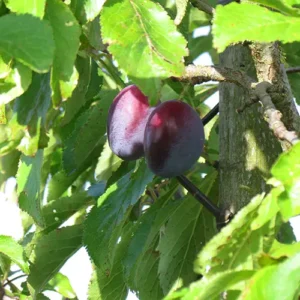
The fruit is small to medium-sized and oval, with a yellow ground colour becoming heavily spotted and flushed pink, red and sometimes violet as it ripens. The golden-yellow flesh is juicy, sweet and pleasantly flavoured. It is a useful dual-purpose plum, enjoyable fresh from the tree but equally suitable for jam, preserves and cooking.
Its main advantage is earliness. ‘Early Laxton’ is usually ready from late July into early August, making it one of the first European plums of the season. The fruit is relatively delicate and can bruise or drop when fully ripe, so timely harvesting is worthwhile.
The tree grows strongly when young but comes into bearing early, after which growth becomes more moderate and the crown develops a broader, somewhat spreading shape. Cropping can be very heavy and overloaded branches may need thinning or support. Current National Fruit Collection records describe ‘Early Laxton’ as self-fertile, although older references are not completely consistent on this point.
Variety characteristics
Raised by Laxton Bros. of Bedford, England, and introduced in 1916 after receiving an RHS Award of Merit.
Origin and identity
Parentage uncertain. Jaune Hâtive x Early Orleans is one published parentage, but historical records are inconsistent.
Bleue de Perk, Bleue de Bergues, Belgian Purple
Growth and adaptation
Strong-growing when young, then more moderate after early cropping. Crown becomes broad and spreading and heavily laden branches can bend or break.
‘Bleue de Belgique’ is an old variety traditionally grown in Belgium and northern France, valued for its hardiness and abundant crops.
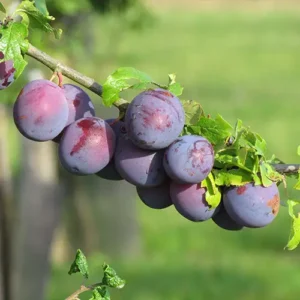
The medium to large plum is oval, almost round and sometimes slightly irregular. Its thin skin turns dark bluish purple when ripe and is covered with a heavy pale bloom.
The greenish-yellow flesh is initially firm, becoming melting, exceptionally juicy and pleasantly aromatic. Its flavour is richly sweet, balanced by a light acidity that provides freshness. The stone generally separates well when the fruit is fully ripe.
Harvest takes place mainly around mid-August and may continue over several weeks depending on the climate and exposure. The fruit has a short storage life and should be eaten or processed soon after picking.
‘Bleue de Belgique’ is a good dessert plum and is also very well suited to tarts, compotes, jams, preserves and fruit brandies.
The tree is vigorous and hardy, begins cropping fairly quickly and is generally highly productive. It initially forms a fairly upright crown, becoming more spreading with age. As heavily laden branches can become brittle, balanced pruning and occasional fruit thinning help reduce the risk of breakage.
The variety is partially self-fertile and produces good-quality pollen. It can crop alone, although another European plum flowering at the same time will generally improve fruit set and the abundance of the harvest.
Disease behaviour
Bleue de Belgique – Old Belgian blue plum
Pollination
Compatible pollinating varieties
For reliable fruit set, plant at least one variety with a compatible flowering period nearby. Flowering period: 3 - mid season.
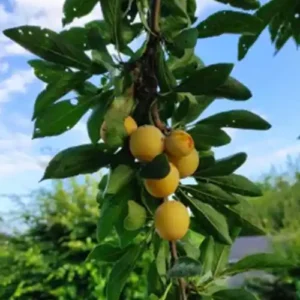 Mirabelle de Nancy Price range: 26,50 € through 64,50 €View this variety
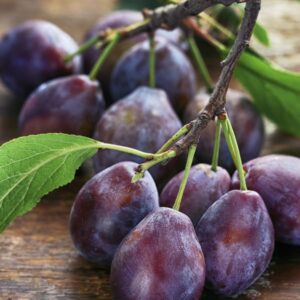 Madeleine Price range: 26,50 € through 42,75 €View this variety
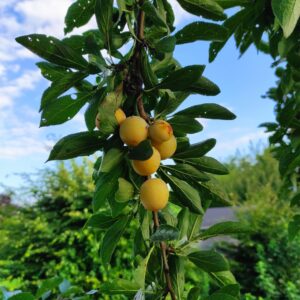 Badoual Mirabelle Price range: 26,50 € through 64,50 €View this variety
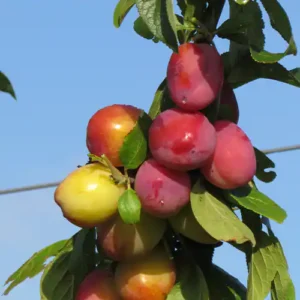 Victoria Price range: 26,50 € through 64,50 €View this variety
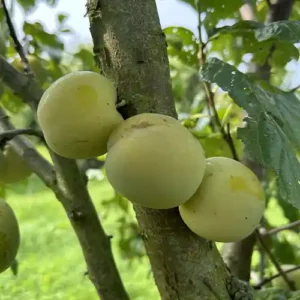 Reine Claude De Bavay Price range: 26,50 € through 64,50 €View this variety
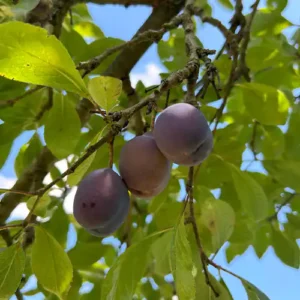 Datil Price range: 26,50 € through 64,50 €View this variety
Harvest calendar
Extend your harvest season
Discover varieties from the same category harvested just before, at the same time or just after.
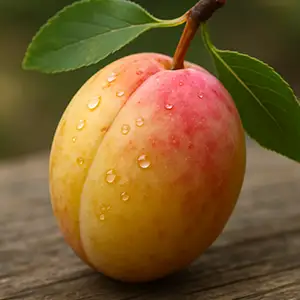
About 15 days later
August 1-15
Related products
Plum trees
Plum trees
Plum trees
Plum trees