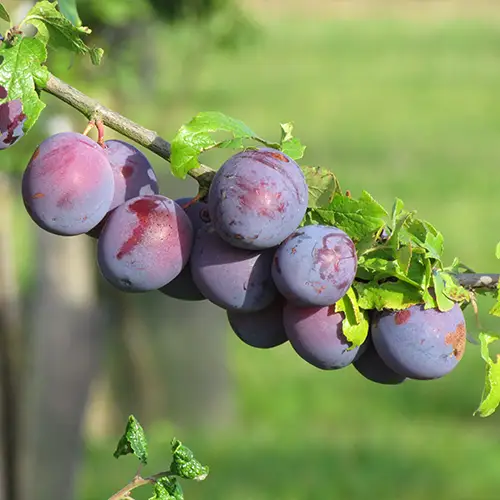
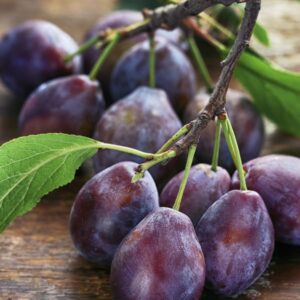
Bleue de Belgique is an old Belgian cultivar producing large dark blue plums with firm, juicy and sweet golden-yellow flesh. Highly productive, the fruit is suitable for fresh eating, pies, preserves and bottling. The hardy tree performs well across temperate European regions. Although it can crop well, the presence of another compatible plum generally helps secure heavier and more reliable yields.
Belgian Blue Plum
Price range: 26,50 € through 64,50 €
bleue-de-belgique
An old Belgian plum with dark-blue fruit and juicy, sweet-sharp, aromatic flesh, suitable both for eating fresh and for cooking.
Variety characteristics
Parents unknown
Origin and identity
Bleue de Perk, Bleue de Bergues, Belgian Purple
Growth and adaptation
Vigorous, hardy, initially upright then spreading, early cropping and abundant production
‘Bleue de Belgique’ is an old variety traditionally grown in Belgium and northern France, valued for its hardiness and abundant crops.
The medium to large plum is oval, almost round and sometimes slightly irregular. Its thin skin turns dark bluish purple when ripe and is covered with a heavy pale bloom.
The greenish-yellow flesh is initially firm, becoming melting, exceptionally juicy and pleasantly aromatic. Its flavour is richly sweet, balanced by a light acidity that provides freshness. The stone generally separates well when the fruit is fully ripe.
Harvest takes place mainly around mid-August and may continue over several weeks depending on the climate and exposure. The fruit has a short storage life and should be eaten or processed soon after picking.
‘Bleue de Belgique’ is a good dessert plum and is also very well suited to tarts, compotes, jams, preserves and fruit brandies.
The tree is vigorous and hardy, begins cropping fairly quickly and is generally highly productive. It initially forms a fairly upright crown, becoming more spreading with age. As heavily laden branches can become brittle, balanced pruning and occasional fruit thinning help reduce the risk of breakage.
The variety is partially self-fertile and produces good-quality pollen. It can crop alone, although another European plum flowering at the same time will generally improve fruit set and the abundance of the harvest.
Disease behaviour
Bleue de Belgique – Old Belgian blue plum
Pollination
Compatible pollinating varieties
For reliable fruit set, plant at least one variety with a compatible flowering period nearby. Flowering period: 3 - mid season.
 Reine Claude Doree Price range: 26,50 € through 64,50 €View this variety
 Datil Price range: 26,50 € through 64,50 €View this variety
 Reine Claude De Bavay Price range: 26,50 € through 64,50 €View this variety
 Victoria Price range: 26,50 € through 64,50 €View this variety
 Madeleine Price range: 26,50 € through 42,75 €View this variety
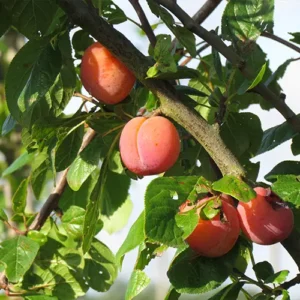 Reine-Claude Rose de Marcoing Price range: 26,50 € through 64,50 €View this variety
Harvest calendar
Extend your harvest season
Discover varieties from the same category harvested just before, at the same time or just after.
About 15 days earlier
July 15-31
Related products
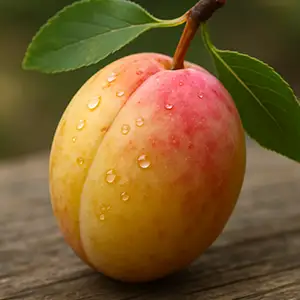
Plum trees
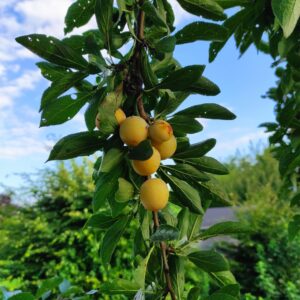
Plum trees
Plum trees
Plum trees