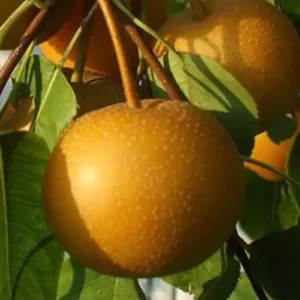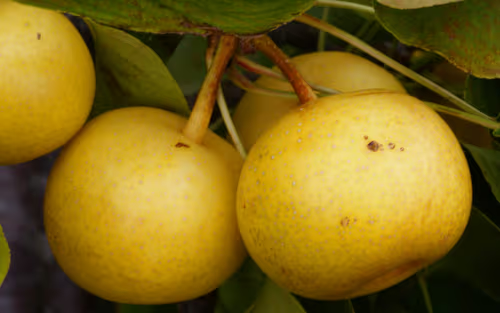

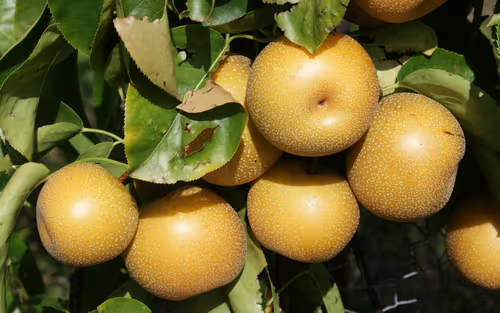
Kosui is one of the nashis I would choose primarily for eating quality. The flesh is exceptionally juicy and sweet with very little acidity, and it ripens early enough to open the main Asian pear season. Its weakness is disease susceptibility, particularly in wetter conditions.
Kosui
Price range: 26,50 € through 59,75 €
One of Japan’s classic nashi cultivars, producing golden-russeted fruit with exceptionally juicy, tender flesh, high sugar and very little acidity.
Pre-orders are open
No payment today. You are reserving your trees before the inventory in early August.
After inventory, we will confirm the available trees and send you a payment link.
Dispatch generally takes place from late November to February, depending on the weather and the progress of lifting the trees.
Asian Pear ‘Kosui’ is a Japanese cultivar of Pyrus pyrifolia, raised from the cross ‘Kikusui’ × ‘Wasekozo’. The cross was made in 1941 and the cultivar was officially recognised in Japan in 1959.
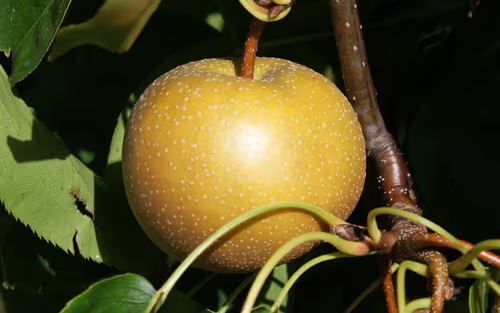
The fruit is medium-sized, slightly flattened and golden yellow to tan with partial russeting. The white flesh is fine, tender and extremely juicy, with a high sugar level and very little acidity. Its excellent eating quality made ‘Kosui’ one of the major Japanese pear cultivars.
In Japan the main harvest falls in the middle to second half of August, while timing can be somewhat later in cooler climates. Fruit can be stored for around two months under suitable refrigerated conditions.
The tree has moderate to strong vigour. ‘Kosui’ is self-incompatible and needs a compatible pollinizer. ‘Hosui’, ‘Chojuro’ and ‘Nijisseiki’ are commonly compatible, while ‘Shinsui’ is incompatible. Kosui itself produces abundant pollen and is regarded as a valuable pollinizer for many other Japanese pears.
The variety is susceptible to fire blight and pear blast, so it benefits from good orchard hygiene and an open, well-aerated canopy.
Variety characteristics
Japanese cultivar from a Kikusui × Wasekozo cross made in 1941 and officially recognised as Nashi Norin No. 3 in 1959.
Origin and identity
Kikusui x Wasekozo
Kousui|Kohsui
Growth and adaptation
Moderate to strong vigour, with relatively limited spur formation on young trees. Produces abundant pollen and is a valuable pollinizer for many Japanese pears.
Disease behaviour
Susceptible to fire blight and pear blast.
Pollination
Compatible pollinating varieties
For reliable fruit set, plant at least one variety with a compatible flowering period nearby. Flowering period: 4 - late.
 Kumoï Price range: 26,50 € through 59,75 €View this variety
 New World Price range: 26,50 € through 59,75 €View this variety
 Hosui Price range: 26,50 € through 59,75 €View this variety
 Chojuro Price range: 26,50 € through 59,75 €View this variety
 Shinseiki Price range: 26,50 € through 59,75 €View this variety
 Benita Price range: 26,50 € through 59,75 €View this variety
Harvest calendar
Extend your harvest season
Discover varieties from the same category harvested just before, at the same time or just after.