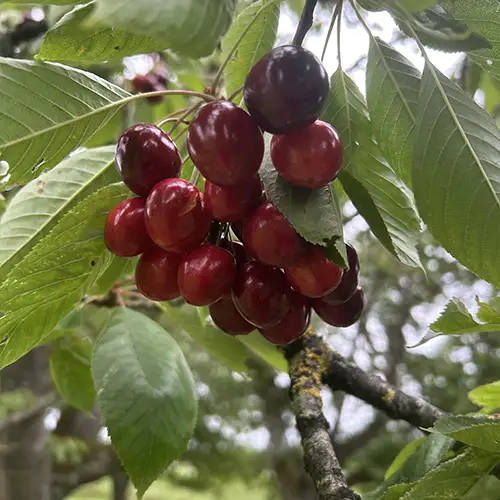
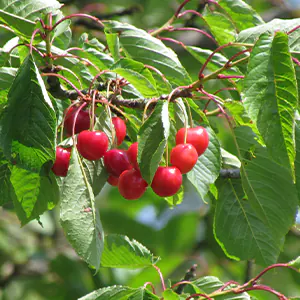
Sam suits gardens and orchards seeking a hardy, reliable dark cherry. Its dark red to black fruit is firm, fleshy, pleasantly sweet and relatively resistant to cracking, while the tree crops heavily. We also recommend it for its fairly late blossom. The cherries need to ripen fully for best flavour, and a compatible pollinator is required.
Sam
Price range: 26,50 € through 64,50 €
A hardy and productive Canadian bigarreau cherry with dark red to almost black fruit, firm, pleasantly sweet flesh and low susceptibility to cracking.
‘Sam’ is a Canadian variety selected at the Summerland Experimental Station in British Columbia and released in the early 1950s.
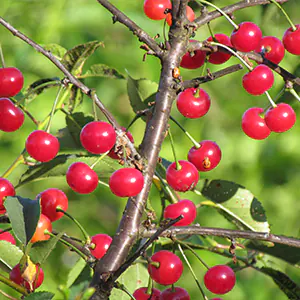
The medium to large fruit is rounded to slightly conical or heart-shaped. Its glossy skin turns dark red to almost black when fully ripe. The stalk is fairly long and the stone medium-sized.
The dark-red flesh is firm, fleshy and has a good texture. Its flavour is mild and pleasantly sweet, although the fruit should be left on the tree long enough to develop its full eating quality. It is suitable both for eating fresh and for preserves, jams and cooking.
Harvest generally takes place during the first half of July. The fruit has good resistance to rain cracking and is also relatively resistant to rotting under normal growing conditions, although its tendency to form tight clusters may encourage brown rot when the cherries remain wet.
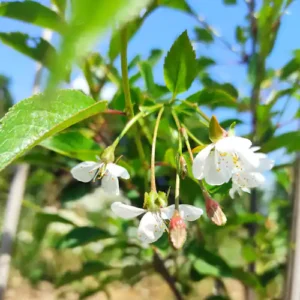
The tree is vigorous and hardy, with a semi-upright habit and a strong framework. It is productive and carries abundant crops distributed throughout the crown. Its fairly late flowering may sometimes allow it to escape the last spring frosts.
‘Sam’ is self-sterile and has the incompatibility genotype S2S4. Nevertheless, it is a good pollinator for many other varieties. Suitable partners include ‘Star’, ‘Annabella’, ‘Castor’ and ‘Bigarreau Ghijssens’.
Variety characteristics
A Canadian variety raised from seed collected in 1938 by Arthur J. Mann at the Summerland station, planted in 1940 and selected in 1946 under the number S-6-10. It was named and commercially released in 1953; its name combines the initials of Summerland and Arthur Mann.
Origin and identity
Open-pollinated seedling of V-160140, itself an open-pollinated seedling of Windsor
Summerland S-6-10
Growth and adaptation
Vigorous, hardy, semi-upright habit, strong framework and abundant cropping
Pollination and fertility
S2S4
Pollination
Compatible pollinating varieties
For reliable fruit set, plant at least one variety with a compatible flowering period nearby. Flowering period: 4 - late.
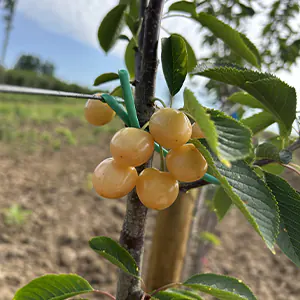 Verchocq Price range: 26,50 € through 64,50 €View this variety
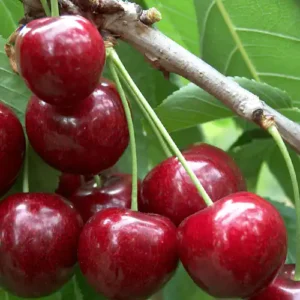 Sunburst Price range: 26,50 € through 64,50 €View this variety
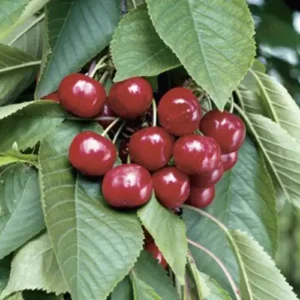 Stella Price range: 26,50 € through 64,50 €View this variety
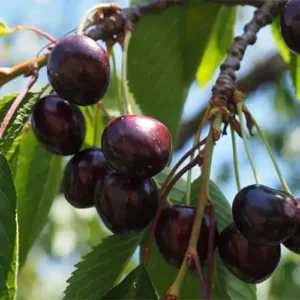 Kordia Price range: 26,50 € through 64,50 €View this variety
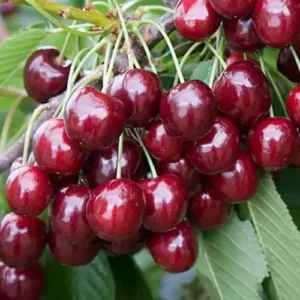 Regina Price range: 26,50 € through 64,50 €View this variety
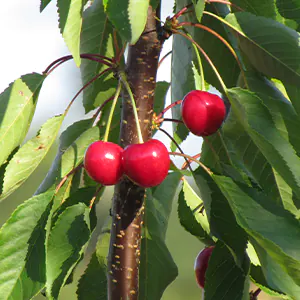 Gros Bigarreau de la Groise Price range: 26,50 € through 64,50 €View this variety
Harvest calendar
Extend your harvest season
Discover varieties from the same category harvested just before, at the same time or just after.
About 15 days earlier
June 15-30
Related products
Cherry trees
Cherry trees
Cherry trees
Cherry trees