
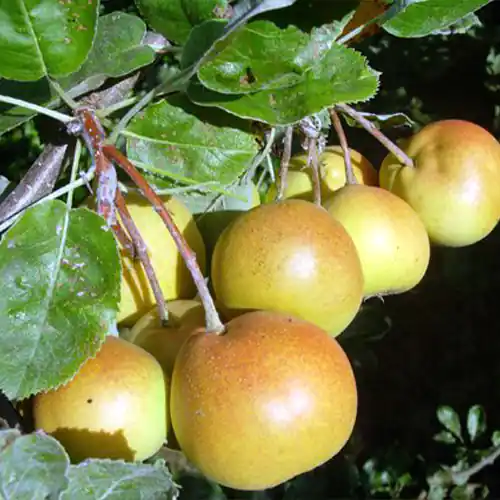
Tatarova appears most valuable for its very late season and exceptionally sweet fruit. Material circulated under this name produces paler fruit than Shipova, eaten progressively as it softens in November. The flavour seems less complex and storage life is virtually nonexistent. We would therefore reserve it for a collection seeking an unusual late-autumn fruit rather than a genuinely productive orchard tree.
Tatarova
Price range: 26,50 € through 59,75 €
Tatarova sorbopyrus, a rare pear–whitebeam hybrid with small sweet fruit, ornamental grey foliage and late November maturity.
Tatarova sorbopyrus tree, also known as the Tatarova Bollwiller pear, produces small fruit that resemble pears, although this is not a true pear but a hybrid between pear and whitebeam.
The fruit is delicious, with an unusual aromatic character and notes reminiscent of mango. Compared with Shipova, Tatarova has paler, less coloured fruit; it is sweeter, but less aromatic.
The fruit does not keep and tends to blet. It is eaten progressively during the second half of November.
No particular disease sensitivity is noted. The variety is self-fertile.
In addition to its fruit, Tatarova is also a beautiful ornamental tree, with greyish foliage and attractive white blossom. It is a rare and sought-after botanical subject.
Sorbopyrus is an intergeneric hybrid between pear, Pyrus, and whitebeam, Sorbus aria. The Bollwiller pear was originally discovered naturally in Alsace, near Colmar, and is now botanically known as x Sorbopyrus auricularis.
The Tatarova variety is an improved selection, distinct from the wild type. It originated in Prague in the early twentieth century and is more accurately named x Sorbopyrus auricularis ‘Tatarova’.
We produce this grafted Tatarova sorbopyrus on several rootstocks, which influence the vigour and final size of the mature tree. It is available in several tree forms depending on availability.
Variety characteristics
Origin and identity
Growth and adaptation
Disease behaviour
Pollination
Compatible pollinating varieties
These varieties flower at a compatible time and are the most relevant matches in the catalogue. Flowering period: 3 - mid season.
Related products
Pear trees
Dessert pear trees
Pear trees
Dessert pear trees