Bollwiller pear trees
Tatarova sorbopyrus, a rare pear–whitebeam hybrid with small sweet fruit, ornamental grey foliage and late November maturity.
Bollwiller pear trees: a rare hybrid between pear and whitebeam
The Bollwiller pear is not simply an unusual cultivar of the common pear. It originated from an exceptional hybridisation between the European pear, Pyrus communis, and the common whitebeam, historically known as Sorbus aria and now generally classified as Aria edulis.
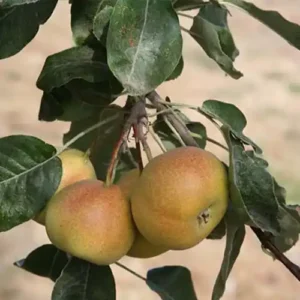
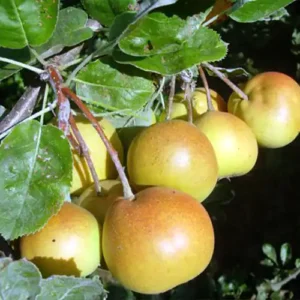
It is therefore a hybrid between two botanical genera. Its leaves, habit, blossom and fruit combine characteristics of both parents: thick leaves with pale undersides, flowers carried in clusters and small yellow to orange fruit resembling a rounded pear, a small quince or a particularly large whitebeam fruit.
The tree is primarily valuable as a botanical and horticultural rarity, but its fully ripe fruit is also edible. Fruit size, texture and eating quality differ considerably between the historic Bollwiller clone and selections sold as ‘Shipova’, ‘Bulbiformis’ or under other commercial names.
This variability makes accurate identification especially important. A description written for one large-fruited Shipova should not automatically be applied to every tree sold as Bollwiller pear or Sorbopyrus.
An exceptional hybrid originating in Alsace
The historic hybrid is believed to have appeared towards the end of the sixteenth century in the gardens of the Barons of Bollwiller in Alsace, now in eastern France.
Historical accounts place its observation at approximately 1599. The tree was reportedly known locally as Rothbirle, meaning little red pear.
The botanist Jean Bauhin later observed it in the garden of the Prince of Montbéliard. His description, published posthumously in 1650 under the name Pirus polvvilleriana, is among the earliest detailed records of the hybrid.
The original tree probably resulted from an extremely rare spontaneous pollination event in a garden where European pear and whitebeam grew close together.
It was not initially a population of different seedlings. The first tree was preserved and multiplied by grafting, allowing genetically identical descendants to be distributed through European gardens.
A tree preserved through more than four centuries of grafting
Vegetative propagation explains how a hybrid that appeared more than four hundred years ago could survive into modern horticulture.
Scion wood was distributed through nurseries, botanical gardens and private collections. The Baumann nurseries of Bollwiller, among the most influential horticultural establishments in Alsace during the eighteenth and nineteenth centuries, played an important role in its wider circulation.
The tree was subsequently planted in France, Germany, central Europe, Britain, North America and other temperate regions.
It remained much more common in botanical collections and arboreta than in commercial fruit orchards because its principal value was its exceptional origin rather than high-volume fruit production.
Why does the Bollwiller pear have so many botanical names?
Botanists have interpreted this intermediate tree in different ways during its long documented history.
Names applied to it have included Pyrus pollveria, Pyrus bollwylleriana, Pyrus irregularis, × Sorbopyrus auricularis and × Sorbopyrus irregularis.
These names do not necessarily represent different plants. Many are alternative classifications of the same pear–whitebeam hybrid.
The hybrid-genus name × Sorbopyrus was constructed from Sorbus and Pyrus. Following the separation of whitebeams from the broad traditional genus Sorbus, the name × Pyraria irregularis has been adopted in modern botanical treatments, combining Pyrus and Aria.
The older names × Sorbopyrus auricularis and × Sorbopyrus irregularis remain widely used by nurseries, collectors and arboreta. They are therefore still useful search terms and frequently appear on older labels.
The multiplication sign placed before the botanical name indicates a hybrid between two genera. It does not imply that the plant is artificial or recently created.
Why are several Bollwiller pear selections offered?
The large number of names results from several different situations.
Some names are simply botanical or regional synonyms for the historic clone. Scion wood circulated between countries and collections for centuries, and local names were sometimes attached to trees without documentation linking them conclusively to the original plant.
The hybrid is also almost sterile rather than completely incapable of reproduction. A very small number of viable seeds have occasionally been produced.
Each seedling is genetically different from the grafted historic clone and may inherit a different combination of pear and whitebeam characteristics.
Some named forms are therefore genuine descendants with larger, rounder or more pear-like fruit. Others are probably the original clone carrying a different botanical, regional or commercial name.
In some cases, the exact origin of material currently in cultivation is no longer documented sufficiently to establish whether two names represent the same clone.
The historic Bollwiller clone
The historic form produces small fruit carried in clusters. Individual fruits generally measure approximately 2.5 to 3 centimetres across, although larger examples can occur according to growing conditions.
At maturity, the skin becomes yellow to orange-yellow and often develops a reddish flush on the side exposed to sunlight.
The flesh is yellow-orange, mild and sweet, with a relatively dense or floury texture more suggestive of a soft apple than a melting dessert pear.
Some descriptions mention a light quince-like flavour.
The fruit usually contains very few fully formed seeds. It should be allowed to reach complete maturity, when the colour becomes richer and the flesh begins to soften.
Fruit harvested too early may remain dry, firm and weakly aromatic.
This historic clone should not be selected in the expectation of obtaining a large, juicy and melting European pear. Its main value lies in its history, exceptional parentage, ornamental character and unusual fruit.
What does the name ‘Shipova’ mean?
‘Shipova’ is the name most commonly encountered in international nursery catalogues.
It is sometimes used as the general English name for any Bollwiller pear and sometimes as the cultivar name of a particular large-fruited selection.
Twentieth-century horticultural accounts generally describe ‘Shipova’ as material distributed from the former Yugoslavia. It usually produces larger and more pear-like fruit than that attributed to the historic Alsatian clone.
It is therefore unwise to assume that every plant called ‘Shipova’ is genetically identical to the first tree recorded at Bollwiller.
Depending on the supplier, the name may describe the hybrid as a whole, a particular large-fruited clone or material whose exact provenance has been lost.
The name ‘Smokvarka’ is also associated with some Balkan material. It may represent a regional synonym or a distinct but closely related clone.
‘Bulbiformis’: a descendant with more pear-like characteristics
‘Bulbiformis’ originated from an exceptional seedling raised in Prague during the nineteenth century.
It is therefore not merely another name for the historic Bollwiller clone, but a genetically distinct descendant produced from one of its rare viable seeds.
The selection generally displays more characteristics of the European pear. Its foliage is less strongly reminiscent of whitebeam and its fruit is larger, rounder or slightly pear-shaped.
The name bulbiformis refers to the swollen or bulbous form of the fruit.
It has sometimes been distributed under names suggesting a Tatar pear or a large-fruited Shipova.
Its more pear-like appearance may result from backcrossing, in which a flower of the original hybrid was fertilised by pear pollen. Such a cross would increase the proportion of characteristics inherited from Pyrus communis.
‘Malifolia’: a form whose identity remains uncertain
The plant known as ‘Malifolia’ or Pyrus malifolia was described in Paris in 1834. Its foliage and fruit were reported to differ slightly from those of the classic Bollwiller pear.
Its origin has received several interpretations. It has been considered a seedling of the Bollwiller hybrid, a separate hybridisation and, in some older publications, a plant possibly carrying apple influence.
Modern botanical classifications generally do not recognise it as a separate species and may include the name among synonyms associated with × Pyraria irregularis.
Horticultural literature nevertheless continues to present ‘Malifolia’ as a form or cultivar in its own right.
This uncertainty does not mean that no plant existed under the name. It reflects the difficulty of matching historical descriptions, preserved specimens and living trees to one perfectly documented clone.
Commercial names are not consistently standardised
Names such as Shipova, Bollwiller Pear, Baby Shipova, Sorbopyrus, Tatar Pear and Large-Fruited Bollwiller Pear are applied inconsistently between countries and nurseries.
The name Baby Shipova may describe a smaller tree, a small-fruited clone or material believed to represent the historic form. It does not provide a sufficiently precise botanical identity on its own.
When comparing plants, examine the documented origin of the scion wood, the expected dimensions and shape of the fruit and any available photographs of the mother tree.
Two plants offered under different names may be identical. Conversely, two trees both labelled ‘Shipova’ may descend from different selections.
Where identification is uncertain, the description should state this openly rather than combining the most attractive characteristics reported for several unrelated clones.
Can an almost sterile hybrid still produce fruit?
Yes. Low fertility primarily concerns the production of viable seeds and descendants, not the ability of the tree to flower and develop fruit.
The Bollwiller pear has been described as triploid, possessing three sets of chromosomes. This irregular number disrupts the normal formation of reproductive cells and helps explain why viable seeds are so rare.
The tree can nevertheless carry a crop, sometimes containing fruit with few or no properly developed seeds.
Information about self-fertility and the best pollinating cultivars is less precise than it is for ordinary European pear cultivars.
Some clones can produce fruit when planted alone, but the presence of a European pear flowering at the same time is a sensible precaution and may improve fruit set.
No particular pear cultivar should be guaranteed as a universal pollinator for every tree sold as Shipova or Bollwiller pear because the material circulating under these names may not be genetically identical.
The triploid hybrid should also not be relied upon as an effective pollinator for neighbouring pear trees.
Which rootstock should be chosen?
The historic Bollwiller pear was mainly propagated on seedlings of the common pear.
This combination normally produces a vigorous, deeply rooted and potentially very large tree.
On pear seedling rootstock, it should be regarded as a genuine orchard or collection tree rather than a compact fruiting shrub.
Old trees can exceed ten metres where their growth is not restricted by soil, training or available space.
A less vigorous rootstock may reduce the mature dimensions and encourage earlier cropping, but long-term compatibility has been documented less extensively than it has for ordinary pear cultivars.
The precise identity of the Bollwiller selection is also relevant because related clones may not behave identically on the same rootstock.
Keep the graft union clearly above the final soil level. Any shoot emerging from beneath the graft belongs to the rootstock and should be removed.
Soil and planting position
The Bollwiller pear prefers a sunny position and deep, fertile, well-structured soil with adequate drainage.
Its soil behaviour is influenced strongly by the rootstock and is generally comparable with that of a European pear grafted on the same root system.
Winter hardiness is normally sufficient across much of northern, western and central Europe.
A bright and reasonably warm position remains useful because it encourages sugar accumulation, orange fruit colour and the development of aroma.
A young container-grown tree that has already begun growing under protection is more vulnerable to late frost than a mature dormant specimen.
Where the plant is already in leaf, spring planting after the main risk of frost is preferable.
Prepare a broad area of soil rather than a narrow hole filled with potting compost. Cultivate once the ground has drained, create a fine crumbly structure and remove couch grass, bindweed and other perennial weeds carefully.
Backfill mainly with the original soil and keep the graft union above ground.
Maintain a weed-free area around the tree and water throughout the first growing season whenever rainfall is insufficient.
The mature tree may become robust and deeply rooted, but a newly planted specimen cannot resist drought until it has established a functional root system.
Training and pruning
The Bollwiller pear naturally forms an upright and vigorous tree.
During the early years, establish a strong framework with a central leader and well-positioned main branches rather than immediately attempting to suppress its height.
Branches with very narrow unions can become weak as the tree matures and should be corrected while still young.
Once the framework is established, pruning should remain moderate.
Remove dead wood, crossing branches and shoots growing towards the crowded centre while retaining short fruiting branches.
Severe pruning stimulates long upright shoots and may delay cropping.
It is better to provide sufficient space at planting than to attempt to maintain a vigorous seedling-rooted tree through repeated heavy cutting.
Harvest season and fruit maturity
The fruit generally ripens from late summer into early autumn, depending on clone, rootstock, climate, crop load and exposure.
Do not harvest according to the calendar alone. Wait until the skin changes from green to yellow or orange-yellow, often with a red cheek on the sunlit side.
Ripe fruit develops a noticeable aroma, begins to soften and normally detaches more readily.
The small fruit of the historic clone has denser and more floury flesh than a dessert pear.
More pear-like selections distributed as large-fruited ‘Shipova’ or ‘Bulbiformis’ may be juicier and substantially larger.
The fruit can be eaten fresh when completely ripe or used for cooking, compotes and mixed-fruit preparations.
Eating quality genuinely varies between clones. A flavour description based on one large-fruited Shipova should not be treated as representative of the entire category.
How should you choose between the different forms?
For the historic Alsatian tree
Choose material whose provenance is clearly documented as the old Bollwiller clone.
Expect small yellow to orange fruit with a mild, sweet but relatively dense texture and value the tree primarily for its history and botanical importance.
For larger and more pear-like fruit
Choose a documented large-fruited ‘Shipova’ selection or ‘Bulbiformis’.
Check the source of the propagation material rather than relying solely on the commercial name.
For a botanical collection
Different documented forms are genuinely valuable because they illustrate how a nearly sterile intergeneric hybrid can occasionally produce descendants showing a stronger resemblance to one parent.
For a small garden
Check the rootstock carefully. A tree grafted on pear seedling can become far too large for a restricted space, while a less vigorous combination may be easier to manage if long-term compatibility is considered satisfactory.
Part of the nomenclature remains uncertain. A responsible choice depends on distinguishing documented historic clones, genuinely described seedlings and loosely applied commercial names.
Frequently asked questions about Bollwiller pear trees
Is the Bollwiller pear a true pear tree?
It is partly a pear by ancestry. It originated from a hybridisation between the European pear and the common whitebeam and combines characteristics of both parents.
What is its correct botanical name?
× Pyraria irregularis is used in modern botanical classification. The older names × Sorbopyrus auricularis and × Sorbopyrus irregularis remain widely used in horticulture.
Why are there so many synonyms?
The tree has been described by different botanists during more than four centuries and has been placed successively among pears, whitebeams and several hybrid genera. Many names refer to the same hybrid rather than separate plants.
Are ‘Shipova’ and Bollwiller pear exactly the same?
Not necessarily. ‘Shipova’ is sometimes used as a general name for the hybrid and sometimes for a relatively large-fruited selection distributed from the Balkans. Its precise identity depends on the source of the plant.
What is ‘Bulbiformis’?
‘Bulbiformis’ is a distinct seedling descendant raised in Prague during the nineteenth century. It normally displays more pear-like foliage and larger fruit than the historic Bollwiller clone.
Why are there cultivars when the hybrid is sterile?
The hybrid is almost sterile rather than completely sterile. A few viable seeds have occasionally been produced, and each seedling creates a new individual that can subsequently be preserved by grafting.
Can the seeds be sown?
Most fruit contains no viable seeds. Germination remains exceptionally possible, but the resulting seedling will not reproduce the parent clone and may possess very different characteristics.
Is the Bollwiller pear self-fertile?
Some clones can produce fruit alone, but observations vary. A European pear flowering at the same time may improve fruit set, although no universal pollinator can be guaranteed for every form sold under the Bollwiller pear or Shipova names.
Is it a useful pollinator for ordinary pear trees?
It should not be relied upon as a pollinator. Its triploid chromosome structure interferes with the production of regular fertile pollen.
How large does the tree become?
On pear seedling rootstock it can become a large orchard tree exceeding ten metres. Mature size depends strongly on rootstock, soil and training.
Are the fruits good to eat?
They are edible and sweet when completely ripe, but quality depends on the clone. The historic form produces small and relatively dense fruit, while some Shipova selections and ‘Bulbiformis’ produce larger and more pear-like fruit.
When are the fruits ready to harvest?
They generally ripen from late summer into early autumn. Wait for the skin to become yellow or orange-yellow, the aroma to develop and the flesh to begin softening.
Can the fruit be cooked?
Yes. It can be eaten fresh at full maturity or used in compotes, cooked preparations and mixtures with other orchard fruit.
Can the Bollwiller pear be grown in a cool climate?
Yes. The tree is sufficiently winter hardy for much of northern, western and central Europe. A sunny position remains important for complete fruit maturity.
Which rootstock should be chosen?
Pear seedling rootstock is the traditional choice for a vigorous and durable tree. Less vigorous rootstocks may produce a smaller and earlier-cropping tree, but long-term compatibility is less extensively documented.
Why might two Shipova trees produce different fruit?
The name Shipova has been applied to more than one type of material. The trees may represent distinct clones, seedlings or propagation lines whose original identity was not documented consistently.