Gooseberry
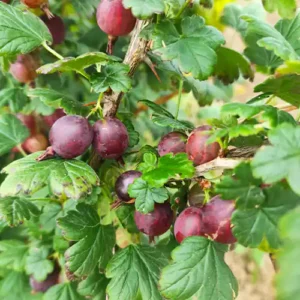
Black Velvet gooseberry bush, self-fertile with very dark, sweet berries and exotic notes, best harvested soft in late July.
Gooseberry
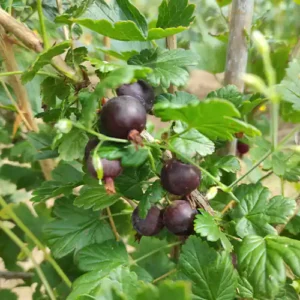
Miel Noir gooseberry bush, self-fertile with large juicy black berries, sweet when fully ripe and harvested in early July.
Gooseberry plants: choosing a cultivar for eating or cooking
The European gooseberry belongs mainly to the species Ribes uva-crispa. It forms a compact shrub, usually carrying thorns at the nodes, and produces fruit considerably larger than redcurrants or whitecurrants.
Depending on the cultivar and stage of maturity, gooseberries may be green, yellow, pink, red or deep purple. Colour alone does not indicate their flavour, sweetness or intended use.
Some cultivars produce large, firm and sharp fruit traditionally picked early for cooking. Others become tender, juicy, sweet and highly aromatic when allowed to ripen fully on the plant.
Across cool temperate regions of Europe, winter hardiness and fruit maturity are rarely the principal difficulties. Success depends more on maintaining sufficient soil moisture, providing good airflow, protecting the blossom from severe spring frost and selecting a cultivar with useful resistance to gooseberry mildew.
European gooseberries and hybrids with North American ancestry
Traditional European cultivars descend mainly from Ribes uva-crispa. They can produce exceptionally large fruit with excellent flavour, but some are highly susceptible to American gooseberry mildew.
North American species, including Ribes hirtellum and Ribes divaricatum, have been used in breeding programmes to introduce improved mildew resistance, vigour and general robustness.
Many modern gooseberries are therefore complex hybrids rather than genetically pure forms of Ribes uva-crispa.
North American ancestry can provide better disease resistance, although earlier hybrids sometimes produced smaller berries or fruit with a less refined flavour.
The best modern cultivars aim to combine the flavour and size of traditional European gooseberries with the health and reliability of resistant breeding material.
A cultivar described as mildew-resistant should not be treated as completely immune. Dense growth, excessive nitrogen, shade and prolonged disease pressure can still produce symptoms.
Green, yellow, red and purple gooseberries
Green gooseberries
Green gooseberries are often associated with cooking because they are frequently harvested while still firm and sharp.
Some green cultivars nevertheless become remarkably sweet and aromatic when left to ripen fully on the shrub.
Their colour may change very little as they mature. Softness, translucency, flavour and ease of detachment are therefore more useful indicators than waiting for a dramatic colour change.
Yellow gooseberries
Yellow and yellow-green fruit often becomes translucent and particularly sweet at full maturity.
Several excellent dessert cultivars belong to this group and may develop flavours suggesting grapes, honey, mirabelle plums or other ripe summer fruit.
Thin-skinned yellow gooseberries can be especially pleasant when eaten directly from the plant, but may require careful handling once fully ripe.
Red and purple gooseberries
Red-fruited cultivars may develop pale pink, bright red, burgundy or deep purple skin.
They are valued for their appearance and often for fresh eating, but red fruit is not automatically sweeter than green or yellow fruit.
The cultivar, exposure, crop load and stage of maturity have a greater influence on flavour than skin colour alone.
Culinary and dessert gooseberries
Gooseberries for cooking
Culinary gooseberries can be picked while still green, firm and sharply acidic.
At this stage, they retain their structure during cooking and are suitable for pies, crumbles, compotes, jams, chutneys and sauces.
Their natural acidity balances added sugar and gives cooked preparations a fresher flavour than very sweet, fully ripe fruit.
Firm fruit is also easier to top and tail, transport and store briefly before processing.
Dessert gooseberries
Dessert cultivars should normally remain on the plant until they have reached full eating maturity.
The flesh then becomes softer and juicier, the acidity decreases and the characteristic aroma of the cultivar becomes much clearer.
A dessert gooseberry harvested too early may taste harsh and uninteresting even when the same cultivar is excellent when fully ripe.
The best fruit for eating directly should combine sweetness, sufficient freshness, a pleasant aroma and skin that is not excessively tough.
Dual-purpose cultivars
Many gooseberries are genuinely dual-purpose.
Part of the crop can be harvested early for cooking, while the remaining fruit is left to develop sweetness and aroma for fresh eating.
This two-stage harvest also acts as a form of thinning, allowing the berries left on the plant to grow larger.
Useful characteristics when comparing gooseberry cultivars
Flavour
For fresh eating, compare sugar, acidity, aroma, juiciness and skin thickness rather than fruit size alone.
Very large gooseberries can be impressive but are not always the most highly flavoured.
For cooking, firm flesh and pronounced acidity may be advantages rather than faults.
Fruit size
Traditional European cultivars can produce exceptionally large berries.
Actual fruit size is also influenced by pruning, pollination, crop load, sunlight and water availability during swelling.
Spur pruning and partial thinning can increase the size of the remaining berries, although total yield may be slightly reduced.
Skin thickness and cracking
Thin skin is pleasant for fresh eating but may make fully ripe fruit more vulnerable to splitting and damage during picking.
Firmer skin generally improves handling and short-term storage but can become noticeable when fruit is eaten raw.
Susceptibility to cracking is strongly dependent on cultivar and is often increased by heavy rain following a dry period.
Thorns
Most gooseberry plants carry thorns at the nodes, but their number, size and sharpness vary greatly between cultivars.
Few-thorned and nearly thornless selections make pruning and harvesting easier.
Lack of thorns should not take priority over flavour, mildew resistance and adaptation. Some nearly thornless cultivars produce smaller fruit or particularly vigorous growth.
Resistance to gooseberry mildew
In humid climates, mildew resistance is one of the most important selection criteria.
Susceptible cultivars require excellent airflow and regular observation of young shoots and fruit.
Where serious mildew attacks have already occurred, choosing a cultivar with documented resistance is usually more effective than repeatedly trying to maintain a highly susceptible historic variety.
Shrub habit
An upright habit makes picking easier and keeps fruit away from the soil.
Cultivars with long, arching branches can crop heavily but may require support or more careful pruning to prevent the fruit from touching damp ground.
A naturally open habit also allows air and light to reach the centre more readily.
Ripening season
Combining early, mid-season and late cultivars extends the harvest and provides fruit for cooking and fresh eating over a longer period.
In humid situations, very late cultivars may encounter greater disease and splitting pressure before the final fruit is harvested.
Can one gooseberry plant produce fruit?
Most cultivated gooseberries are self-fertile, so one correctly identified plant can produce a crop without a second cultivar nearby.
The flowers are nevertheless pollinated by bumblebees, honeybees and other insects.
Good pollinator activity improves fruit set and helps the berries develop regularly.
Self-fertility means that the cultivar’s own pollen can fertilise its flowers. It does not mean that pollinating insects are unnecessary.
Cold, windy or persistently wet weather during flowering can therefore reduce the crop of a perfectly self-fertile plant.
Planting several cultivars can extend the harvest and provide different colours and flavours, but is not normally required purely for pollination.
Winter hardiness and spring frost
Dormant gooseberry wood is very hardy and is well suited to cold temperate winters across much of Europe.
Open flowers and newly formed fruit are considerably more vulnerable than dormant stems.
A spring frost can destroy part of the crop without causing lasting damage to the shrub itself.
Avoid hollows, the bottom of slopes and enclosed positions where cold air accumulates overnight.
An exceptionally warm south-facing wall may advance bud break and flowering, increasing exposure to late frost.
In cool climates, a bright but not excessively warm position often provides a better balance between fruit maturity and frost avoidance.
Where should a gooseberry be planted?
Full sun generally encourages abundant flowering, good colour and a high sugar concentration.
Gooseberries also tolerate light partial shade and can be grown against east- or north-facing walls.
Fruit produced with less direct sunlight usually ripens later and may retain slightly more acidity.
Light shade can be useful in very hot or drought-prone regions, where intense afternoon sun may scorch fruit and dry the shallow roots.
Good airflow is particularly important for reducing mildew and allowing leaves and fruit to dry after rain.
Avoid planting within a dense hedge, beneath low tree branches or in an enclosed corner where humid air remains trapped.
Allow approximately 1.2 to 1.5 metres around a conventional bush, depending on cultivar vigour and pruning.
Cordons and fan-trained plants require less ground space but need a permanent support and more precise annual pruning.
Soil, moisture and tolerance of lime
Gooseberries prefer fertile soil containing useful organic matter, remaining moist during fruit development and draining adequately during wet periods.
Structured clay soil can be very suitable. Its ability to retain water is valuable during dry weather and fruit swelling.
Compacted clay that remains saturated for long periods restricts oxygen and produces weak root development.
The species tolerates soil ranging from slightly acidic to moderately calcareous.
Very calcareous, shallow and dry ground may restrict growth and increase the risk of nutrient deficiencies.
In sandy soil, add mature organic matter over a broad area and monitor water availability closely.
Drought during fruit swelling reduces berry size, thickens the skin and can cause part of the crop to fall.
Dense grass competes strongly with the shallow root system. Maintain a weed-free or mulched area around the plant, especially during establishment.
Planting a young gooseberry
Dormant bare-root and container-grown plants are preferably planted between autumn and early spring whenever the soil is neither frozen nor waterlogged.
Container plants can be installed later in the season where regular watering can be provided.
A plant that is already in leaf after growing under protection is more susceptible to late frost than a dormant established shrub.
Where frost remains possible, delay planting until the principal risk has passed or protect the young plant temporarily.
Prepare a broad area of soil rather than a narrow hole filled with compost.
Work the ground only when it has drained sufficiently to form a fine crumbly structure, and remove couch grass, bindweed and other perennial weeds carefully.
Plant a bush form at approximately the same depth at which it grew in the nursery or only slightly deeper to encourage rooting near the base.
Do not bury the lower branches deeply.
Standard gooseberries should be planted at their original depth with the graft union clearly above the soil.
A standard requires permanent support because its narrow stem and fruit-laden head are vulnerable to wind.
Backfill mainly with the original soil, improved over a broad area with mature compost where necessary.
Avoid placing fresh manure, concentrated fertiliser or a pocket of pure potting compost directly against the roots.
Water thoroughly after planting and maintain a weed-free root zone.
Continue watering throughout the first growing season whenever rainfall is insufficient, rather than limiting care to the first few weeks.
Which wood carries gooseberries?
Gooseberries crop near the base of shoots formed during the previous season and on short fruiting spurs carried by older branches.
Main branches can therefore remain productive for several years and should not be renewed as rapidly as those of a blackcurrant.
As the plant ages, some branches become weak, densely branched, shaded or strongly arching.
These older and less productive branches should be removed progressively to allow new framework shoots to replace them.
The objective is to maintain a balanced mixture of established fruiting branches and younger replacement wood.
How should a bush gooseberry be pruned?
Form an open bush carried above a short clear stem with several well-spaced main branches.
An open structure makes harvesting easier despite the thorns and reduces the humid conditions favourable to mildew.
During winter, remove dead, diseased or broken wood, inward-growing shoots and branches likely to touch the ground beneath the weight of the crop.
Every year or two, remove some of the oldest and least productive branches and retain strong young shoots capable of renewing the framework.
Lateral shoots can be shortened to two or three buds to form compact fruiting spurs.
Keep the extensions of the main branches longer so that they continue developing and can replace older wood.
During summer, lateral shoots may be shortened to approximately five leaves where a compact plant and larger fruit are required.
Do not shorten vigorous shoots intended to replace an old framework branch.
Severe pruning stimulates numerous tender shoots that are particularly susceptible to mildew and can substantially reduce the following crop.
Bush, cordon, fan or standard gooseberry?
Bush form
The conventional bush is the simplest form and generally provides the best balance between yield, longevity and ease of maintenance.
It requires more ground space than a cordon but is relatively forgiving of imperfect pruning.
Cordon
A cordon consists of one or more permanent vertical stems carrying short fruiting spurs.
It allows several cultivars to be grown within a restricted area and keeps the fruit relatively accessible despite the thorns.
Annual winter and summer pruning are required to maintain the compact spur system.
Fan-trained gooseberry
A fan can be trained against a wall, fence or wire support.
The branches are spread across the surface to improve light exposure, airflow and access to the fruit.
An east- or north-facing support can be useful where a south-facing wall would encourage excessively early flowering.
Standard gooseberry
A standard gooseberry is decorative and leaves useful space beneath the crown.
It requires permanent staking, careful watering and regular pruning to prevent the head from becoming dense or excessively heavy.
Shoots emerging from below the graft union belong to the rootstock and must be removed.
Harvesting twice for different uses
An initial harvest can be made while part of the crop remains green, firm and sharply acidic.
These fruits are suitable for pies, compotes, sauces, chutneys and preserves.
Removing part of the young crop also acts as thinning. The remaining berries receive more light, water and carbohydrates and can grow larger.
The second harvest takes place when the fruit is fully ripe, softer and considerably sweeter.
Depending on the cultivar, the skin may become translucent and change to yellow, pink, red or purple.
Ripe fruit should detach readily, although it may remain connected by a short stalk.
Pick the fruit with its stalk where possible to avoid tearing the skin.
Gooseberries do not develop their complete flavour after picking in the way that some pears soften after harvest.
Fruit intended for eating fresh should therefore be allowed to reach its best flavour on the plant.
Harvesting, handling and storage
Pick during dry weather and use shallow containers to prevent the lower berries from being crushed.
Firm culinary fruit tolerates handling better and may keep for several days under refrigeration.
Fully ripe dessert gooseberries are more delicate and should be cooled and eaten or processed promptly.
Remove split, mouldy or insect-damaged fruit before storage.
Do not wash the crop until shortly before use, as surface moisture encourages deterioration.
Gooseberries freeze well and can be frozen whole after topping and tailing.
Fruit intended for pies or compotes can be frozen while still relatively firm, whereas fully ripe berries provide more sweetness and aroma for desserts and preserves.
American gooseberry mildew
American gooseberry mildew, caused by Podosphaera mors-uvae, is the disease most strongly associated with gooseberries.
It attacks young leaves, shoots and fruit.
The fungal growth begins as a white powdery covering before becoming grey or brown and forming a thicker crust around affected shoots and berries.
Infected shoots become distorted and may stop growing.
Dense growth, restricted airflow and excessive nitrogen encourage tender tissues and conditions favourable to infection.
Cultivar choice, planting distance and appropriate pruning therefore play central roles in management.
Remove severely affected shoot tips and do not use them for propagation.
Lightly marked fruit may remain usable after cleaning, but severe infection reduces growth, appearance and eating quality considerably.
Where mildew occurs repeatedly, replacing a highly susceptible cultivar with a resistant one is often the most durable solution.
Gooseberry sawfly and other important problems
Gooseberry sawfly
The larvae of several sawfly species resemble small caterpillars and can remove almost every leaf from a gooseberry within a short period.
They often begin feeding within the lower and inner parts of the shrub, where the early damage is easily overlooked.
Inspect the undersides of leaves regularly from spring onwards.
On a small number of plants, removing the first colonies by hand can prevent severe defoliation.
A defoliated shrub may produce replacement leaves, but its berries remain smaller and it stores fewer reserves for the following season.
Leaf spots and anthracnose
During humid summers, dark spots may appear on the foliage before the leaves become yellow and fall prematurely.
Repeated early defoliation gradually weakens the shrub and reduces future crops.
Maintain an open structure, remove heavily affected fallen leaves and avoid repeatedly wetting the foliage during irrigation.
Grey mould
Botrytis can produce soft decay on fruit, particularly when ripening berries remain within dense wet foliage or touch the ground.
Remove affected fruit promptly and support or prune strongly arching branches.
Fruit splitting
Some cultivars split following heavy rain, particularly when a dry period is followed by a sudden increase in soil moisture.
Regular watering, appropriate crop load and timely harvesting reduce the risk but do not eliminate the genetic susceptibility of a sensitive cultivar.
Birds
Birds readily eat fully ripe gooseberries and may also damage buds during winter.
A properly tensioned net or fruit cage provides the most reliable protection.
A loose net placed directly over thorny branches becomes difficult to remove and may trap birds.
Which gooseberry should you choose?
For eating directly from the plant, choose a sweet and aromatic dessert cultivar capable of remaining healthy until full maturity.
Thin skin and low susceptibility to splitting are also valuable for fresh eating.
For pies, preserves and compotes, choose a productive cultivar with firm flesh and sufficient acidity to provide flavour after sugar is added.
For a humid garden or a site where mildew has already been severe, disease resistance should take priority over maximum fruit size.
A slightly smaller but healthy cultivar normally provides a more dependable harvest than a spectacular historic variety repeatedly damaged by mildew.
For easier picking, choose a few-thorned cultivar or train a conventional variety as a cordon.
Highly thorny cultivars remain worthwhile where their flavour, productivity or resistance justifies the more difficult harvest.
For a small garden, cordons and standards use less ground space, although a conventional bush remains simpler and more robust.
In every form, pruning should maintain enough light and airflow within the centre of the plant.
Frequently asked questions about gooseberry plants
Are two gooseberry plants required?
No. Most cultivars are self-fertile and one shrub can produce fruit. Bumblebees and other insects remain important for effective pollination and regular fruit development.
Are green gooseberries ripe?
Some cultivars remain green at full maturity. Ripe fruit becomes more translucent, softer, sweeter and easier to detach.
Can gooseberries be eaten before they are fully ripe?
Yes. Firm and acidic fruit is traditionally harvested for cooking, although it is normally much less pleasant to eat raw than fully ripe fruit.
Are red gooseberries sweeter?
Not necessarily. Sweetness depends mainly on the cultivar, sunlight, crop load and maturity. Some green and yellow cultivars become exceptionally sweet when fully ripe.
What is the difference between a culinary and a dessert gooseberry?
Culinary fruit is generally harvested while firm and acidic for cooking. Dessert gooseberries are left to become soft, sweet and aromatic for eating fresh.
Can one cultivar be used for both cooking and fresh eating?
Yes. Many dual-purpose cultivars can be picked early for cooking, with the remainder left to reach full dessert maturity.
Can gooseberries grow in partial shade?
Yes. They tolerate light partial shade, although fruit is generally sweeter and more abundant in a bright position. Light shade can be beneficial in very hot and dry climates.
Can gooseberries grow in clay soil?
Yes, provided that the clay remains structured and adequately drained. Deep, moisture-retentive clay can be very suitable, while prolonged waterlogging weakens the roots.
Do gooseberries tolerate calcareous soil?
They tolerate moderate lime better than blueberries. Very calcareous, shallow and dry soil can nevertheless restrict growth and cause nutrient deficiencies.
Which wood produces the fruit?
Gooseberries crop near the base of shoots produced during the previous year and on short fruiting spurs carried by older branches.
Should a gooseberry be pruned like a blackcurrant?
No. Blackcurrants require rapid renewal of their branches, while gooseberry fruiting spurs can remain productive on older wood for several years.
How can the thorns be made less troublesome during picking?
Maintain an open centre, remove crossing branches and lift shoots that hang towards the ground. Cordon training also makes the fruit more accessible.
Why are the berries covered with a brown crust?
This is likely to be American gooseberry mildew. The infection normally begins as a white powdery coating before becoming grey or brown.
Which larvae are eating all the leaves?
They are usually gooseberry sawfly larvae. They resemble caterpillars and can defoliate the plant quickly when the first colonies are not detected.
Why are the berries small?
Possible causes include drought, heavy crop load, insufficient pruning, poor pollination, shade or the natural characteristics of the cultivar.
Why do gooseberries split?
Splitting often follows heavy rain after dry weather. Cultivar susceptibility, irregular soil moisture and a heavy crop can all contribute.
Can gooseberries be grown in containers?
Yes, particularly compact cultivars and standards, provided that the container is large and the substrate remains moist without becoming waterlogged.
Does a standard gooseberry require a stake?
Yes. The stem and fruit-laden head are vulnerable to wind, so a strong permanent stake should support the plant.
When should gooseberries be harvested for fresh eating?
Wait until the berries are fully coloured or translucent for the cultivar, slightly soft, sweet and easy to detach. Fruit picked too early will not develop its complete flavour after harvest.
Can gooseberries be frozen?
Yes. They freeze particularly well for pies, compotes and preserves. Top and tail the fruit before freezing and store it dry in suitable containers.