Pre-orders are open No payment today. Stock will be checked during the inventory in early August, then you will receive a payment link for the available trees.

Aronia

Autumn 2026

Aronia

Nero

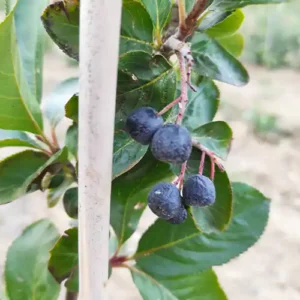
A productive Russian aronia variety producing large antioxidant-rich berries, ideal for juices, syrups and preserves.
From 9,50 
Autumn 2026

Aronia

Viking

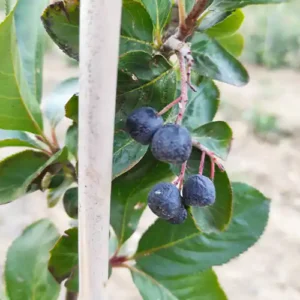
A productive aronia variety producing large antioxidant-rich berries, ideal for juice, syrups and preserves.
From 9,50 

Aronia berry plants: choosing a cultivar for fruit production

Aronia, commonly known as chokeberry, is an exceptionally winter-hardy fruiting shrub belonging to the rose family, alongside apples, pears and serviceberries. Its black, purple or red fruits resemble berries, but botanically they are small pomes containing several seeds.

Aronia grows successfully across a wide range of European climates and its fruit can ripen reliably in cool regions. The main challenge is not keeping the shrub alive, but choosing a genuine fruiting cultivar, providing enough sunlight and water and allowing the fruit to reach full maturity before harvest.

Aronia is frequently promoted only as a “superfruit”. This commercial description provides no information about flavour or cultivar quality. Its high concentration of polyphenols contributes to its intense colour and pronounced astringency, but does not make the fruit as mild or immediately enjoyable as a blueberry.

The best fruiting cultivars produce larger, juicier and relatively less astringent fruit than wild or ornamental forms. Most of the crop is nevertheless better suited to juice, syrup, preserves, jelly, compote, fruit wine, drying or blending with sweeter fruits.

Black, red and purple chokeberries

Aronia melanocarpa: black chokeberry

Aronia melanocarpa is native to eastern North America. It normally forms a compact multi-stemmed shrub that can spread gradually through suckers.

The fruit becomes black at maturity and this species has provided much of the original material used to develop cultivars for juice and processing.

Wild forms often produce relatively small and highly astringent fruit. Fruiting cultivars have been selected for larger berries, higher juice yield, productivity and more uniform ripening.

Aronia arbutifolia: red chokeberry

Aronia arbutifolia often forms a taller and more upright shrub. Its red fruit may remain on the plant for a long period and is valued mainly for ornamental and ecological interest.

The fruit is edible, but this species has been selected much less extensively for food production. For regular juice or processing use, black- and purple-fruited cultivars are generally more suitable.

Aronia × prunifolia: purple chokeberry

Aronia × prunifolia is recognised as a hybrid between black and red chokeberries. Its fruit becomes purple to black and several cultivated selections have been placed within this group.

The distinction between Aronia melanocarpa and Aronia × prunifolia is not applied consistently in nursery catalogues. The same cultivar may therefore appear under different botanical names depending on the supplier.

The particular origin of large European fruiting cultivars

Large-fruited cultivars such as ‘Nero’, ‘Viking’ and ‘Galicjanka’ are commonly sold as Aronia melanocarpa and sometimes as Aronia × prunifolia.

Botanical and genetic research has also associated some of these cultivated plants with a group known as × Sorbaronia mitschurinii or × Sorbaronia fallax, which may include historical rowan ancestry.

This taxonomic question is not fully reflected in commercial naming and does not alter the practical growing advice. It does, however, show that some major European cultivars are not necessarily simple selections of wild black chokeberry.

For the gardener, the known performance of the named cultivar is more important than an excessively rigid botanical classification.

Are several aronia plants required for pollination?

Fruiting aronia cultivars are generally self-fertile. The flowers of one cultivar can be fertilised by their own pollen and a single isolated plant is capable of producing a crop.

There is no need to buy separate male and female plants. Each shrub carries complete flowers containing both male and female reproductive organs.

Pollination is carried out mainly by bees, bumblebees and other insects attracted to the clusters of white flowers.

Cold, windy or persistently wet weather during flowering may reduce insect activity and result in less regular fruit set.

A second cultivar flowering at the same time may improve pollination and yield, but it is not essential. One correctly identified fruiting cultivar is normally sufficient for a small garden, while several cultivars can be useful for a productive hedge or larger harvest.

Aronia should not be treated like a dioecious plant such as sea buckthorn or some kiwifruit. A lack of fruit on an isolated shrub is more likely to result from youth, insufficient sunlight, frost on the flowers, inappropriate pruning or poor flowering weather.

Fruiting cultivars and ornamental cultivars

Many aronia selections have been developed for compact growth, blossom or autumn foliage rather than for the quantity and quality of their fruit.

They may still produce berries, but these are not necessarily large, abundant or sufficiently juicy for regular processing.

Cultivars such as ‘Nero’, ‘Viking’ and ‘Galicjanka’ have been distributed more widely for fruit production. They normally form vigorous shrubs, carry large clusters and produce bigger fruit than wild forms.

Some very compact landscape cultivars were selected mainly for their shape and foliage. They may be suitable for a small ornamental garden, but should not be chosen solely because the label includes the name aronia.

Before selecting a cultivar, decide whether the main objective is fruit production, a productive hedge, autumn colour or a compact ornamental shrub. An excellent landscape cultivar is not automatically a good fruiting selection.

Useful characteristics when comparing aronia cultivars

Fruit size

Selected fruiting cultivars generally produce larger and more uniform fruit than wild populations. Larger berries make harvesting easier and increase the amount of juice obtained from each cluster.

Fruit size also depends on crop load, water availability, soil fertility and sunlight. Even a naturally large-fruited cultivar cannot maintain its expected size if the shrub suffers from drought while the fruit is swelling.

Juice content

Some cultivars produce fleshy and juicy fruit, while others have a firmer or drier texture. Juice yield is particularly important for syrups, juices, fruit wines and jellies.

A berry that is rich in pigment but relatively low in juice may still be useful for drying or adding natural colour, but will be less convenient for small-scale pressing.

Astringency and flavour balance

Astringency is the dry and rough sensation caused mainly by tannins interacting with the proteins in saliva. It should not be confused with acidity, as a fruit can be low in acid yet strongly astringent.

Cultivars differ in sugar, acidity, tannin concentration and aromatic intensity.

No aronia should be presented as equivalent to a sweet blueberry. Even cultivars described as milder normally retain a noticeable tannic sensation when eaten raw in quantity.

Concentrated ripening

A relatively concentrated ripening period allows most of the fruit to be collected in one or two passes. This is useful for processing because the clusters can be harvested and handled together.

Uniform black colour does not guarantee that every fruit has reached its best flavour. Some cultivars become dark before they have accumulated their maximum sugar and juice content.

Vigour and habit

Large fruiting cultivars can reach approximately 1.5 to 2.5 metres in height and may widen through suckers.

Some cultivars are strongly upright, while others spread beneath the weight of the fruit clusters.

A compact habit makes netting easier, but the centre may become excessively dense if old stems are never renewed. A more open habit improves light penetration but requires more space.

Suckering

Aronia normally grows on its own roots and may produce new shoots at some distance from the original crown.

This behaviour allows the shrub to form a dense hedge and can help stabilise a bank or slope.

Suckering must be controlled when the objective is to retain a single isolated plant. The intensity varies significantly between cultivars.

What does aronia actually taste like?

Fully ripe aronia has a dark fruit flavour that may suggest blackberry, blackcurrant, black plum or red wine, usually with a moderate level of acidity.

Its dominant characteristic remains astringency, which can conceal part of the aroma when the fruit is eaten raw.

This explains the English name chokeberry. The name refers to the dry, tightening sensation in the mouth and throat and does not mean that the fruit is poisonous or causes actual choking.

Chokeberry should not be confused with chokecherry, Prunus virginiana, which is a completely different North American cherry species.

A few perfectly ripe berries may be eaten directly, particularly from the juicier cultivars. For most people, the fruit becomes much more enjoyable when cooked, sweetened, processed or combined with a milder fruit.

Blending aronia with apples, pears, raspberries, blackberries, plums, grapes or blackcurrants retains its colour and aroma while reducing the dry tannic sensation.

A deeply pigmented fruit without medical promises

The black colour and strong colouring ability of aronia juice are produced partly by high concentrations of anthocyanins and other phenolic compounds.

These compounds also contribute to bitterness and astringency.

Their concentration varies according to cultivar, maturity, exposure, season and processing method. Two black fruits harvested at the same time do not necessarily have an identical composition.

Aronia can form part of a varied diet, but its polyphenol content does not justify claiming that the fruit prevents or treats disease.

Results obtained in laboratory studies or with concentrated extracts should not be converted into medical promises concerning normal consumption of the berries.

Where should an aronia shrub be planted?

Aronia is exceptionally winter hardy and established dormant shrubs tolerate cold European winters without difficulty. Winter survival of the wood is rarely the limiting factor.

For sweet, juicy and strongly coloured fruit, choose a sunny position.

The shrub tolerates partial shade, but insufficient light often reduces flowering, delays maturity and encourages leafy growth at the expense of fruit.

Within a mixed hedge, make sure that the aronia will not quickly become dominated by taller trees. A shrub can survive beneath partial shade while becoming of little value for harvesting.

Avoid frost pockets where cold air accumulates. Flowering is relatively late, but a sufficiently late frost can still damage open flowers and newly formed fruit without threatening the survival of the shrub.

Good air circulation helps the foliage dry and reduces conditions favourable to powdery mildew and leaf diseases. There is no benefit in placing the plant in a position constantly exposed to drying winds.

Soil, moisture and tolerance of lime

Aronia can grow in an unusually broad range of soils. It occurs in fresh or temporarily wet sites as well as in ordinary well-drained garden soil.

This tolerance does not mean that every situation gives the same yield. For fruit production, deep and fertile soil that remains reasonably moist in summer but retains good aeration is preferable to marshy or permanently saturated ground.

Aronia tolerates clay where the soil maintains sufficient structure. Fresh clay can even support good fruit size, while compacted clay or ground cultivated when waterlogged delays root establishment.

Slightly acidic to neutral soil is generally ideal. Aronia also tolerates higher pH levels and does not require ericaceous compost. It is considerably less acid-loving than a blueberry.

Growth may become weaker and chlorosis may appear in extremely calcareous, shallow and drought-prone soil. Soil depth and water availability are often more important than the presence of lime alone.

Sandy soils are suitable provided that water and mature organic matter are supplied regularly. Without them, fruit size and the growth of replacement stems decline rapidly.

Planting a young container-grown aronia

A dormant aronia can be planted in autumn or winter whenever the soil is neither frozen nor saturated. Autumn planting normally allows the roots to begin establishing before the following growing season.

Where a container plant is already in leaf, particularly after being grown under glass or in a tunnel, its young shoots and flower buds are less frost-resistant than the dormant wood of an established shrub.

In this situation, plant in spring after the main risk of late frost or provide temporary protection during cold nights.

This precaution does not contradict the excellent winter hardiness of aronia. It simply distinguishes dormant mature wood from tender tissues that have already begun growing.

Prepare a broad area of soil rather than a narrow hole filled with potting compost. Loosen the ground, create a fine crumbly structure once it has drained sufficiently and allow it to begin warming where planting takes place in spring.

Remove couch grass, bindweed, docks and other perennial weeds before planting. Once suckers and new stems have developed, these weeds become much harder to remove without damaging the shrub.

Position the root collar at soil level. Aronia is normally grown on its own roots and may not have a graft union. Do not bury the plant deeply in an attempt to protect it from cold.

Backfill mainly with the original soil, incorporating mature compost over a broad area where the ground is poor. Avoid creating an isolated pocket of pure compost or fresh manure.

Water thoroughly after planting to settle the soil around the roots. A temporary stake may be useful where strong wind moves the root ball before it has established.

Weed control and watering during the first year

An established aronia can tolerate moderately dry periods, but a young plant initially has a limited root system.

Keep a sufficiently broad weed-free area around the shrub during the first years.

Dense grass removes a considerable amount of water during spring and summer. The aronia may remain alive while producing very little growth, delaying the formation of a productive clump.

Water throughout the first year whenever rainfall is insufficient, not only during the first few weeks after planting.

Water is particularly important while new shoots are growing and the fruit is swelling.

Drought may reduce fruit size, accelerate shrivelling and restrict the development of shoots that will carry future flowers.

Organic mulch can conserve moisture and suppress annual weeds, but it should not be piled directly against the stems or root collar.

Seedling or vegetatively propagated cultivar?

A seed-grown aronia is not necessarily identical to the shrub that produced the seed. Habit, vigour, suckering, fruit size and fruit quality may all vary.

Some cultivated aronia populations have relatively limited genetic diversity and may produce fairly uniform seedlings. This still does not guarantee the precise characteristics of a named cultivar.

Named cultivars are propagated by cuttings, division, separation of suckers or tissue culture.

A correctly identified clonal plant retains the characteristics of the cultivar.

Aronia is normally grown on its own roots and does not require a rootstock. Suckers appearing around the crown therefore usually belong to the same cultivar.

Growing aronia as an isolated shrub or fruiting hedge

As an isolated shrub

Allow sufficient space around the clump and remove suckers growing beyond the area allocated to the plant.

Depending on the cultivar, a width of approximately 1.5 to 2.5 metres may be required.

This method provides easy access to the fruit and simplifies netting and the gradual removal of old stems.

As a fruiting hedge

When planted more closely, aronia shrubs eventually meet and form a dense hedge. Their suckers help fill gaps and stabilise the soil.

A hedge intended for fruit production should not become a completely opaque wall. Light must reach the lower stems to maintain fruiting throughout its height.

Avoid repeatedly clipping it like a privet hedge. Geometric trimming removes shoots carrying flower buds and creates a dense outer shell around an ageing interior.

Which wood produces aronia fruit?

Flower clusters develop mainly at the ends and along the sides of well-grown shoots.

The buds producing the following year’s crop begin developing while the current fruit is still ripening.

Severe summer pruning or systematic shortening of new shoots can therefore remove part of the future blossom.

Young, well-lit stems generally crop more effectively than old branches that have become excessively divided and shaded.

Pruning should maintain gradual renewal without removing all mature wood every year.

How should a fruiting aronia be pruned?

During the first few years, pruning should remain very light. Allow the shrub to develop several strong stems and remove only broken, very weak or badly positioned growth.

Once the clump becomes dense, gradually remove several of the oldest stems at ground level. This creates space for younger replacements and maintains good light penetration.

Do not remove every old branch in the same year unless renovating a completely neglected shrub. Progressive renewal avoids a major interruption in cropping.

Pruning systems vary according to the method of production. Some orchards periodically renew shrubs through low cutting, while a home garden can maintain more regular crops by removing only a few old stems each winter.

Avoid shortening every branch tip uniformly. This removes flower buds, stimulates dense growth and gradually moves the crop towards the outer surface of the clump.

An old shrub can tolerate severe cutting and regrow from its base, but the harvest will be greatly reduced while the clump rebuilds.

How can fully ripe aronia fruit be recognised?

Aronia often develops its black colour well before reaching its best eating and processing maturity.

A berry that has become black may still be firm, low in juice and exceptionally astringent.

At full maturity, the colour is uniformly black or purple, including close to the stalk. The flesh becomes softer and juicier and the sugar concentration increases.

Astringency remains present but normally becomes less aggressive.

For a home harvest, the most useful method is to taste several berries regularly. Compare sweetness, juice and tannic dryness rather than relying only on colour or a fixed calendar date.

A refractometer can measure soluble solids in the juice, but a high value does not describe the whole flavour. Two cultivars with similar sugar readings may differ considerably in acidity and tannins.

Fruit can remain on the shrub for some time after colouring. This may improve concentration but also increases the risk of shrivelling, bird damage and deterioration during wet autumn weather.

Must aronia fruit experience frost before harvest?

Frost is not required for aronia to ripen. The fruit should complete its development before exposure to severe cold.

Waiting systematically for the first frost can result in losses from birds, shrivelling or mould.

A cultivar suited to the local climate should reach maturity without depending on an autumn freeze.

Freezing the fruit after harvest may make some processing methods easier by breaking down its cells, but it cannot transform immature berries into high-quality ripe fruit.

Harvesting and storing aronia berries

The fruit is carried in clusters that can be cut or picked by hand. Concentrated ripening allows much of the shrub to be harvested quickly.

Harvest during dry weather where possible and cool the fruit promptly.

Wet clusters or fruit packed deeply into a container can heat and deteriorate.

Aronia has relatively tough skin and tolerates handling better than raspberries or blackberries, but it should not remain in direct sunlight for several hours after picking.

The fruit keeps for several days in the refrigerator. For longer storage, it can be washed, dried and frozen whole, processed into juice, dried or cooked.

The firmness that improves transportability also contributes to the distinctive texture of aronia when eaten raw.

The best uses for aronia fruit

Aronia juice is intensely coloured and concentrated. When consumed alone, it may seem dry and strongly tannic.

It is often more balanced when blended with apple, pear or grape juice or with another milder fruit.

In preserves and jelly, cooking and sugar reduce the astringency without completely removing the character of the fruit. Apples also add sweetness and useful pectin.

Aronia is suitable for compotes, sauces, syrups, coulis, pies and baked products. It can replace part of the blackcurrants or blueberries in a recipe where very deep colour is required.

Drying concentrates both sugar and tannins. Dried aronia remains quite firm and astringent and is generally more pleasant within a mixed fruit preparation than when eaten alone.

Fruit wines, liqueurs and other fermented products can make good use of the colour and aroma, but the recipe must account for the high tannin concentration of the juice.

Important diseases and pests

A generally robust shrub

Aronia is generally robust and requires little disease control. Serious problems remain uncommon on a well-established shrub receiving sufficient light and growing in soil with adequate drainage.

This robustness does not mean complete immunity. Symptoms may appear according to cultivar, climate and the proximity of other plants in the rose family.

Powdery mildew and leaf spots

Powdery mildew can form a white coating on the foliage, particularly in dense, shaded or poorly ventilated plantings.

It is often a secondary problem but may reduce the growth of young shoots during severe infections.

Various fungi may also cause leaf spots. Maintaining an open centre and avoiding repeated overhead watering reduce favourable conditions.

Juniper-associated rust diseases

Like several members of the rose family, aronia can be affected by rust fungi in the genus Gymnosporangium, some of which alternate with junipers.

Yellow or orange spots and distorted areas may appear on leaves or fruit.

The presence of a nearby juniper does not automatically cause infection and spores may travel over a considerable distance. Removing every alternate host in the surrounding area is rarely realistic.

Leaf-feeding insects

Aphids, bugs, leafhoppers, beetles and leaf-feeding larvae may occasionally colonise aronia shrubs. Damage is usually limited on a vigorous mature plant.

Significant discoloration should be examined on both sides of the leaves to distinguish nutrient problems, mites, lace bugs and disease.

Spotted-wing drosophila

Spotted-wing drosophila, Drosophila suzukii, can lay eggs in various ripe soft fruits. Aronia is firmer than raspberry, but it should not be considered completely protected.

Harvesting promptly at the correct maturity, cooling the crop quickly and removing damaged fruit reduce the period during which the berries remain exposed.

Birds and mammals

Bird interest varies greatly between locations, seasons and the availability of other food. Some crops remain untouched for a long time, while others disappear rapidly at full maturity.

A properly supported net or fruit cage provides the most reliable protection. Loose netting placed directly on the shrub may trap birds and become tangled in the branches.

Rabbits, hares and deer may also eat young shoots or damage the bark. Physical protection is particularly useful during the first years.

Which aronia cultivar should you choose?

For juice, preserves or syrup, choose a vigorous and productive fruiting cultivar with high juice content and relatively concentrated ripening. ‘Nero’, ‘Viking’ and ‘Galicjanka’ have been widely grown for these purposes.

For occasional fresh eating, look for a cultivar described as juicy and relatively low in astringency, while remembering that no aronia offers exactly the mild sweetness of a blueberry.

For a small space, a compact and less freely suckering cultivar is easier to maintain and protect. Check that it is a genuine fruiting selection rather than a purely ornamental form.

For a hedge, choose a vigorous cultivar capable of producing replacement shoots and use renewal pruning rather than annual geometric clipping.

For moist ground, aronia is one of the more tolerant fruiting shrubs, but moist soil is not the same as permanently oxygen-starved ground. For a good crop, prioritise sunlight and a soil structure that still allows the roots to breathe.

Do not choose solely according to an advertised antioxidant level. Juice yield, astringency, productivity, ease of harvest and intended use are far more practical criteria.

Frequently asked questions about aronia berry plants

Are two aronia plants required for fruit?

No. Fruiting cultivars are generally self-fertile and one plant can crop. A second cultivar may nevertheless improve pollination and yield.

Are separate male and female aronia plants required?

No. The flowers contain both male and female reproductive organs. Aronia does not function like sea buckthorn or dioecious kiwifruit.

Is aronia a blueberry?

No. Aronia belongs to the rose family and its fruit is a small pome comparable with a miniature apple. It also does not require soil as acidic as that needed by blueberries.

Can aronia berries be eaten raw?

Yes, they are edible, but generally very astringent. A few perfectly ripe berries may be enjoyable, while most of the crop is better suited to processing.

Why does aronia make the mouth feel dry?

The sensation is produced mainly by tannins interacting with proteins in saliva. It can remain strong even when the fruit contains a substantial amount of sugar.

Are black aronia berries always ripe?

No. The fruit may turn black before accumulating sufficient sugar and juice. Wait until the flesh becomes less firm and taste berries from several clusters.

Must aronia be harvested after a frost?

No. A suitable cultivar should ripen without frost. Waiting too long increases the risk of shrivelling, mould and loss to birds.

Does aronia tolerate calcareous soil?

It generally tolerates neutral and moderately calcareous soil and does not require ericaceous compost. Extremely calcareous, shallow and dry ground may nevertheless restrict growth.

Can aronia be planted in clay soil?

Yes. Deep and moisture-retentive clay may suit it well when the soil remains structured and sufficiently aerated. Avoid waterlogged or severely compacted ground.

Will aronia grow in shade?

It tolerates partial shade but produces better crops in full sun. Heavy shade normally reduces flowering and results in less sweet fruit.

Why does my aronia flower without producing fruit?

Late frost, cold flowering weather, insufficient light or pruning that removed flower buds may reduce the crop. A second cultivar is not normally essential.

Why does my aronia produce numerous suckers?

Suckering is part of the natural habit of the shrub. Remove unwanted shoots at ground level or allow them to develop into a fruiting hedge.

When should aronia be pruned?

Renewal pruning is normally carried out during dormancy. Gradually remove the oldest stems while retaining sufficient young, well-lit shoots.

Can an old aronia shrub be cut back hard?

Yes. It can regrow from the base after severe cutting, but the crop will be greatly reduced during reconstruction. Progressive renewal is preferable while the shrub is still productive.

How long does an aronia take to produce fruit?

A well-established young plant may produce a small crop relatively early, but several years are normally required to form a large productive clump. Weed control and watering during establishment considerably improve its development.

Is aronia susceptible to disease?

It is generally robust but may develop powdery mildew, leaf spots or certain rust diseases. A sunny position and an open clump reduce many of these problems.

Do birds eat aronia berries?

Their interest varies according to location and maturity. Fully ripe fruit may disappear quickly, and a properly supported net remains the most reliable protection.

What is the difference between ‘Nero’, ‘Viking’ and wild aronia?

‘Nero’ and ‘Viking’ are productive fruiting selections with large berries. Wild seedlings generally produce smaller fruit and show greater variability.